
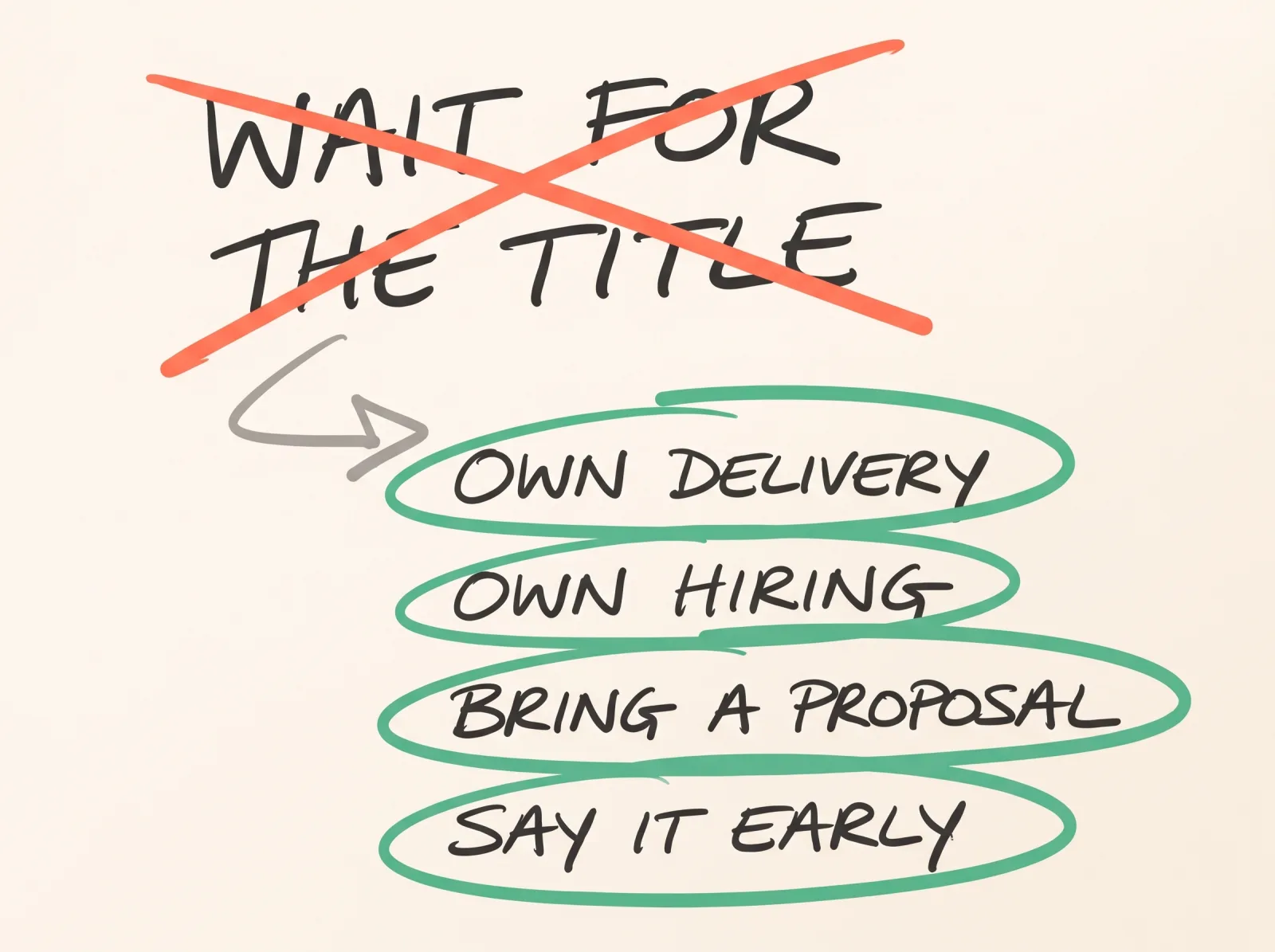
To become head of engineering at your current company, do the job one level up before anyone gives you the title: own delivery and hiring across several teams, bring the CEO a proposal nobody asked for, and say early that you want the seat. Companies promote the person already working one level up.
A tech lead at a startup sent me the question this page answers. He wanted to be on track to become head of engineering where he works now, and to grow from there to the next level, head of or director. Nothing in his question was about switching companies. Most career guides answer a different question, where to apply. This one is about the seat you can get in the company that has already watched you lead, and about the cases where you should leave instead.
I held the seat above this one, VP of Engineering at Mews while engineering grew from 8 to 80 teams. Across 3,662 1:1 sessions with 317 leaders since 2019, the people who got there inside their own company did the same few things, in about the same order. What the seat is, and how it differs from VP of Engineering, director and CTO, is on the head of engineering role page. This page is about getting there.
Check that the seat exists where you work
In many startups no one holds it. A founder-CTO runs engineering, or a VP of Engineering already sits above the teams. Before you plan a path, find out two things: who you would report to in the seat, and whether that person plans to leave their own.
The title matters less than the scope. A head of engineering who runs the whole function and reports to the CEO is working at VP scope. With a VP of Engineering or a CTO above, the same title is director scope. If the scope you want is already taken and the person holding it isn’t moving, that is a sign for the section on moving below, not for another year of waiting.
How do I become head of engineering at my current company?
Do the job one level up before anyone gives you the title. Own delivery and hiring across more than one team, bring the CEO one proposal nobody asked for, and tell your manager and the CEO early that you want the seat. Then ask what they would need to see from you by a date.
Four moves, in this order:
- Take the work one level up. Delivery across teams, not only yours. Hiring: at 10 to 50 engineers it is the single biggest lever the company has, and the head of engineering is judged on it. Org shape, meaning who should become the next manager and where the team boundaries sit.
- Say it out loud, early. “I want to be head of engineering here. What would you need to see from me by spring?” The answer gives you a shortlist, and it turns your manager into a sponsor with a stake in the result. A manager who hears about your ambition for the first time in the promotion conversation has no evidence and no stake.
- Bring a proposal nobody asked for. A costed one-pager on how engineering should be organised in the next 12 months: a number, a problem, a bet. It can be wrong. What hurts is bringing nothing, because then the people above you may never learn that you think about direction.
- Know who runs your team when you move up. In practice, a promotion is easier to approve when the CEO can see who takes over your current job. Start growing that person now.

Build the case before you make the ask. I published a free Claude skill for it, engineering-promotion-case. You tell it your role, the target level and what changed in the last 12 months because of you. It gives you a score out of 10 (8 is the bar for asking), the three gaps worth the most, a one-page case from your own facts, and a plan for the conversation with your manager. Pick the track “engineering manager to director, head of or VP”. Install it with npx skills add marian-kamenistak/engineering-promotion-case.
How do I grow from tech lead to head of engineering?
Add two things a tech lead doesn’t carry yet: people and the whole function. A tech lead owns technical direction with no reports. A head of engineering owns hiring, delivery and the managers across every team. Get direct reports or run a hiring loop end to end first, usually as an engineering manager, and keep the technical credibility you have.
In a company under about ten engineers the step can be one jump, because no one sits between you and the CEO. From roughly forty engineers up it rarely is, because the seat then manages managers. I recommend tech lead before engineering manager for the first step, and the same logic applies here: the CEO wants to see you lead before anyone signs.
What you start depends on where you stand today:
| Where you start | What the CEO needs to see | The gap I see most | Start this month |
|---|---|---|---|
| Tech lead, no reports | You can lead people, not only designs | No direct reports, no hiring record | Run one hiring loop end to end. Take on one junior’s growth. |
| Engineering manager, one team | You run more than your own team | Arguing for your team instead of the department | Argue one position that costs your team something. Own a cross-team forum. |
| Senior EM or director | You own the whole function and the exec conversation | Delivering the agreed roadmap, no direction of your own | Bring the CEO a costed org proposal. Act on one hard piece of feedback where people can see it. |
If you are still a tech lead, the team lead vs tech lead vs engineering manager page draws the boundaries between the three roles you pass through.
How do I go from engineering manager to head of engineering?
Close three gaps: argue for the whole department instead of your own team, propose direction instead of only delivering the agreed roadmap, and treat hard feedback as data. They are the same three gaps that keep strong engineering managers out of the VP seat, because a head of engineering holds that scope in a smaller company.
I wrote the long version after a VP of Engineering emailed me about his stuck senior manager: the three gaps. Everything that made a great EM, the fight for the team, the flawless delivery, the thick skin, is what caps you at EM if you leave it unchanged. At Mews, direction meant changing the machine instead of shipping tickets, and the numbers followed: four months in, sprint completion was up 30% and average cycle time was down 36%.
The three questions to ask yourself after your next leadership meeting: did I argue a position that cost my team something, did I bring anything that wasn’t on the roadmap, and what did I do with the last hard feedback, and who saw me do it?
If you manage managers already, the layer you sit in is probably the engineering director one. That role covers what changes when the org grows under you, and in a 40-person engineering org it often is the head of engineering job under another name.
What comes after engineering manager?
Usually senior engineering manager or director of engineering. Where no layer sits between you and the CEO, which is common in companies of 10 to 80 engineers, the next seat is head of engineering. Above it sit VP of Engineering and CTO, once the company splits the function in two.
The ladder in one list, with the page for each step:
- Tech lead and engineering manager: where leading people starts.
- Engineering manager: one team, with reports.
- Engineering director: managers of managers, a department inside the org.
- Head of engineering: the whole function before the VP and CTO split.
- VP of Engineering: the org half of the split, with a CTO next to it.
- CTO: the technology half, and how people get there.
Companies skip rungs all the time. They don’t skip the behaviours, which is why the title is a late signal and the work one level up is the early one.

Stay and get promoted, or move to get the title?
Get promoted where you are, in most cases. Your manager and the CEO have seen you lead, while an outside hiring manager has seen a CV and two interviews. Move when the seat cannot open: someone above you holds the scope and isn’t going anywhere, or the company plans to hire the head from outside.
My position after watching both routes since 2019 is the same as for the engineering manager seat. A promotion is a decision made on evidence, and the evidence sits in your current company. Three signs that tell you to move:
- A VP of Engineering or a CTO holds the scope and has no plan to split it. Ask the CEO directly: “Is this seat open to me, and by when?” A vague answer after two conversations is an answer.
- The company will hire the head from outside. It happens when the CEO wants someone who has run an org of that size before. You can still compete, but you now compete with a CV, not a record.
- The company isn’t growing toward a size where the seat exists. In a team of six, “head of engineering” is a title, not a seat.
If you move, ask the questions the title hides before you say yes: who do I report to, do I own hiring and firing, and who holds the technology decisions. A head of engineering with no say on hiring is an engineering manager with a better title. Check the pay against the scope too: head of engineering salary lists US, UK, German and Czech figures with a source for each.
What changes the day you get it
The calendar splits in two. Hiring, delivery and people problems arrive every morning. Architecture direction and technical debt strategy rarely knock on the door, so in a busy week they don’t happen. I wrote about that trap on the head of engineering role page, and it is the reason to protect time for the quiet half from the first week.
The first quarter has its own rules: meet your peers and reports before you form opinions, understand where the money comes from and what has been promised to whom, and make no big changes yet. The full plan is in your first 90 days as a new CTO, and nearly all of it carries over to a head of engineering seat.
Do I need a mentor to become head of engineering?
No, but a mentor helps with the part no one inside your company can say straight. The person who decides your promotion is also the person you would ask for advice. An outside mentor tests your case, your timing and your ask before you spend them. Mine start with a free 30-minute intro call.
What it costs, on the pricing page: one 60-minute session is €395. One quarter is six sessions over three months for €1,975, and the sixth session is free (prices exclude VAT). Most people who come to me with this question start with the quarter: the first session sets the three goals and the ask date, and the rest work through delivery, hiring and the proposal for the CEO. If you hold the seat already, the Head of Engineering mentoring page shows how I work with people in it.
The titles around this seat
- Head of engineering: the role, the title map and the trap
- Head of engineering salary: US, UK, Germany and Czechia, with sources
- Head of engineering mentoring: coaching for the seat before and after you get it
- How to become an engineering manager: tech lead first, then the ask
- How to become a VP of Engineering: the three gaps
- How to become a CTO: the three routes and the readiness test
- Engineering director: the layer between manager and head
- VP of Engineering vs CTO: who owns delivery, who owns direction