An AI enablement lead is the person who turns a company’s AI tools into changed work: they run the training, shape the tooling and answer for adoption with a number. The same seat is advertised as head of AI enablement, director of AI enablement or AI adoption lead.
Most companies open it after the licences are already paid for. That order explains a lot of what follows, because the person arrives to prove a purchase somebody else made. If you’re about to hire one, or the offer is on your desk, two questions matter more than the title: which version of the seat is it, and which number will it be judged on.
Engineering enablement or workforce enablement?
The postings split into two jobs, and few of them say which one they are.
The engineering version sits next to the CTO and changes how software gets built. Capital on Tap’s head of AI enablement & engineering in London reports to the CTO, will “Lead decisions on AI developer tooling, model access, AI gateway and evaluation”, and redesigns “our software delivery lifecycle around agentic AI”. EveryMatrix in Bucharest hires an AI lead for developer productivity and puts “Faster development cycle times” first in its success metrics.
The workforce version reports to a Chief AI Officer, to HR or to IT support, and teaches everybody else. Synchrony’s VP, Head of AI Enablement reports to the Chief AI Officer and helps staff use “approved AI tools”. Autodesk’s AI enablement lead sits in the people team, asks for “10+ years of experience in HR” and prefers a Prosci change-management certificate.
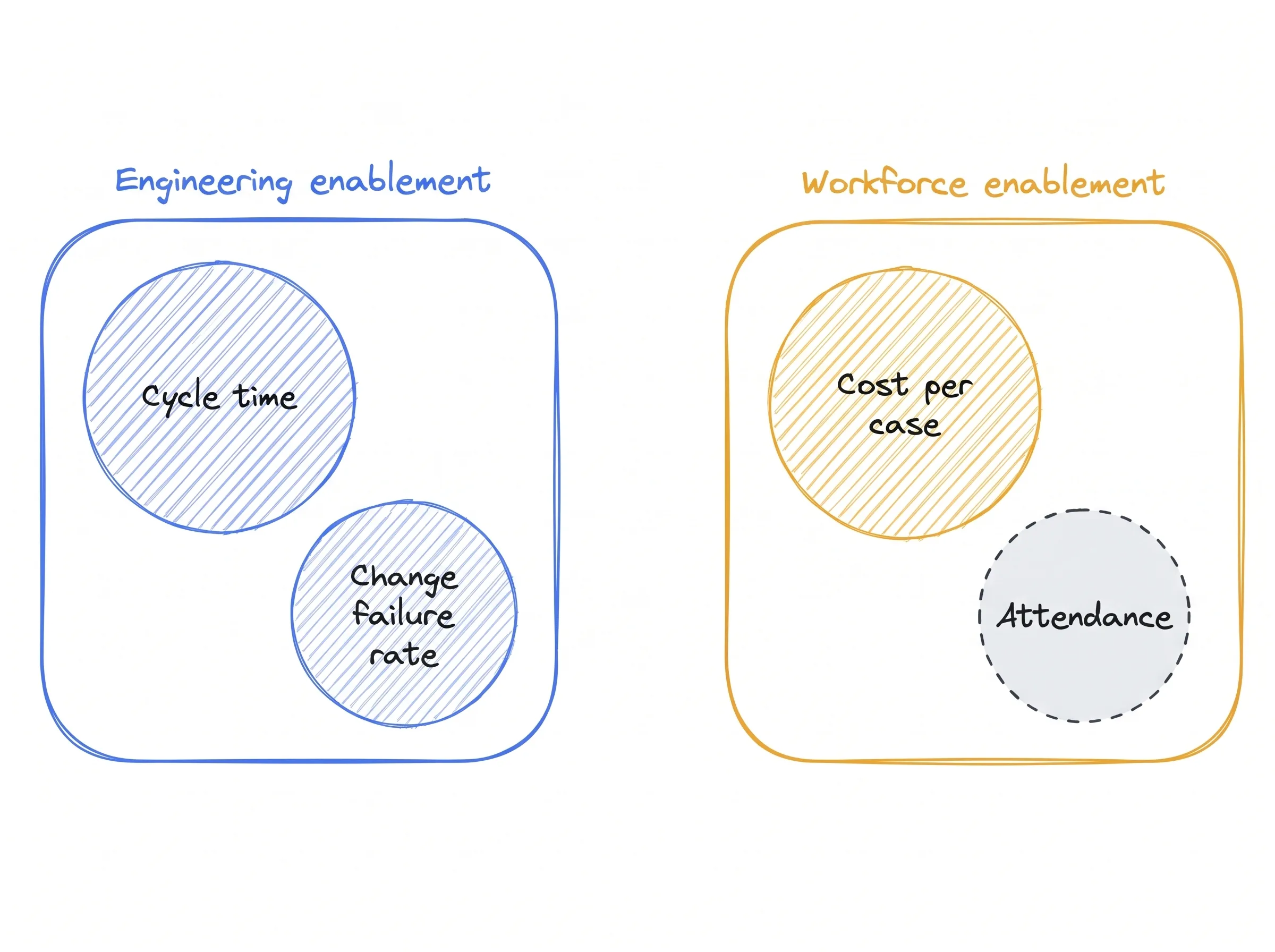
The two get measured in different currencies. Engineering enablement can be judged on delivery data the teams already collect: cycle time, change failure rate, review time. Workforce enablement first has to find a process with a cost per case or a lead time, and until it does, attendance is all it can report.
A third version lives at the AI vendors. Anthropic hires activation managers to get a customer’s staff active on its product and tracks “activation rate, time-to-value, customer satisfaction, and operational efficiency”; OpenAI runs a similar role in London. Activation is the vendor’s revenue, so for the vendor it’s the right metric. An internal enablement lead who copies that dashboard ends up measuring the vendor’s success as opposed to the employer’s.
What fifteen employers wrote into the job
The 15 AI enablement postings read for this page on 24 October 2026 came from banks and lenders, software and fintech firms, Harvard, two AI labs, a UK trade body and a Berlin non-profit. Six were based in Europe. Across them:
- 14 put training or enablement delivery in the job.
- 5 let the holder choose the tools outright, and 2 say the tools are already “approved” by someone else.
- 0 give the holder a budget. Licence money shows up once, at Harvard, and there it means billing and cost recovery.
- 8 name activity metrics such as usage, participation or sentiment. 5 name an outcome such as cycle time, efficiency or ROI. 3 name no metric at all.
- 1 asks for a baseline before the rollout, and 1 names Finance as a partner on the value case.
So the common deal is training on your plate, the tools and the money on somebody else’s, and the definition of value left open.
The pay range under one title is wide. Base pay published by US employers runs from $114,700 to $185,570 at Autodesk to $225,000 to $325,000 for a director at Bullish. Capital One’s New York director lists $251,400 to $286,900, Synchrony’s VP $170,000 to $290,000, OneMain’s workforce director $180,000 to $230,000. In Europe one posting printed a number: techUK’s Head of AI Adoption at £45,000 to £65,000. That job is “secretariat” for an industry coalition, “booking speakers” for a conference, with “no coding required”. It’s a fair job, and it shares a title with seats that rebuild a delivery lifecycle.
Two of the seats are built to end. Harvard’s AI enablement lead is “funded for two years from date of hire”, with renewal subject to “the continued availability of funding”, and the Berlin non-profit role is fixed-term. Capital on Tap writes the exit into the goal itself: a team and playbook that “keep compounding without you in the room”. Tie your role to a workflow, a platform or a budget that keeps running after month 12, and ask at the offer stage what the job becomes then.

The enablement ladder
My five AI maturity levels score a whole company, two KPIs per level. This ladder is narrower. It scores the programme one enablement lead runs, and it shows where each number stops being evidence.
| Stage | What you run | The metric that proves it |
|---|---|---|
| 0. Access | Contracts, single sign-on and provisioning, an acceptable-use policy, rules for company data | Days from a request to working access |
| 1. Activation | Onboarding, role-based training, office hours | Repeat use: weekly active users as a share of paid seats, measured again a month after launch |
| 2. Habit | Champions in teams, a library of use cases and prompts per role | The share of one named workflow done with AI, such as AI-assisted pull requests |
| 3. Redesign | One process rebuilt end to end, with the baseline taken before the rollout | Baseline cycle time against today’s, same team |
| 4. Guarded speed | Review capacity, tests and evals sized for the extra output | Throughput up while defect rate, change failure rate and review time hold |
| 5. Money | A value plan co-owned with Finance, with AI spend tracked per team | The gain net of spend, as a line Finance signs |
A number from a lower stage is still worth collecting once you’ve moved up. It just stops being the headline. Five of the 15 postings name an outcome of the kind stages 3 to 5 measure. Three name only activity numbers from stages 0 to 2, and Synchrony’s VP role is one of them: “tool usage, participation, sentiment, community activity, use case activation, learning engagement, barriers to adoption, and qualitative feedback”.
Metrics that survive a CFO’s follow-up question
A finance director rarely argues with the first number in your report. The trouble starts with the second question. Below are the first numbers enablement reports usually lead with, the question each one gets, and whether it holds.
-
“Everyone who asked has a licence.” Next question: how many used it last week, and what did the idle seats cost? A seat count is spend. In a 2024 Gartner survey of 132 IT leaders on Microsoft 365 Copilot, 90% said employees would “fight to retain access” and 3% said the tool gave “significant” value, Computerworld reported. Report repeat use instead, and keep seats as a cost line.
-
“Most of the company finished the AI training.” Next question: what changed in their work? For a while a completion rate at least answered a legal duty. Article 4 of the EU AI Act, applying since 2 February 2025, asked providers and deployers to “ensure, to their best extent, a sufficient level of AI literacy”. The Digital Omnibus, Regulation (EU) 2026/1744, replaced that in July 2026 with a duty to “support the development of AI literacy”, and added that it “does not require providers or deployers to guarantee any specific level of AI literacy of any individual”. Report completions to compliance, and keep them out of the value report.
-
“People tell us they save hours every week.” Next question: measured how, and where did the hours go? In METR’s 2025 trial, 16 experienced open-source developers expected AI to make them 24% faster; measured, they took 19% longer, and afterwards they still believed it had sped them up by 20%. METR now marks that study “out of date”. Its February 2026 update leans towards a speed-up, and METR calls its own new data “an unreliable signal”: the developers keenest on AI started turning the study down, and 30% to 50% held back tasks they didn’t want to do without AI. So the slowdown is no longer the finding, while the gap between feeling faster and measuring faster still is. DX, which sells measurement, collects time saved through a “periodic pulse survey”. Use survey hours as an early signal, not as the ROI figure.
-
“Pull requests per developer are up.” Next question: and defects, review time, incidents? Faros AI’s telemetry from more than 10,000 developers, vendor data, found high-adoption teams merging 98% more pull requests while review time rose 91% and bugs per developer 9%, with no significant gain at company level. DX reports AI usage up 65% against pull-request throughput up about 8%. Put throughput, defect rate and review time in the same table, every time.
-
“Baseline cycle time on one named process fell, same team, defect rate flat.” Next question: who measured the baseline? This one holds if someone outside your team signed the baseline before the rollout. Capital on Tap’s posting gets the order right, “In your first 30 days, baseline how fast and how well we build today”, then fixes the target at “roughly three times the customer value per quarter” against “the baseline you set”. The holder grades their own exam. Ask Finance or the CTO’s analytics people to sign the starting number.
-
“Net of AI spend, the hours went to a named backlog or replaced a planned hire.” Next question: show me the budget line. This holds when Finance co-owns the plan, and of the 15 postings only OneMain’s asks for “value realization plans with business and Finance partners”. McKinsey’s 2026 survey shows the same gap across companies. Eight in ten respondents say AI improved their productivity, and 37% report a positive effect on EBIT.
Three things are cheap to ask for before you accept and hard to win afterwards: a seat at tool selection and renewals, an enablement budget separate from the licences, and the right to move licences away from teams that don’t use them. None of the 15 postings offered the second. If you’re the company’s AI champion alongside your regular job, the same logic applies to your hours: a written share of the week, and a sponsor who takes other work off you.
If you’re writing the enablement plan, or weighing whether to take the seat, Head of AI mentoring is where we work on the mandate, the budget line and the first number you report. Mentees rate every session from 0 to 10 right after it. Since 2024 the average is 9.79/10. Bring the posting along to the free intro call.