
An engineering manager is the person accountable for a software team’s people and its delivery. That covers who gets hired, how each engineer grows, how performance problems get handled, and whether the team ships what it committed to. Most of that work happens through other people, so the time spent writing production code drops sharply, in some companies to zero.
The job you’re promoted out of and the job you’re promoted into share a team, a Slack channel and usually a desk. Very little else carries over. A senior engineer is paid for the quality of their own work. An EM is paid for the output of a team and for the conversations that keep it going, which is why the first months tend to feel like a step down. Counted the way you used to count, they are.
The handover table
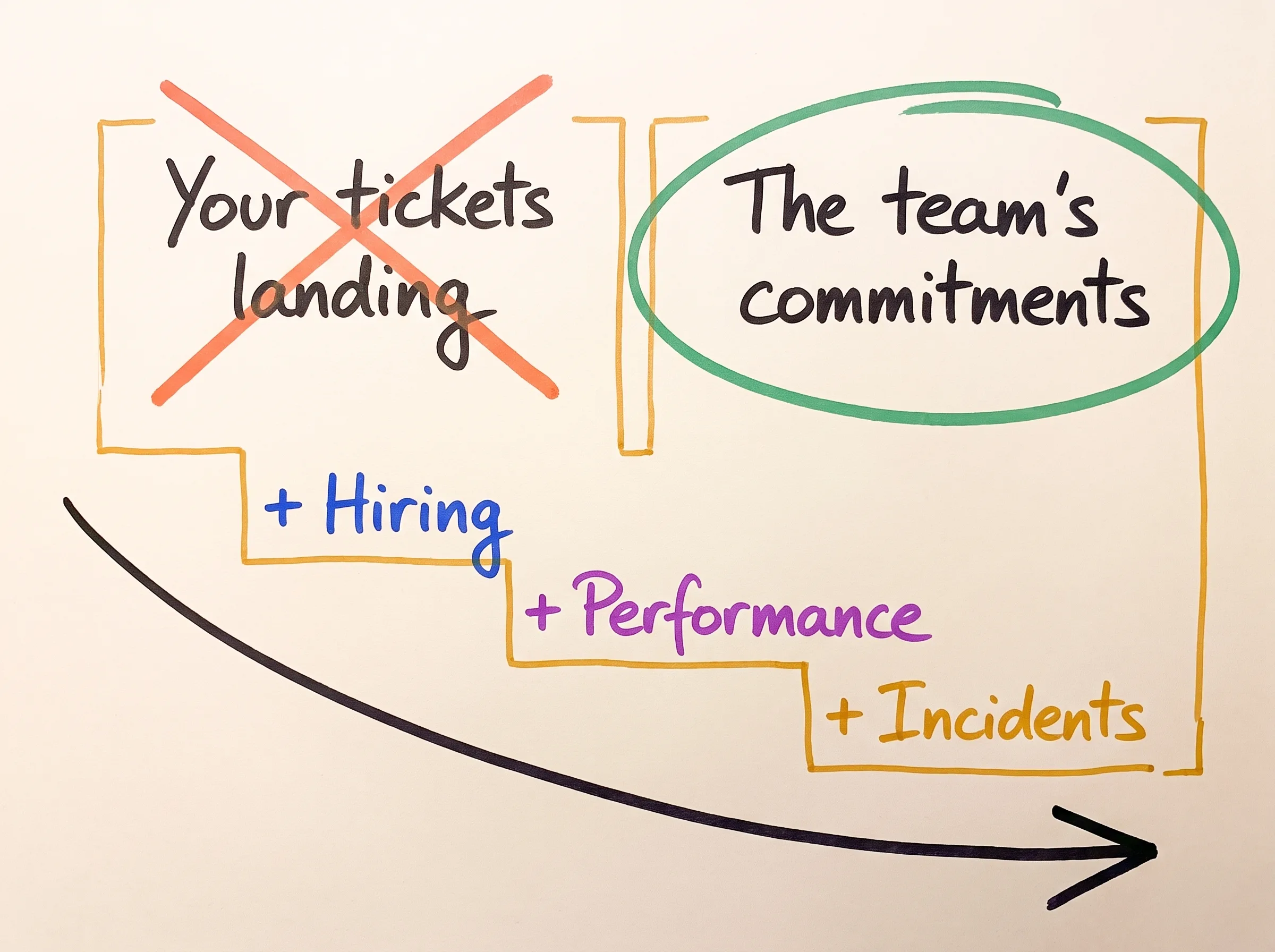
These things move the day you accept the title. The last column is the one people skip, and in practice it’s where most first-year pain comes from.
| Area | What you stop owning | What you start owning | Who should pick up what you let go |
|---|---|---|---|
| Code | Your own feature work, the critical path | Design reviews, code reviews, unblocking people | The senior engineers on the team |
| Technical decisions | Making them yourself | Making sure the right person makes them, on time | A tech lead or staff engineer |
| Hiring | Interviewing when someone asks | The pipeline, the bar, the closing call | No one, this part is new |
| Performance | Your own review | The reviews of all your reports, the hard ones included | No one, also new |
| Delivery | Your tickets landing | The team’s commitments, and explaining the slips upward | Scope is shared with the PM |
| Incidents | Fixing it yourself at 2am | An on-call rotation people can survive, and follow-ups that happen | The rotation |
If the right-hand column is empty where you work, you don’t have a handover, you have two jobs. Of the twelve engineering manager postings behind this page, one names the split out loud. Stora’s posting asks the EM to “partner with Tech Leads without competing with them” and lists what the role isn’t, starting with tech lead. The other eleven leave it for you to discover in month two.

What are an engineering manager’s responsibilities?
An engineering manager’s responsibilities are people, hiring, delivery and operations, with code pushed to the side. All twelve postings read for this page list people and performance work. Some make hiring the main job, a few add incident and on-call duty, and the expected coding share runs from zero to about 40%.
The textbook list says people, process and delivery. Real postings are more specific, and more honest about the load if you read them twice.
People and performance appear in all twelve. Stora goes furthest: about twelve engineers across three product teams, a performance framework still to be built, and “underperformance situations” to handle. Read that as a people backlog the head of engineering has been carrying on the side.
Hiring is the main job in some seats. Ashby’s Americas EM manages three to five engineers and hires three to five more, so half the team doesn’t exist yet. The same company tries to keep junior EMs within six direct reports, per its UK posting, one of the few ads that says how many people is too many.
Operations land on the EM more often than the explainers admit. Airbnb names “incident response and on-call quality”. Supabase adds Incident Commander duty and a support SLO. Anthropic asks its EM to “wear the product hat” when no PM is in the room.
Code is where the range gets wide. Supabase says “we don’t expect managers to contribute to code directly”. BETER in Warsaw asked for “roughly 40% of your time coding and 60% on management”, and then, in the same ad, sprint planning, task assignment, recruiting, on-call shifts and approving the team’s vacations and sick leave. Add that up honestly and it’s more than one person’s week, which is a good reason to read any hands-on EM ad with a calculator.
The Prague posting in the set, at Everpure, asks for five to eight reports and delivery across global teams. It doesn’t say who sets the dates. In a company headquartered elsewhere, that question decides half the job.
Level, pay, and the layer that gets cut
Pay follows level, and the level is often open until the offer. Reddit’s EM posting says the role “may span more than one career level”. Get the level and band before the final round, not after.
For orientation, Levels.fyi puts median US total compensation for software engineering managers at $357,360 (3,186 submissions, October 2026). The Prague median on the same site is CZK 2.61 million a year, from only 29 submissions, so treat it as a hint. Published US base bands in the postings above run from $192,000 at Datadog to $405,000 at Anthropic.
Small-team EMs are also the cheapest layer to remove when a company wants to look leaner. Google cut 35% of its managers who led fewer than three people, and many of them moved into individual contributor roles (NBC News, August 2025). Amazon told its organisations to raise the ratio of individual contributors to managers by at least 15% (Andy Jassy’s memo, September 2024). An EM title over two reports is fragile. Keep your technical depth fresh enough that going back to IC would be your choice.
Four ways the first year goes wrong
- You say yes to player-coach and end up doing both roles in full. The coding share from the ad stays, and the people load grows on top of it. Fix: get the coding percentage in writing before you sign, and agree what comes off your plate when a deadline hits. Ashby’s posting has its EMs “staying off the critical path”. Borrow that rule.
- You keep score the way you did as an engineer. Tickets closed, PRs reviewed, lines written. On that count you’re now a mediocre engineer, and you feel it daily. The breaking point I see most often in sessions comes somewhere between month 12 and month 24. Fix: sit down with your own manager and write the three things you’ll be judged on at month six. None of them should be a ticket count.
- You inherit a performance problem the ad didn’t mention. Stora’s ad is unusually open about it, most aren’t. Fix: in the final round, ask how many open performance cases sit on the team and whether HR has backed an exit in the last year. If the answer is vague, ask why the last EM left.
- You answer for dates someone else set. Delivery is yours, the roadmap often isn’t. When dates come from a PM, a director or a headquarters six time zones away, each slip lands on you anyway. Fix: before day one, agree who sets dates, what you’re allowed to cut, and who tells the stakeholders when you cut it.

Where the role leads
Up: senior EM, then director, where you manage managers. That step is covered in the engineering director guide, and in a company under about 80 engineers the top of this path is often called head of engineering.
Or back. Charity Majors argued in the engineer/manager pendulum that management “is not a promotion” but a change of profession, and that moving between the two is healthy as opposed to a failure. The IC track continues through staff to principal engineer.
Weighing EM against tech lead or team lead? That comparison has its own page: team lead vs tech lead vs engineering manager.
If you’re in the first two years of the seat, mentoring for engineering managers is how I help you to get through it: weekly sessions on the decisions in front of you that week, built on 3,662 1:1 leadership sessions since 2019. The intro call is free. Bring the job description you signed up for and last month’s calendar.