
The short answer to how to become an engineering manager is to get the job in the company that already watched you lead: a tech lead stint first, six months of visible delivery and unblocked decisions, then a direct ask to your manager with that evidence on the table. That’s the path I recommend after 3,662 1:1 sessions with 317 leaders since 2019, and it runs against most of the career guides in the search results, which tell you to polish a résumé and apply for the title somewhere else.
Before the path, one check.
The one signal that says stay IC
If you prefer coding over taking care of people, don’t take the job. That’s the whole test. An engineering manager has to delegate the coding, so what fills the freed hours is 1:1s, feedback, hiring, and the slow work of making other people better. If that list reads like a tax on the part of the week you enjoy, the title will cost you more than it pays.
Karl Hughes listed five things you give up in management on the Stack Overflow blog: focus time, short feedback cycles, conflict avoidance, making technical decisions, learning new technical skills. Four of the five are about code. The fifth, conflict avoidance, is the one you give up by taking care of people. Read your own reaction to that list before you read anything else on this page.
Staying IC is a career with its own ladder. It runs through staff to principal engineer, and the pay ceiling is close. If you’re unsure which side you’re on, the six-dimension readiness test was built for exactly that question; this page assumes you passed it.
Tech lead first, then engineering manager
My recommendation is, go through tech lead before you go for EM.
Tech lead is where you lead without the authority. You own the technical direction of a team, you run the design discussions, you’re the person the PM comes to with “can we”, and nobody reports to you. Which is the point. You find out whether you like coordinating other people’s work while you still have a keyboard to go back to, and your manager gets to watch you do it before anyone has to sign a promotion form.
LeadDev calls the tech lead step “a useful stepping stone” and adds that it isn’t required. Correct on paper. In practice, the senior engineers who skip it tend to be the ones who arrive in the EM seat still wanting the hardest ticket.
Four routes lead into the seat. This is how they compare:
| Route | What you prove before the title | Who decides | Where it tends to break |
|---|---|---|---|
| Tech lead, then EM in the same company | Technical direction, coordination, a team that ships with you steering | Your manager, who watched it | Rarely. The slow route, and the one I recommend |
| Senior engineer straight to EM, same company | Delivery, plus whatever leadership you took on informally | Your manager, on less evidence | Month three, when the people work turns out to be the job rather than the side of it |
| Team lead, then EM | People and delivery for one team, often with some coding kept | Your manager | The coding share. Team lead lets you keep it; EM takes it away |
| External hire into an EM title | An interview performance and a CV | A hiring manager who has never seen you lead | Day one. No track record, no sponsor, a team that didn’t choose you |
The team lead vs tech lead vs engineering manager page draws the boundaries between the three roles; this page only cares about the order you take them in.
Internal promotion beats switching companies for the title
Switching companies to get the EM title works less often than getting promoted where you are. That’s my position after watching both routes since 2019, and it goes against the common advice to go where the title is open.
A promotion is a decision made on evidence. Your manager has seen you close an epic that was slipping, has seen a junior engineer you mentored start to deliver, has seen you take a decision that had been left on the table for weeks. An external hiring manager has seen a CV and two interviews. Uber, for one, built the transition as an internal program: Gergely Orosz describes its Apprentice Engineering Management program, “a structured way to help senior and above engineers transition into the engineering manager role”, and notes that first-time EMs often get “no clear and specific expectations” at all.
The external route also puts you in an org that didn’t watch you earn the seat, with a title to defend from day one and no sponsor upstairs yet.
If you do switch companies, switch as a tech lead and earn the EM step inside. Slower by a year, as opposed to being a stranger with a title.
The six months before you ask
Give yourself a runway. Six months is enough to build the evidence a promotion decision needs, and short enough that you won’t lose patience. Four things to be doing in that window.
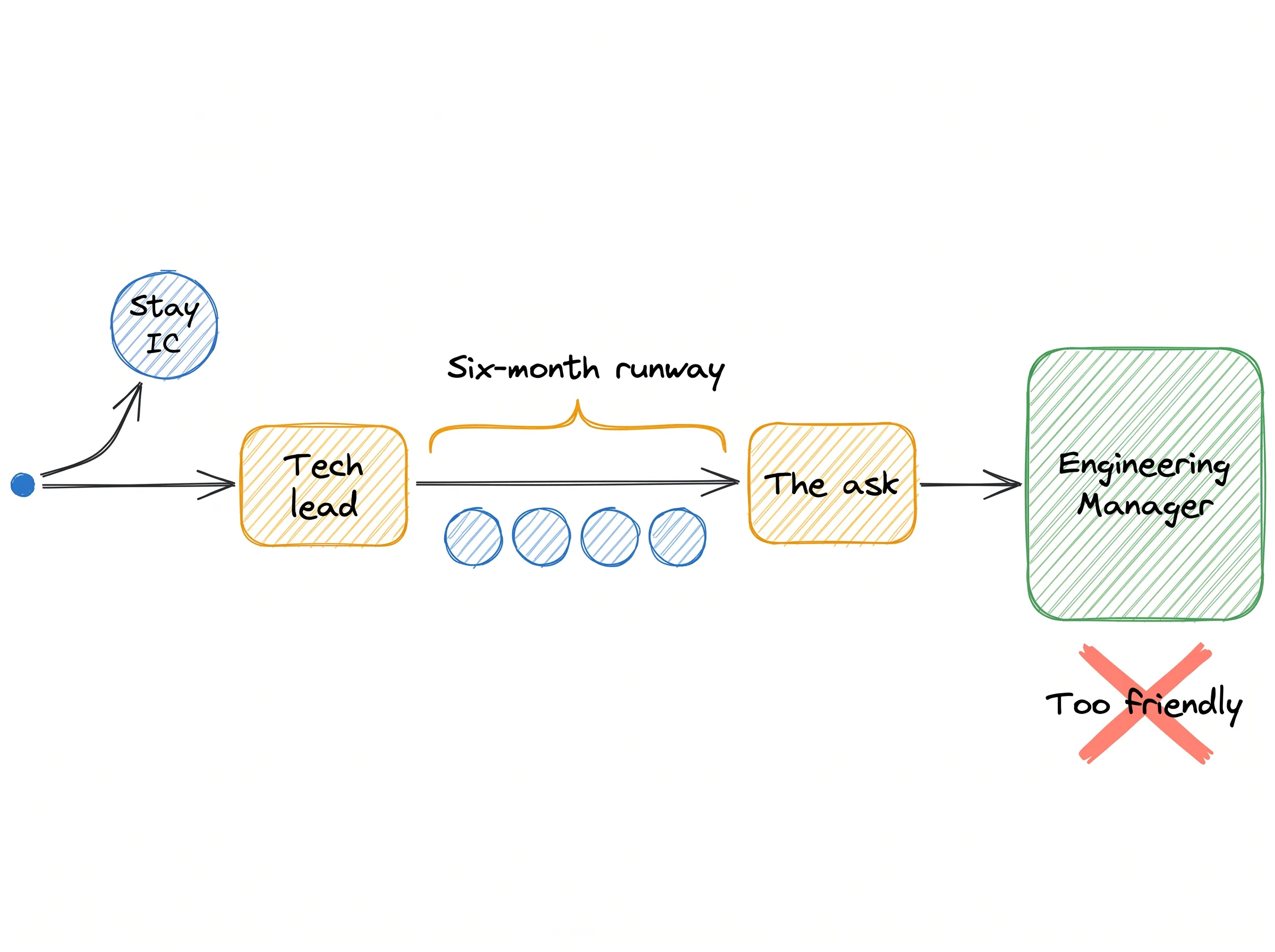
Resolve epics, the multi-sprint kind. The piece of work that has been “almost done” for a quarter: take it over, cut the scope that won’t be missed, and close it. A closed epic is the clearest proof that you can finish other people’s work and not only your own.
Deliver value the business can see. Pick the work a PM or a sales lead will name in a meeting without you in the room. Internal refactors are good engineering and weak evidence.
Resolve decision-making. I’d weight this one the most. Most teams have a decision that has been open for weeks: the migration nobody will commit to, the API shape two seniors disagree on, the fix-or-rewrite thread that is 60 messages long. Be the person who writes the one-pager with three options and a recommended default, puts a date on it, gets the two people who disagree into one room, and then writes down what was decided and who owns it. None of that requires a title. It’s the EM job, done in advance, and your manager will notice it long before they notice your commit count.
Ask your manager for support. Early in the six months, not at the end. “I want to go for engineering manager. What would you need to see from me by spring?” The answer gives you a shortlist, and it turns your manager into a sponsor with a stake in your success. A manager who hears about your ambition for the first time at the promotion conversation has no evidence and no stake.
Six months later, the ask itself is short: here is what I closed, here is what the business got, here are the decisions I unblocked, you said you’d need to see these three things, here they are. Then stop talking.

The first 90 days: the mistake I see most
Being too friendly. That’s the most common first-90-days mistake I see in new engineering managers, and it’s the natural one, because yesterday these people were your peers and some of them are your friends.
It shows up as 1:1s that are pleasant and say nothing, feedback saved for “a better moment” that doesn’t come, and a performance problem the whole team can see except, officially, you. The team reads it fast. A manager who can’t say no to them can’t say no for them either, and saying no for the team is a large part of what they need from you.
The fix is to hold the first hard conversation early, in the first month if there is one to have, and to let the friendships change shape instead of pretending they haven’t. You’re allowed to be warm. Being one of the gang is over. For the week-by-week plan once you’re in the seat, the 30-60-90-day guide picks up where this page stops.
How long it takes, and what it pays
Count on five or more years as an engineer before the seat is realistic. LeadDev puts it as “most engineering manager jobs require at least five years of professional experience”, and the internal path above adds a tech lead year and a six-month runway on top, so a senior engineer starting today should think in terms of 18 months, not a quarter.
The level, and with it the pay, usually gets settled in the offer conversation, so ask for the band before the final round. For orientation, Levels.fyi reports a median total compensation of $357,360 for US software engineering managers (3,186 submissions, pulled 9 October 2026). The Prague median on the same site is CZK 2.61 million a year from 29 submissions, so treat it as a hint. Run your own numbers in the engineering manager salary calculator, and read the engineering manager role page for what the pay buys you: the hiring, the performance reviews, the dates set by someone else.
Where this leads next
If you’re in the runway or the first 90 days right now, mentoring for new engineering managers is how I work through it with people: one session a week on the decision in front of you that week, the ask included. The intro call is free. Bring your last three months of work and the name of the epic that’s stuck.