There are three answers to how to become a CTO: you co-found a company and grow into the title, you get hired into the seat from outside, or you get promoted into it from head of engineering or VP of Engineering. What the seat is, and how it changes with company size, I covered in what is a CTO. This page is about getting there, and about what changes the day you do.
I’ve held the org side of that split myself, as VP of Engineering at Mews while engineering grew from 8 to 80 teams, and I’ve sat in the technology seat on a day rate in 35+ fractional CTO engagements since 2019. Most of the people who ask me how to become a CTO already have the technical half. The question underneath is usually whether they’re ready for the other half, and that one has a test.
The three routes to the seat
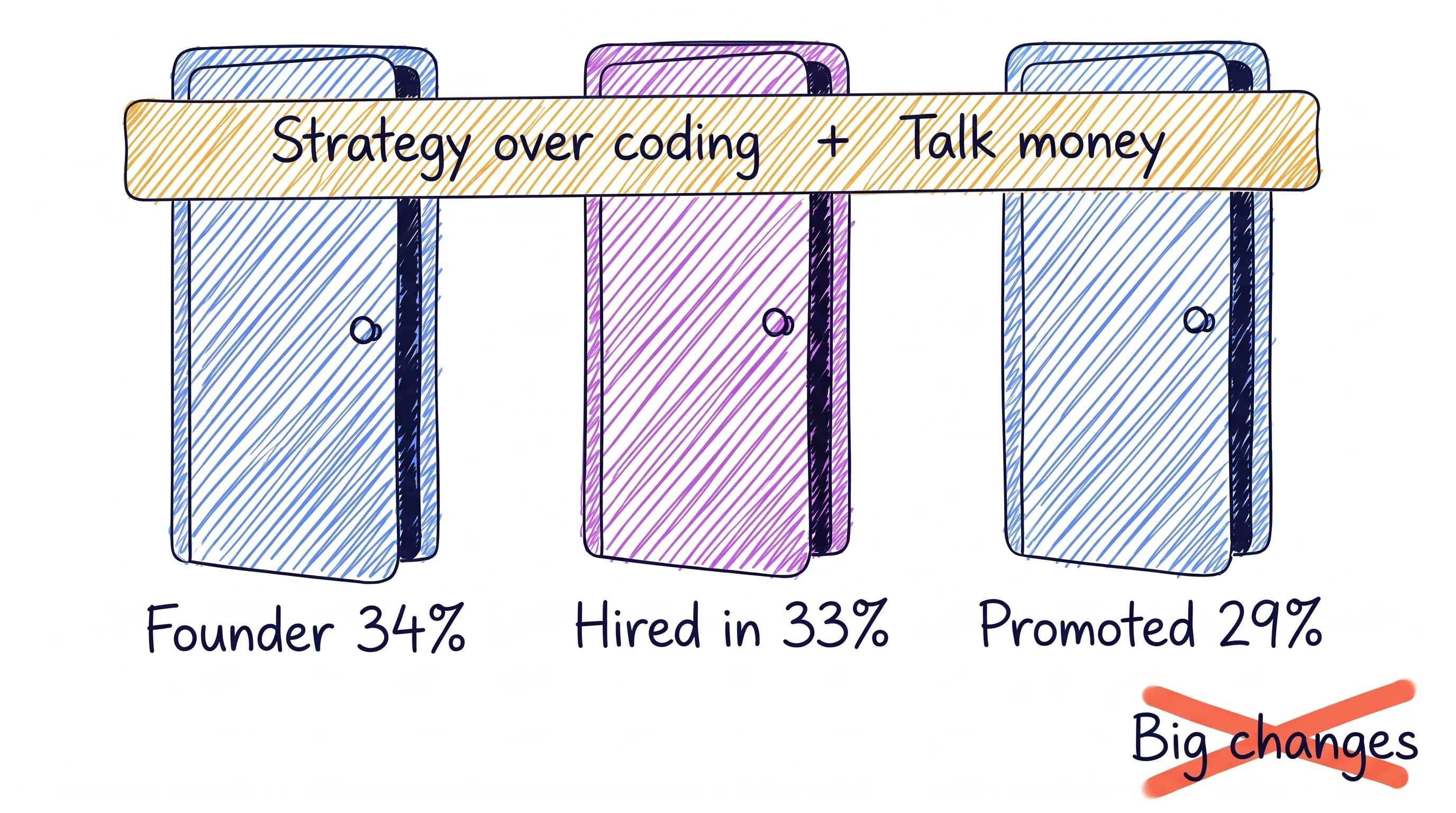
STX Next asked 500+ CTOs how they got the title in their 2021 Global CTO Survey: 34% co-founded the company, 33% were hired in from another company, and roughly 29% were promoted internally. Three doors of almost equal width, and a very different first year behind each.
| Route | Share of CTOs (STX Next, 2021) | What gets you through the door | What the first year is |
|---|---|---|---|
| Founder | 34% | A co-founder who can build the product, plus the nerve to start | You write most of the code, and the title arrives before the job does |
| Hired in | 33% | A track record of running an org of a similar size somewhere else | You inherit teams, debt and a roadmap you didn’t choose |
| Promoted | 29% | Being the head of engineering or VPE when the company decides it needs a CTO | Your peers become your reports and your CEO becomes your only boss |
The same survey has 20% of CTOs reaching the seat in under five years and 27% taking eleven to fifteen. The fast group is the founder door almost by definition. If you’re a senior engineer with no company to found, your realistic routes are the other two, and both of them ask the same question about you.
The one test: strategy over coding, and the ability to talk money
My test for whether somebody is ready for a CTO seat has two parts, and I apply it in the first intro call.
Strategy over coding. Can you spend a week without opening the codebase and still feel you did your job? The founding CTO at 8 engineers writes code because there’s nobody else; the CTO at 60 engineers who still writes code is usually hiding from the part of the job they’re worse at. If the thought of handing the hardest technical problem to a senior engineer, and watching them do it differently from how you would, makes you itch, you’re a very good principal engineer. That’s a fine seat and a different one.
The ability to talk money. This is the half most engineers are missing, and it’s the half the CEO is buying. In practice it means three things. Reading the company’s P&L well enough to know where engineering sits in it, which in a software company is usually the largest cost line after sales and marketing. Converting technical decisions into the CFO’s units: when a platform migration comes up, the answer has four numbers in it, the engineering months it takes, what those months would otherwise have shipped, the change in the hosting bill afterwards, and the date the company stops paying for the old and the new system in parallel. Bring the first number alone and you’ll be sent back for the other three. And holding a budget argument against a sales leader who has been having them for fifteen years and is better at it than you.

If you pass the first part and fail the second, the fix is cheap: ask your current CFO or finance partner for one hour a month to help you to read the numbers, sit in on three sales calls a quarter, and present engineering’s cost in the exec meeting once before you ever have to. A year of that beats any executive MBA I’ve seen on a CV.
Startup CTO or scale-up CTO: which first seat
For a first-timer, the biggest difference between a startup CTO and a scale-up CTO is simple to state. In a startup you code. In a scale-up you scale the company.
The startup version, under about ten engineers, is a senior engineer with a title and a shareholding. You pick the stack, you hire the first people, and the strategy is whatever gets the product in front of a customer this month. It’s the easier first seat to get, through the founder door, and the harder one to grow out of, because the company keeps paying you to be its best engineer long after it needs you to be something else.
The scale-up version, from roughly forty engineers up, is the job the hired-in door leads to. Managers of managers, a budget, a board deck, platform bets measured in years. Almost no code. The startup CTO who gets this seat second has to unlearn the first one; the head of engineering who gets it through promotion has usually been doing most of it already under a different title, which is why that route exists. The VP of Engineering vs CTO guide covers which half of that job you’d be keeping.
Which first seat to take, then. If you can found, found; the title is cheap and the learning is fast. If you can’t, aim at the promoted door inside a company that’s about to need a CTO, usually one crossing thirty to forty engineers with a founder-CTO who wants to go back to building. Being the obvious internal candidate when that moment comes beats being one of 200 applicants to a hired-in posting.
What the ads promise, and what they mean
Eight live CTO postings, read in October 2026 for this piece, four in Europe and four in the US, from a Series B in Berlin to a UK national institute to a $200M-revenue US scale-up. Two of the eight are linked below; the rest sat on LinkedIn, Lever and Greenhouse and will have expired by the time you read this. Seven of the eight asked for proven leadership of 50 or more engineers, one required prior CTO experience outright, five named no salary and four didn’t say who the CTO reports to. The two that did name a figure put London at £200,000 to £250,000 base and the US at $300,000 to $350,000 (Artsy, 2026); for Germany, ERI SalaryExpert puts the 2026 average at €173,634.
| What the ad says | What it usually means | What to ask in the interview |
|---|---|---|
| ”Currently hands-on. You read and write code” plus “15+ years of engineering leadership” | They want a principal engineer and an executive in one salary, and the executive half will lose | Which of the two do you want on a Tuesday when both are on fire? |
| ”Information security, disaster recovery, payments compliance, capital planning” | This is a CIO seat with a CTO title; the product is somebody else’s problem | Who owns the product roadmap, and does it report to me? |
| ”Experience working with PE or VC investors” and no reporting line | The board is in the room, the runway is the real constraint, and the decisions you’ll be blamed for were made before you arrived | Who do I report to, and what did the last CTO leave unfinished? |
| ”AI-first” in a retailer, a charity and a sports federation alike | A board question looking for an owner, with no budget attached yet | What’s the AI budget, and what number does the board expect it to move? |
The third row is the one that catches first-timers. A hired-in CTO walks into an org someone else shaped, with a tech-debt bill someone else ran up, and the board’s memory doesn’t reset on your start date. Which is why the first quarter in that seat has rules of its own.
What changes on day one
Three things to do, and two to leave alone.
Do meet your peers and your reports, and do it before you form opinions. Do understand the business model and the roadmap, where the money comes from and what the company has already promised to whom. Do build your own roadmap proposal for the improvements you’d make, costed, with dates, and take it to the CEO around day 60 to 75.
Don’t make big changes yet, however obvious they look from the outside; you don’t know yet what the odd structure is holding up. And don’t be loud. Stay rather quiet at first. Week two is too early for a vision, and the org will hold you to it in month six.
The full version of that quarter, including what the mentoring pack covers session by session, is on your first 90 days as a new CTO.
If you’re weighing the move now, or you’ve just made it, this is the conversation I have most often in CTO mentoring: is the seat on offer the one you want, which half of it you’re missing, and what to do in the first quarter so the second one is yours to shape. The intro call is free.