An AI champion is the employee a company names to get the people around them using AI tools, almost always on top of their existing job. A budget, a new title or a pay rise rarely comes with it. Citi invited its staff to volunteer for one of the largest programmes on record, and AI News reported that the badges those roughly 4,000 people earned “did not come with promotions or pay rises”.
So the useful question is on what terms you take it. Nearly everything published about AI champions is written for the company building the programme: how to pick them, how to launch, how to keep them going. This page is for the person being asked, and for the manager doing the asking.
Who gets the tap on the shoulder
Usually the person already using AI more than anyone else on the team. Dylan Oh, a software engineer who held the role, wrote it plainly: “you get picked because you are already comfortable with AI.” At Safe Software the 18 champions volunteered, and every team put forward at least one.
That logic has a cost the invitation leaves out. Using AI well yourself and getting ten colleagues to change how they work are two separate skills, and the second one is change management. Oh spent his first stretch posting feature announcements in Slack, mentioning tools in standup and forwarding feedback. The people who were going to try the tools had already tried them, the rest stayed where they were, and in his words “I burned many months on it.” His conclusion was that the job comes down to letting people see you use the tools on real work, failures included.
The same word also covers seats of very different weight. OpenAI’s champion guide splits it in two: Leaders, who set “AI direction, priorities, governance, and value goals”, and Activators inside teams. Its network guide says Activators “are not expected to own the entire adoption system”. A Leader champion is doing a manager’s job under a volunteer’s name, so ask which of the two you’re being offered.
How much of the week it takes
The people who design these programmes disagree by a factor of 24. GitHub’s guide suggests “a minimum of 30-60 minutes per week”. Rework budgets 2-3 hours. Safe Software’s champions spend about 10% of their time. VirtusLab’s maturity matrix asks for 10-15%, “roughly 4-6 hours per week”, and Voltage Control puts it at between 10 and 30% of capacity. On a 40-hour week the top of that range is 12 hours, against GitHub’s half hour.
Microsoft and OpenAI, who both publish champion guides for their own products, give no number at all. Microsoft’s charter template tells the company to write down an “expected time commitment” and leaves the figure to you.
Where the hours come from decides more than how many there are. Champion work stacked on top of a full week loses to delivery the first time a deadline slips. ChangeEngine says the role “gets dropped within a month” when it’s handed over that way. VirtusLab has the sentence worth quoting to your manager: “A champion who is named but unfunded is an expectation dressed up as a role.”
Champion, enablement lead, Head of AI
The champion is the bottom rung of a structure with paid seats above it. Each rung adds what the one below lacks.
| Seat | Share of the week | What it can decide | Money it controls | Judged on |
|---|---|---|---|---|
| AI champion | 30 minutes to 30%, beside the day job | What to try and what to show; no authority over the people it’s moving | None. Rework’s most generous design adds a $100-300 monthly stipend | Usually team usage, which the champion can’t control |
| AI enablement lead | Full-time | Tool rollouts, the training plan, the champion network | Recommends what to fund, rarely owns the money | Adoption, sentiment, an executive scorecard |
| Head of AI | Full-time, reporting to the CEO or COO | Strategy, vendors, guardrails for tools and data | AI spend: tools, models, compute | Business value tied to revenue or cost |
The champion row comes from GitHub, Voltage Control and Rework above. The enablement lead row comes from Synchrony’s VP, Head of AI Enablement posting, which lists managing the internal AI community “including champion networks”, and an Accela posting that asks its head to “recommend which initiatives to fund, expand, adjust, or stop”. The Head of AI row comes from a since-closed AssetWatch, “Reporting to the CEO”, and NECSWS, whose head would “Manage AI-related spend (tools, models, compute)”.
Pay climbs the same way. Synchrony posts $170,000 to $290,000 for that enablement VP, and AssetWatch $244,000 to $282,000 for its Head of AI. Of the programme write-ups read for this page, Rework’s is the only one that puts any money in the champion’s hand.
The metric that gets used against you
Two of the most detailed programme templates score the champion on how many teammates use the tools. ChangeEngine tracks “Tool usage rate by team, tracked weekly”. Rework calls team usage rate “The primary metric” and wants it up by 20 to 30 percentage points. You can’t make a colleague open Copilot. You can control what you document, which use cases you pass to the central team, and one workflow you measure before and after.
intind says it in nine words: “Active seats measure availability. The changed output measures value.” Oh learned it the expensive way. When someone asked what the company got for its enterprise licences, he had no clean number, because “we never measured the baseline”. Take that baseline in week one, on one workflow, while there’s still a before to measure.
What to agree with your manager before you say yes
Champion hours carved out of the day job survive a bad quarter. Hours on top of it go first. So have the conversation, then send a short note, so the terms live somewhere other than two people’s memories. Something like this:
Subject: AI champion role, what we agreed
- Hours in writing: 4 hours a week, about 10%, and [this task] comes off my plate to make room.
- A charter: I recommend tools and workflows. IT, security and legal approve them. Licences, access requests and tech support aren’t mine.
- My measure: workflows documented and tested by someone else, use cases passed to [the AI team], and a before/after on one workflow. Seat usage isn’t on the list.
- Office hours: [Tuesday 14:00-15:00]. Requests outside that slot go to [the IT channel].
- Data questions: anything about what can go into which tool goes to [a named person in security].
- A review line: the champion work is one objective in my next review, written by [you / the programme lead].
- Review point: on [a date 90 days out] we decide whether to continue, change the hours or hand it over.
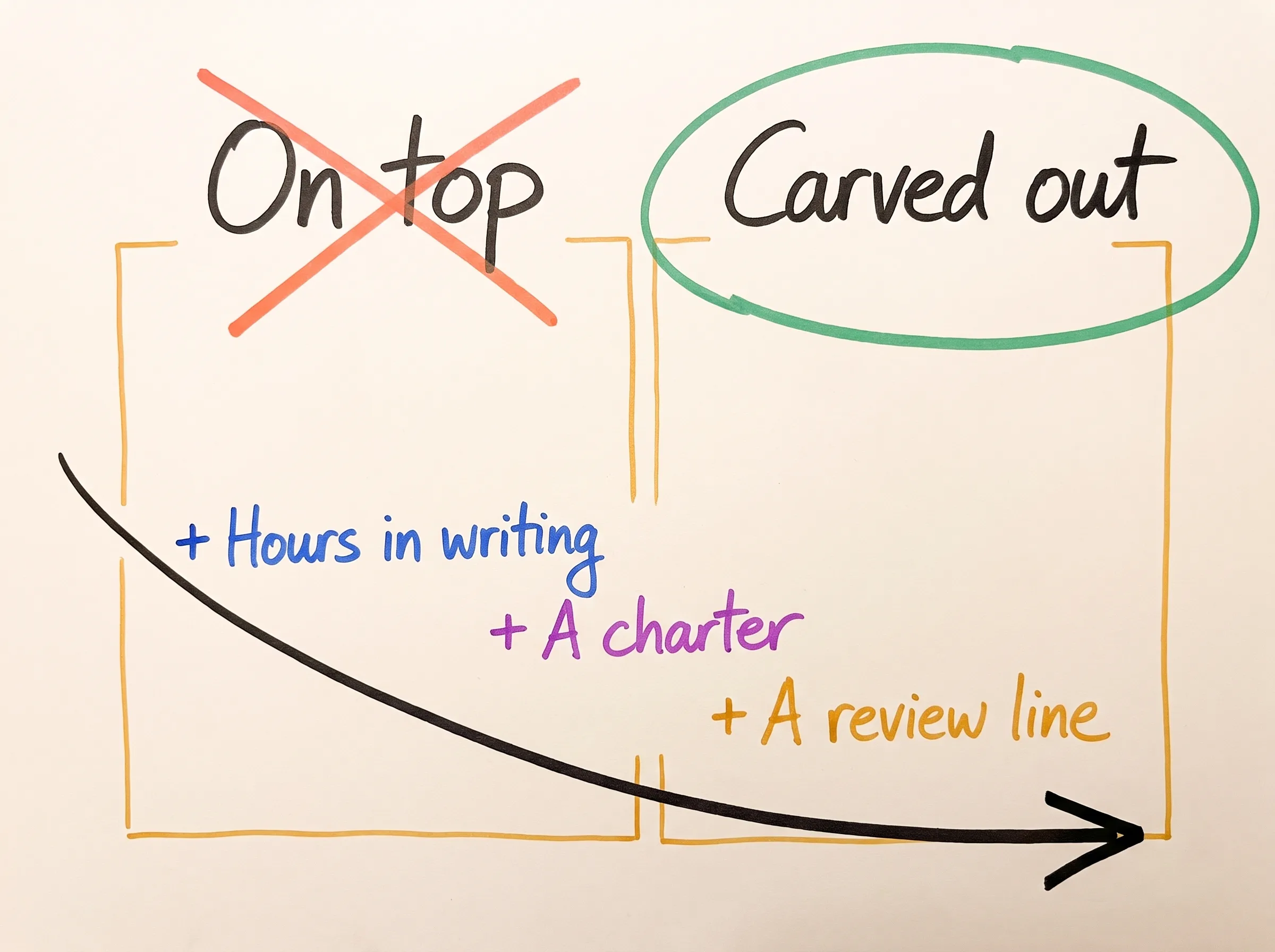
The programme guides say least about three of those lines, and those three decide how the role ends.
The charter. Microsoft’s own template has a section called “what Champions don’t own” and another for “support and escalation paths”. Ask your manager to fill in that template with you. The 2024 Work Trend Index found that 78% of AI users bring their own AI tools to work. When a colleague pastes customer data into a tool you showed them, the record should say that you recommended the tool and that security approved it.
The review line. Citi’s volunteers got badges and no promotions. VirtusLab tells the champion to ask for recognition “as part of his performance review, as a formal role addition to his job description”, and calls the answer “a useful signal about whether this organization is serious about AI adoption”. If the work isn’t in your objectives, it competes with everything that is, and loses.
The review point. The role is built to end. VirtusLab calls it “a temporary structure”, Citi rotates its champions, and Rework says the programmes that fail “do so between months 3 and 6”. A date in the note makes the end a decision, as opposed to a slow fade, and whatever you built (the prompt library, the workflow docs, the before/after numbers) stays yours to show.
One more thing to settle before you repeat anything to colleagues: what leadership has said about jobs. BCG’s AI at Work 2025 found employees at more advanced companies more worried about job security (46%) than those at less advanced ones (34%). The champion is the face of the programme in the team, so you’ll get that question first. If leadership hasn’t put an answer in writing, don’t make one up for them.
If your manager won’t put hours on paper, Boon has the blunt version: “Put hours on the calendar, or do not call it a role.” Saying “not this quarter” is a legitimate answer.
If you’re the manager doing the naming
Your own support moves usage. Gallup’s AI indicator found that only 36% of employees in AI-integrating organisations strongly agree their manager actively supports their team’s AI use, and that those who do are about 1.7 times as likely to use it a few times a week or more. Rework’s advice to managers is to back the programme without taking the champion seat yourself.
Send the note above from your side, before the person asks for it. Keep tool and data decisions with whoever owns them, so the champion isn’t the one approving something on a hunch. And if the job you have in mind includes evaluating vendors and setting guardrails, it isn’t a volunteer seat. Ciena hires that version under the same title, full-time and five days in the office, with “Evaluate and integrate AI tools” in the duties and a posted range of C$109,000 to C$174,000.
What it opens next
Voltage Control describes a typical stint of two to three years before the person “moves into a dedicated AI role”. The enablement postings show which one: Synchrony, Accela, BuildOps and NECSWS all list building or running a champion network as a duty of the senior seat. A former champion has done that job at the scale of one team, and can prove it only with artefacts and numbers.
In my own mentoring, AI adoption came up in 44% of recorded 2026 sessions (19 of 43), per the engineering leadership statistics. If you’re deciding who runs AI adoption in your org, or you were handed it on top of everything else, Head of AI mentoring is where we work through the mandate, the hours and the numbers that will be asked for at the end.