A data science manager runs a team of data scientists and answers for what their work changes in the business: the forecast finance plans against, the fraud model scoring live payments, the experiment that decides whether a feature stays.
Below the seat sit people working in notebooks and SQL. Above it sit people who own a P&L and want an answer by Thursday. The manager picks which of those questions the team takes, and makes sure each answer lands where somebody uses it. Deliveroo’s current posting says you’ll “decide which problems are worth solving” and make sure the work “translates into better product and commercial decisions, not just analysis.”
This page is for the person deciding about the seat: whether to take it, how to shape it, or who to put in it. It’s built on 16 data science management postings from Stripe, DoorDash, Monzo, Robinhood, Gusto, Figma, Reddit and others, read on 24 October 2026.
What does a data science manager do?
The job is people, priorities and proof of impact. All 16 ads ask the manager to grow the team’s data scientists, most ask them to set the team’s direction, and about half keep technical work on the manager’s own desk.
Teams are small. Stripe’s founding manager in Bengaluru starts with 4 individual contributors spread across India and Singapore. Monzo’s financial crime role asks for two years running a data team “larger than 4 people”. At 12 people, as in the Squarespace ad below, the job has already turned into managing managers.
The roadmap is yours, the questions mostly aren’t. Stripe’s finance and strategy manager will “drive the roadmap and priorities for your team”. DoorDash hires two managers to “turn ambiguous questions into clear recommendations that influence roadmap and plan outcomes”, reporting to a Director, Data Science. The questions arrive from product, finance and sales. Deciding what to do with them is the job.
Hands-on is common. GoCardless wants a leader “comfortable diving into the codebase” who owns models “from the initial concept to production-ready code”. Deliveroo says you’ll “remain hands-on while managing a team”. Robinhood goes furthest and wants a player-coach “hands-on in the terminal and in the code”, with daily Claude Code use as a requirement.
AI measurement is moving onto the desk. Five of the 16 ask the manager to own how AI features get evaluated. Figma’s director will “shape how we measure AI products: evals, quality, and experimentation”, and GetYourGuide lists LLM-as-judge and golden-dataset monitoring next to incident management.
In practice, the difference from an engineering manager is what counts as done. An EM’s team ships code against a date, and whether it shipped is easy to check. A data science team often ships a recommendation: a forecast, a test result, a slide. Whether anybody acted on it is checked far less often, and that gap is where the team slowly turns into an internal consultancy.
The data science ladder and what each rung decides
Each rung owns one decision the rung below can’t make. Pay examples are base salary from the postings, US unless marked.
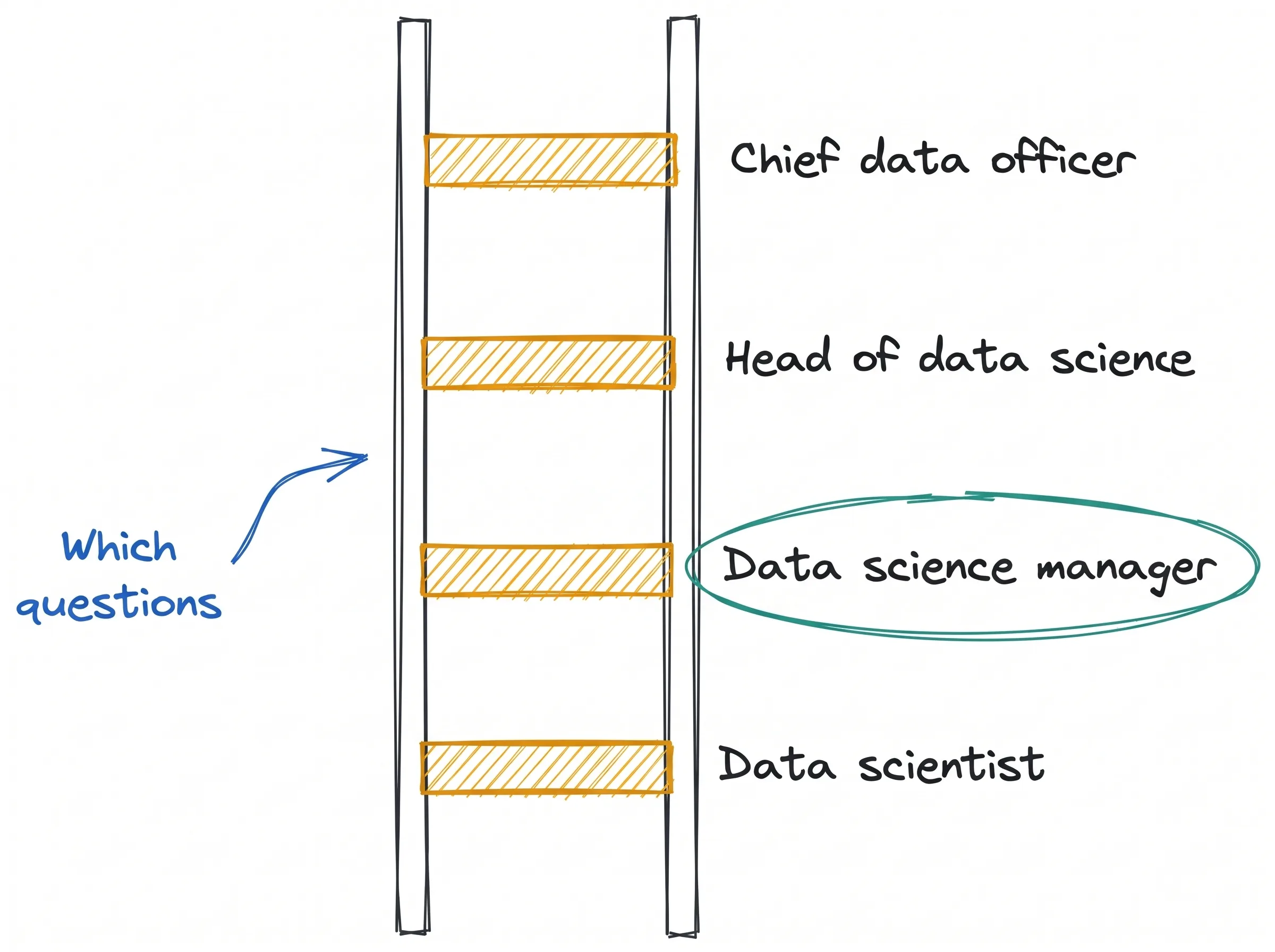
| Rung | Scope in the postings | The decision only this rung makes | Reports to | Posted base, examples |
|---|---|---|---|---|
| Data scientist | One problem, one model or analysis | Which method answers the question, and how sure the answer is | A data science manager | $120,230 median for all US data scientists (BLS, May 2025) |
| Data science manager | One team of about 4 to 12, one product or business area | Which questions the team takes, and which ones wait | A director of data science, at DoorDash | $184,300 to $271,000 (DoorDash); £100,000 to £130,000 (Monzo, UK) |
| Head or director of data science | Managers of managers; in a smaller company, the top data science job | How data science is organised: embedded or central, the hiring plan, the measurement standards | A VP of Data, at Squarespace | $290,000 to $376,000 (Figma director); $317,000 to $443,800 (Reddit senior director) |
| Chief data officer | Data as a company asset: governance, platforms, strategy, often AI too | What data the company keeps, who owns it, and what gets spent on it | Technology leadership in 42.7% of firms, business leadership in 33.6% | No figure sourced for this page |
The top rung comes from the 2026 AI & Data Leadership Executive Benchmark Survey by Randy Bean’s Data & AI Leadership Exchange, which polled nearly 110 leading companies. 90% of them have appointed a CDO, up from 12% in 2012. 93% named culture and change management as the main obstacle to using data and AI, and 7% blamed technology. So the climb from head of data science to CDO changes the main problem of the job, from getting the method right to getting people to use the answer.

There’s a side door off the ladder too. The managers who built evaluation work for AI features already do half of what a director of AI or a head of AI gets hired for.
Where does head of data science sit?
Head of data science is the title on this ladder that means the most different things. Two companies in the set prove it with their own pay bands.
Robinhood is hiring a Head of AI/Data Science, Finance & Strategy and a Senior Data Science Manager, Algorithms. Both post $247,000 to $290,000 base in the top pay zone, both ask for 7+ years in data science with 2+ years managing people, and the first duty listed for the “Head of” seat is to run the NPS survey programme end to end. Gusto posts a Senior Manager, Head of Sales Data Science & Analytics and a Senior Data Science Manager, Growth at an identical $218,000 to $255,000 in San Francisco and New York. Gusto explains in both ads that its titles describe craft and scope as opposed to rank, so you’ll see “something like ‘Head of X’ instead of a rank word like ‘Director’”.
The bands cross the other way as well. Discord’s Senior Data Science Manager starts at $304,000, above the $290,000 floor of Figma’s director. Squarespace’s “Senior Manager” leads 12 people through three managers of their own and asks for 5+ years managing managers, more than the 2 years Figma asks of a director. For orientation across all of it, Levels.fyi puts US median total compensation for data science managers at $250,000, from 309 salaries, with the 90th percentile at $590,000.
If you’re hiring, the title you print decides who applies. “Head of” pulls director-level candidates towards a senior-manager band, and some of them will find out at the offer stage. If you’re being hired, get the level and the band in writing before you discuss the title.
Consultancy or product team? Score yours
Gusto’s ad for its sales data science lead is the most honest document in the set. It says the team must move “from a function defined by query fulfillment and reactive reporting” towards forecasting and causal inference, and in the same seat fix a data foundation with “significant technical debt”. It’s the only one of the 16 that names the problem out loud. A team in that state runs like an internal consultancy: busy, liked by its stakeholders, and hard to defend when the budget gets cut, because nothing on record shows what its answers changed.
Score each line 0, 1 or 2. Use your own team, or ask the hiring manager each question about the team you’d inherit.
| Check | 0 | 1 | 2 |
|---|---|---|---|
| Where the work comes from | Whoever asks in Slack, first come first served | A queue the manager triages each week | A quarterly roadmap agreed with a named business owner |
| Routine questions | The team builds and fixes the dashboards | Some self-serve, analysts still on call for “quick pulls” | Mostly self-serve: Monzo puts it at around 90% through Looker |
| What the team reports upward | Number of analyses delivered | Number of models shipped | The business metric each area moved |
| After the answer | A deck, then silence | The stakeholder decides what to do with it | The team follows the decision into the product and checks it stuck |
| Models | Stay in notebooks | Engineering rebuilds them for production | The team runs them in production, with monitoring |
| A senior person’s request you disagree with | You do it anyway | You can push back with your manager’s backing | You decide, and the roadmap shows why |
| The data underneath | The team patches pipelines it doesn’t own | Shared with data engineering, no clear owner | Analytics or data engineering owns it, with agreed definitions |
0 to 5: consultancy. The team answers questions and the business keeps the decisions. 6 to 9: halfway, usually a team with a good manager and a weak mandate. 10 to 14: product team. GetYourGuide describes this end in its ad: the team’s “output is measured in company-level business impact, not in models shipped”, and it has to “own adoption, not just delivery”. The cut-offs are my rule of thumb built from these ads, not a validated scale.
What the score means depends on which side of the table you’re on.
- You’re taking a seat that scores under 6. The job is a turnaround, whatever the ad calls it. Before signing, get two of the zeros written down as your first-year goals, and get line six (the right to say no) agreed with the person you’ll report to. Without line six the other goals don’t move.
- You’re staffing a seat that scores 0 on the last line. Your new manager will spend year one on pipelines. Gusto plans for it and puts a phased remediation with Data Engineering into the mandate. If you don’t, budget for an analytics engineer before a second data scientist.
- You’re an individual contributor offered the seat. A low score is a fair reason to ask for the team before the title. A consultancy as your first management job mostly teaches you stakeholder management.
Two offer terms the test won’t catch. Deliveroo hires managers into a pool and assigns “the right scope and team at the end of the process”, so take its offer to meet the proposed team before you sign. GoCardless posts £99,200 to £148,800 and says it pays “between the minimum and the mid-point of the pay range until performance can be assessed in role”, so at offer stage the top half of that band isn’t on the table.
Mentoring for the seat
A data science manager does an engineering manager’s job with a different definition of done, so it’s the same ground I cover in mentoring for engineering managers: saying no to a senior stakeholder, turning a request queue into a roadmap, and the performance conversations no model helps you to avoid. Bring the job ad and your score from the table to the first session. You only pay for a session you rate 8 out of 10 or higher.
Seats around this one
- Engineering manager: the role with the same people load and a different definition of done
- Engineering director: what changes when you manage managers
- Director of AI: the seat your eval work can lead to
- Head of AI: who gets handed the AI org, and from which road
- AI platform engineer: who runs the layer your models ship on