
Engineering Director, Tribe Lead, Chapter Lead

Engineering Director Mentor. For the director who opens PRs out of habit.

Six hours of meetings a day and the thinking happening at the weekend. A roadmap shipping 55%. Two EMs struggling and both conversations postponed twice. A CTO who wants a scale-up plan by the end of the quarter.

You don't need another framework. You need somebody to pressure-test the director-level call sitting on your desk this week, then help you sequence the next three. I ran this seat through Mews Series C, 8 to 80+ teams, with 3,400+ mentoring sessions since.

9.2/10 from 300 mentees who rated the work.

Six situations directors bring me

The situations below are composites. Patterns and numbers from real sessions, people invented, because what happens in a session stays in the session.

Marian Kamenistak in a 1:1 mentoring session.

The feedback loop went from days to quarters

You opened a PR review this morning. Nobody asked you to, your EMs didn't need you to, and it cost you the 45 minutes earmarked for the org-design proposal your VPE expects on Friday. You did it because it was the only thing all day where you knew precisely what good looked like.

That's the real difficulty of the director step and it gets described badly. The problem isn't that you have to stop being technical. It's that your feedback loop stretched from hours to quarters. An EM knows by Friday whether the week worked. A director finds out in about eleven weeks, and in the meantime there's nothing to grip.

So we build you shorter loops that are real rather than invented. Which of your EMs you'd hand the hardest conversation to this month, and why. Which one is a retention risk, with evidence rather than a feeling. Which one you've quietly lost confidence in without ever telling them. All of those are checkable inside a fortnight and all of them are the actual job.

We also name three things you stop doing this quarter, written down, because delegation as a principle achieves nothing and delegation as a list works. By week 12 there's a delegation ladder on paper, three abandoned behaviours, and no weekend spent drafting org charts you then delete.
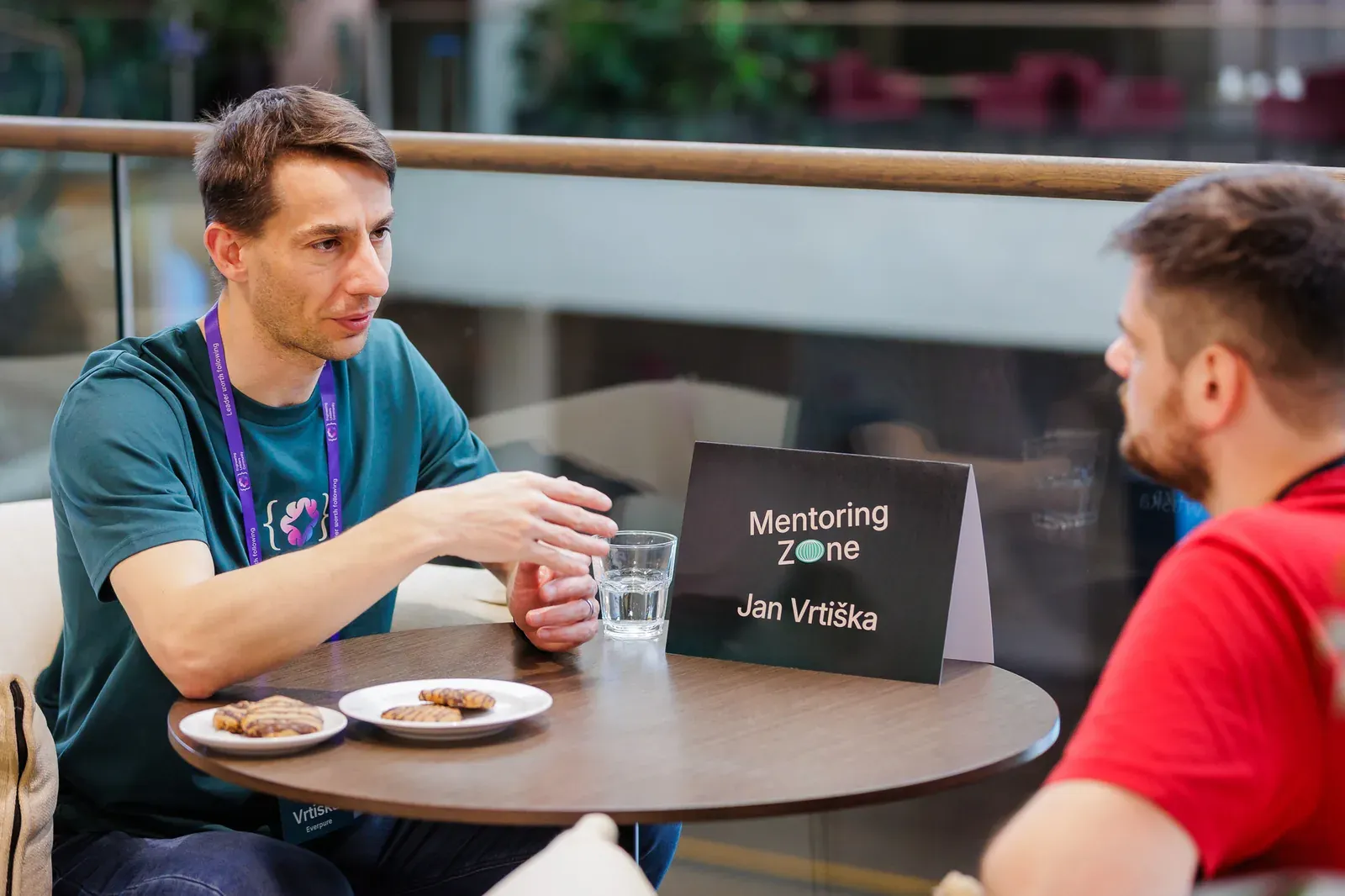

Marian Kamenistak in a 1:1 mentoring session.

You are the translation layer and only the failures are visible

The CTO sets direction on Monday. Your EMs need it as sprint work by Wednesday. Most of the tension in the org lives inside that translation and all of it lands on you. Nobody notices a good translation. Everybody notices when a team builds the wrong thing because you paraphrased under time pressure.

Longer strategy documents make this worse, reliably. So does standing up an alignment forum, which becomes a status meeting by about week three.

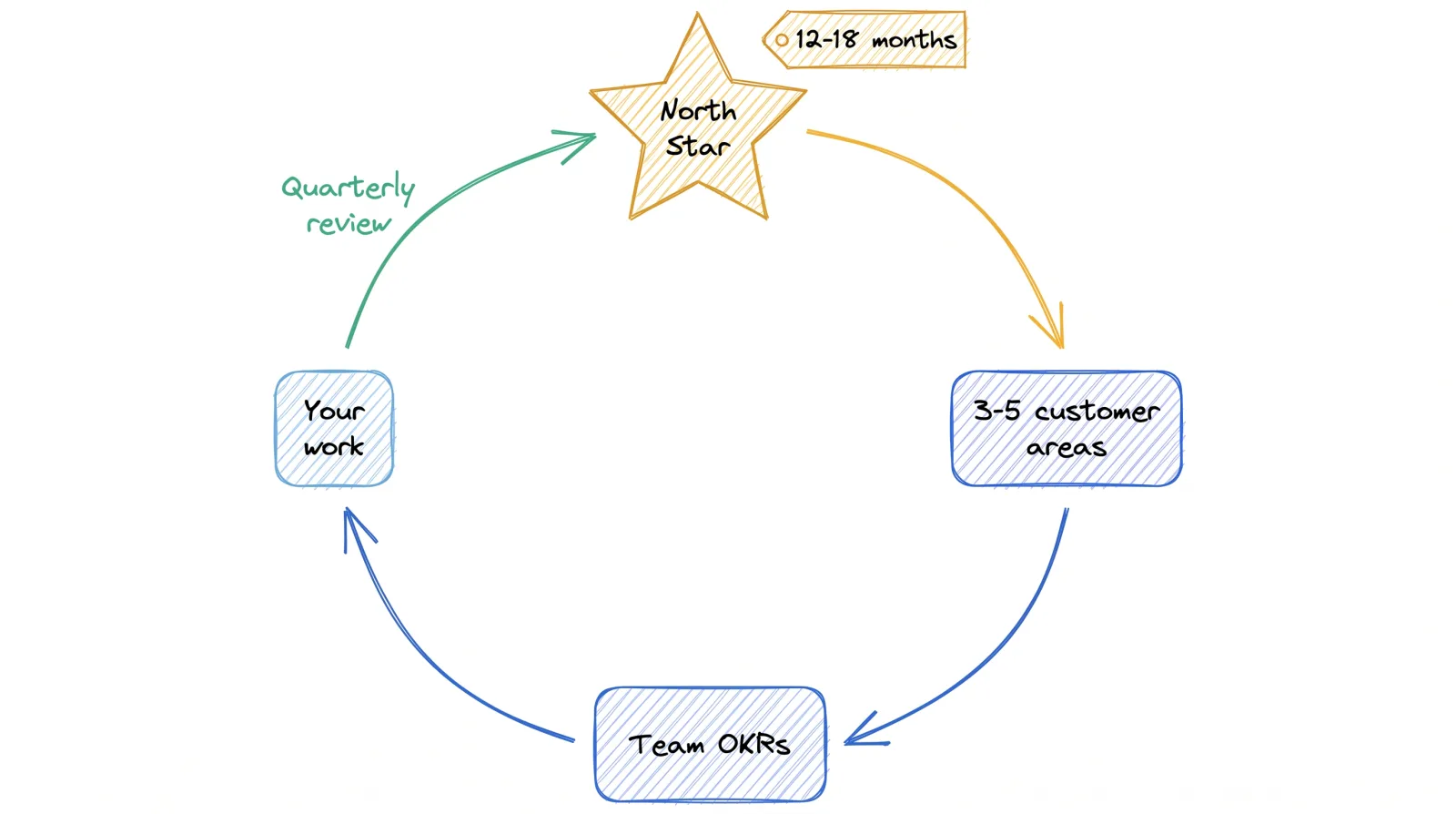
What works is a cascade that fits on one page and survives being read aloud: company objective, group outcome, team KPI, sprint commitment, every row traceable to the one above it. Where a row can't be traced, you've found the thing generating your tension, and it usually sits above you rather than below.

Then we rehearse both directions, because what you send up to the CTO and what you send down to your EMs have to be recognisably the same story. Your EMs talk to your CTO, and you won't be in the room when they do. By week 8 the cascade exists, gets updated weekly, and both directions match.

Marian Kamenistak in a 1:1 mentoring session.

Every EM has a defensible reason and the quarter still missed

Q3 shipped 55%, Q2 shipped 60%. Your CTO is running out of patience and you're running short on sleep. Each of your EMs has an explanation and each explanation is true. Add them together and you still can't answer when we hit 80% in a way that survives the exec room.

That's the particular trap of this seat. At team level a miss has a cause. At group level a miss has five causes, all locally valid, and the aggregate reads as bad luck rather than as a system doing exactly what it was built to do.

The first split I'd make with you is whether you have a planning-input problem or a delivery problem, because from outside they look identical and they want opposite treatments. Garbage going in means your commitments were never real and your teams are missing them honestly. Garbage coming out means the commitments were sound and something in execution eats them. Most directors assume the second and have the first.

Then a weekly three-metric review across the whole group, which surfaces slip roughly four weeks before a sprint review would. At group scale the pattern is visible long before any single team is willing to admit to it, which is the one structural advantage your seat has.

By week 12 you're consistently above 80%, and the answer to when we hit 80% has a date on it and reasoning underneath.

Marian Kamenistak in a 1:1 mentoring session.

Two of your EMs are struggling and you can't lose both

One was your strongest senior engineer, promoted eight months ago, and his team is coasting because he won't make the hard calls. The other inherited a broken team from your predecessor and is arguably doing better than the situation deserves. HR wants a paper trail on the first. You've avoided both conversations for two months, and the team has noticed whether or not anybody has said so.

The mistake is treating them as one problem because they arrived in the same month. They aren't remotely the same problem, and sequencing them matters more than what you say in either conversation.

So we order them by risk rather than by how uncomfortable each one feels: team impact, retention exposure, how long each can safely wait. Usually one is urgent and the other has a quarter of runway, and simply knowing which is which is most of the relief. Then we draft the specific feedback for each, rehearse the PIP where a PIP is the right instrument, and design a coaching cadence for whichever one is genuinely recoverable.

By week 8 both conversations have happened, each EM has a plan in writing, and you have an escalation criterion you set while calm rather than one you improvise while angry.

Marian Kamenistak in a 1:1 mentoring session.

Six hours of meetings a day and the thinking happens at the weekend

Your calendar is largely other people managing their uncertainty by adding you to something. The only quiet window is Sunday evening, so that's where the strategy work went. You know this is why the roadmap slips, and you know you're the only person positioned to change it.

We audit the calendar against the four things a director genuinely owns: strategy, your direct reports, cross-functional work, and delivery firefighting. Then every recurring meeting gets one question asked of it, which is whose uncertainty it exists to manage. Where the answer is somebody else's, it goes back to them with the authority attached, because a standing meeting is very often a decision right that nobody ever assigned.

That usually clears about 30% of the recurring load within six weeks, and the strategy work moves back into daylight where it belongs.

Marian Kamenistak in a 1:1 mentoring session.

The CEO announced 40 to 80 engineers and you own the how

It went out at the all-hands, the board expects execution, and you have Team Topologies bookmarked and Conway's Law printed and no clear read on which of them matters most at your stage. Every scale-up account you read is somebody else's org describing choices it has already made.

I ran this at Mews, 8 to 80+ teams through Series C, and the thing I'd warn you about isn't the org design. It's that hiring outruns your ability to grow managers. You end up with a structure that's correct on paper and staffed by people who are three months short of ready, and that gap is where scale-ups tend to break.

So we sequence it from that end. Which patterns import cleanly at your stage and which quietly break. Where the manager bench comes from, grown or hired, and when each one has to land relative to the team they'll run. Plus the three mistakes that show up most often in this exact transition, which we plan around rather than discover in month five.

By month 3: a signed-off org design, a hiring plan sequenced against manager readiness rather than headcount, and one honest communication to the team about what is changing and what isn't.

The questions I hear most from Engineering Director, Tribe Lead, Chapter Lead

These are the exact asks from mentees in the last 12 months. Bring one to the intro call and we start there.

How mentoring with me works

Free 30-min intro. Two KPIs to move in 3-6 months. Small homework after every session. The full method, step by step:

See how mentoring works →

Frequently asked

What does an engineering director do, and how is it different from VPE?+
A director runs a group of teams through their engineering managers. A VPE runs the whole org and sits on the exec team. I wrote both up properly: Engineering Director: what the role really is and VP of Engineering vs CTO. If your title is Head of Engineering, that one is covered too. Weighing the jump yourself? The three gaps between EM and VPE is the honest version.
What if the real block is my VPE or CTO, not my team?+
Then that's the work. Roughly half the director-level asks I get are influence-up problems in disguise, and they don't announce themselves as such. We design the specific play for your boss, including what you do if it doesn't land.
I have six weeks before a board meeting. Is that enough?+
Six weeks is enough for one thing done properly, so we pick the one. Weekly cadence, and you finish each one holding a piece of the board deck rather than a plan to write one. Several of the engagements I'd point to as most useful ran 4 to 6 sessions against a fixed date.

If my org design has a hole in it, will you say so?+
Yes, and I'd rather do it early while changing it is cheap. If there's a hole I'll name it and then help you close it. Direct answers while the pressure is on, and the coaching questions once there's room for them.
What if my problem is one specific person, not a general "director skills" thing?+
Bring the specific person. Bring the actual 1:1, the feedback you've been rewording for three weeks, the name. That's the texture most of my sessions run on.


Are you available in US timezones?+
Yes. I'm Prague-based, so European afternoons into early US morning work best, and I keep 1 to 2 late slots a week for the West Coast.

Explore other roles

Why me

Marian Kamenistak, mentor for Engineering Director, Tribe Lead, Chapter Lead

9.17/10 average across 300+ mentees. 3,400+ mentoring sessions since 2019.

  • Been in the seat. Built Mews into a $2bn+ unicorn: 8 to 80 teams, roadmap still shipping. Led engineering at Manta before that, acquired by IBM.
  • CEE-native, US-fluent. 4+ years in the Bay Area as Principal Software Architect at Databricks.
  • Still highly technical. AI freak. Bullshit me on estimate, effort, code quality or architecture and I'll ask to see the code or your AI skill set.
  • Financially independent. I don't need your money. I'm financially retired. Seeing you grow is my payoff.
  • Direct. Mentoring first. I boost you fast. No esoteric loops.
The full story →

The one discount

16 minutes. 16% off.

The First quarter lists at €2,580. Build the inquiry with my AI and the same six sessions come to €2,166 — €361 a session. No more than 16 minutes from the first question to a formal itemized offer in your inbox.

Ready to start?

Free 30-min intro. No pricing conversation on the first call. We figure out if we can move your specific problem forward. That is it.

From the blog

All posts →