An AI product manager owns a product whose main output comes from a model, so the same input can give a different answer tomorrow. Everything a classic product manager relies on assumes the opposite: a spec that passes or fails, a bug you can reproduce, a launch that’s done when QA is green.
That one difference moves the spec, the success metric, the launch call and the cost model. If you’re hiring for the seat, shaping it, or moving into it from a classic PM role, those four moves are where it goes right or wrong.
What a probabilistic product does to the PM job
OpenAI’s posting for a product manager on Core Models says it in one line. The PM has to “Define success across offline evaluations and online product metrics, balancing model quality, usefulness, latency, safety, reliability, and cost.” That’s six measures pulling against each other, and cost is one of them. The same posting asks for someone who can “distinguish a useful metric from a convenient one”.
The spec changes shape first. Anthropic’s research PM posting asks the PM to “Synthesize user insights into actionable requirements and evaluations”. The evaluation is the part engineering can test against: a set of real inputs with the answers you’d accept, and a pass rate that counts as good enough. Synthesia’s interactive avatars role puts the hardest version of it plainly: hold “a quality bar for something subjective and hard”, then “make that bar concrete and defend it.”
Then the cost model breaks. A classic SaaS feature costs close to nothing per extra user. A model call costs money every time. Bessemer’s State of AI 2025 found that its fastest-growing AI companies “have only 25% gross margins”, against about 60% for the steadier growers. In an AI product, the price of one answer is a product decision, and somebody has to own it.
Classic PM vs AI PM, row by row
| Where it shows | Classic product manager | AI product manager | What to settle with engineering |
|---|---|---|---|
| The spec | PRD with acceptance criteria that pass or fail | Requirements plus an eval set: real inputs, accepted answers, a threshold | Who owns the eval set and who may change it |
| Success metric | Adoption or conversion of a feature that behaves the same each time | Offline eval scores and live product metrics, traded against cost, latency and safety | The one value metric that counts at the launch review |
| Launch criteria | Feature complete, QA green | Threshold met, red-teaming and regression run, monitoring live | Who can stop a launch, and what triggers a rollback |
| Failure mode | A bug: reproduce, fix, close | A pattern: drift, a regression after a model swap, an agent acting outside its limits | Whether the root cause is the model or the code around it |
| Cost per use | Close to zero | Every request is paid for, so cost per answer is a product number | A ceiling per request and a fallback when it’s hit |
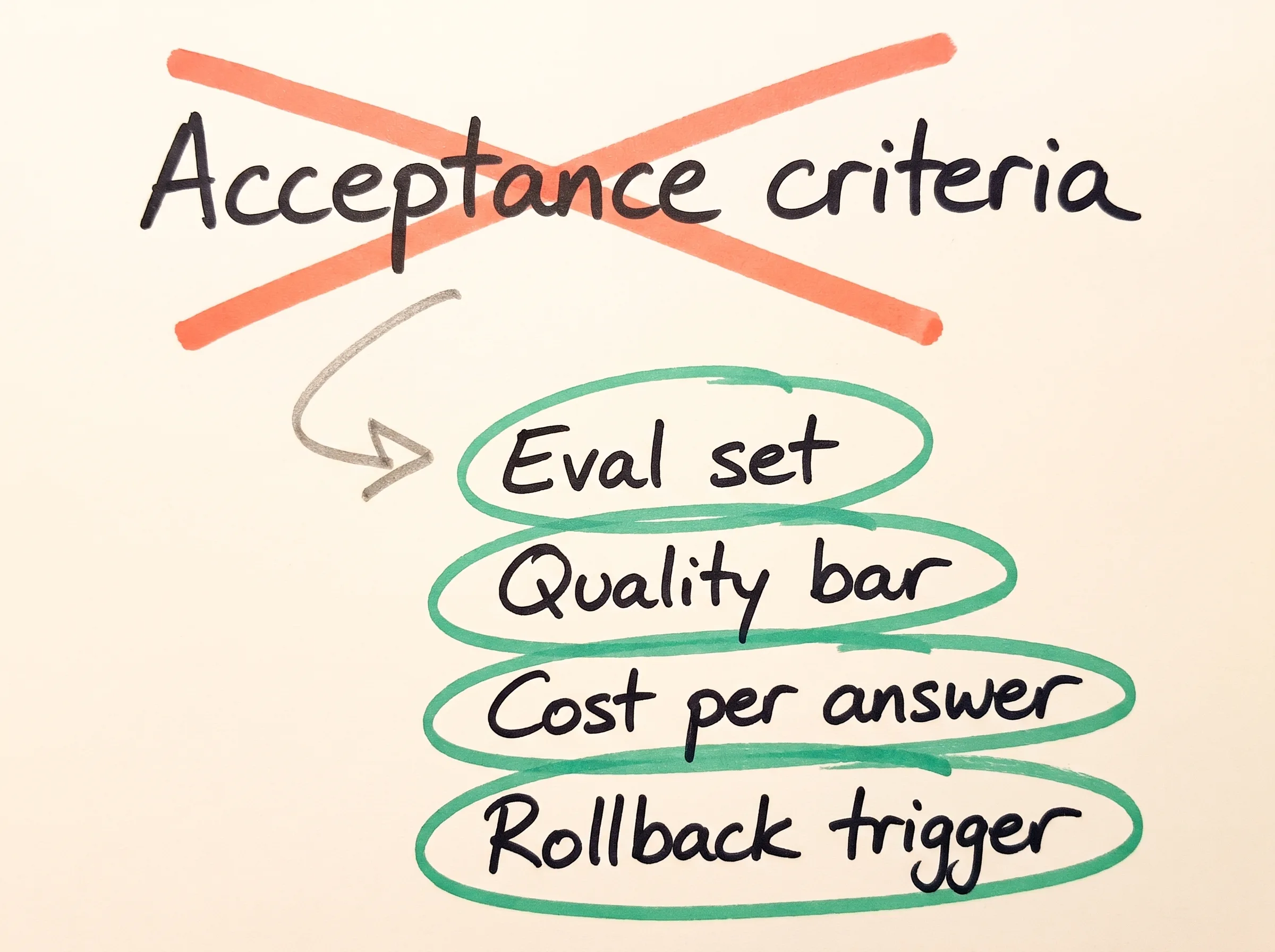
The AI PM should bring the right-hand column to the first sprint planning. Each row holds a question classic product work rarely had to answer in writing.
Where the job ads go quiet
This page draws on 15 AI product manager postings, each read in full on 24 October 2026: three model builders plus Cohere, Microsoft and Amazon, AI-first scale-ups like Fin, Deliveroo and Synthesia, two JPMorganChase roles and a healthcare data company. Seven were based in London or Paris.
Eight of the 15 make evaluation part of the work. Only two say the PM owns it: Cohere’s agent harness PM will “Own North’s agentic evaluation framework”, and Deliveroo’s GenAI platform PM will “Own the evaluation strategy so teams can prove quality before launch and keep improving it after.” JPMorganChase’s London role sets the evaluation standards. In the other five, evals appear as work to do, with the owner left blank. Some companies hand that work to the data science manager instead. Ownership decides who may change the test set when a launch is close and the score is short.
Three gaps stood out:
- The word “hallucination” appears in none of them. Employers write “quality”, “reliability”, “failure modes” and “drift” instead, which is fine, as long as someone turns those words into a number.
- The EU AI Act appears in none of them either, including all seven European roles. Only JPMorganChase’s London agentic AI lead names “model risk management”, and it’s the only posting of the 15 that writes down “autonomy boundaries, human-in-the-loop controls, and escalation paths”.
- Some AI titles carry no AI work. Notion’s AI Product Manager, Growth Marketing needs “Deep paid-growth subject matter expertise across platforms such as Meta, LinkedIn, and Google”. Amazon’s AI Principal Product Manager lists no AI or ML experience in either its basic or preferred qualifications, yet the PM will “maintain accountability for customer outcomes and product reliability” of systems applied scientists build.
The Notion role is a real job with a clear year-one target, moving the majority of paid spend onto the new system. It just won’t build eval or model credentials. A quick test for any AI PM seat: does it own an eval set, a model or prompt decision, and a cost line? With none of the three, it’s a growth or feature PM job with AI in the title, and should be priced and positioned that way.
Red lines to agree with engineering before launch
The company owns what its model says. When an Air Canada chatbot gave a passenger wrong refund advice, the airline argued the bot was “a separate legal entity that is responsible for its own actions”. The British Columbia tribunal called that argument remarkable, rejected it and ordered the airline to pay CA$812. Inside a company, that ownership tends to land on whoever owns the product. Agree these with your engineering and ML leads, in writing, before the first launch:
- An eval threshold per use case, and a named owner of the golden set. The set is versioned like code. Adding, removing or relabelling cases needs both the PM and the ML lead, so nobody passes a launch by editing the test.
- One person who can stop a launch and one who can approve it. OpenAI’s posting admits that “ownership and technical boundaries are still emerging”. Put the two names on the launch checklist, so an incident doesn’t decide them for you.
- A rollback trigger agreed in advance. For example: the regression suite drops by an agreed number of points, or a severity-1 incident happens, and the release rolls back without a meeting.
- A cost ceiling per request plus a monthly budget, and a fallback. A cheaper model, a cached answer or a hand-off to a human when the ceiling is hit. Gartner predicted in 2025 that over 40% of agentic AI projects will be cancelled by the end of 2027, “due to escalating costs, unclear business value or inadequate risk controls”. Agree the dashboard that shows it before launch.
- Autonomy limits and a human in the loop for any decision that affects a person. The JPMorganChase London posting is the model clause to copy.
- A data-use rule and a risk classification signed by Legal before build. Which customer data may go into prompts, evals and fine-tuning, and for how long. Under Article 99 of the AI Act, breaking most operator obligations can cost up to €15 million or 3% of worldwide turnover. The Digital Omnibus moved most high-risk deadlines to December 2027 and August 2028, per Orrick, while the Article 50(2) transparency duty for systems already on the market still lands on 2 December 2026. The PM routes the decision; Legal owns the reading of the law.
- One value metric with a baseline. Resolution rate, hours saved, revenue, retention. Figma’s AI growth PM is asked to “drive users to discover” its AI features, which is usage. Usage on its own shouldn’t pass a launch review.
Who should hire one, and when a strong PM is enough
In practice, a product that calls a model for one feature rarely needs a dedicated AI PM. A strong product manager who gets red lines 1, 3 and 4 signed can run it. The dedicated seat pays off when the product’s quality is the model’s quality: when you choose between models, own an eval set that research and product both answer to, or run agents that act on a customer’s behalf.

If you’re creating the seat, know that the function is often brand new. Fin’s Staff AI PM posting opens with “We’re building a new function at Fin: AI Product Management”, next to an existing team of ML scientists, engineers and researchers. Fin is now part of Salesforce and Deliveroo is now part of DoorDash, both per their own postings. New functions inside freshly acquired companies are easy for a reorg to redraw. Give the seat a written charter at offer stage, with the eval and cost budget and the value metric in it. A charter survives a reorg better than a roadmap slide.
Pay from the same 15 postings, all US base where published: $133,000 to $215,000 for a senior AI PM at JPMorganChase in New York, $179,900 to $243,400 for Amazon’s principal, $305,000 to $385,000 at Anthropic and $347,000 to $490,000 at OpenAI. Not one of the seven European postings published a number, so a London or Prague offer has no posted benchmark to lean on. For a rough anchor, levels.fyi puts the median US product manager at $231,000 total compensation, across all PMs.
The ladder visible in the postings runs to Group PM and Principal: Google DeepMind’s Group PM for frontier AI asks for 10 years building AI products. A path from AI PM to VP of Product or CPO is plausible, and none of the 15 postings shows one yet.
Most of the work above is a negotiation with engineering and research about who decides what, held before anything is on fire. That’s the part mentoring for product managers is built for. I’ve run 3,662 1:1 leadership sessions so far, and you only pay for a session you rate 8 out of 10 or higher.
Who an AI PM works with
- AI platform engineer: who runs the layer your model calls go through
- AI QA engineer: the person who turns your quality bar into evals
- AI program manager: when the launch spans legal, risk and five teams
- Head of AI: the seat that sets AI strategy and spend above you
- CTPO: one executive for product and technology