A director of AI is the manager accountable for a company’s AI work, one level below the VP or the C-suite. Depending on who’s hiring, the job is a research lead, a product engineering lead or an enterprise change lead.
Postings call it Director of AI, Director of Artificial Intelligence or Director, AI Engineering. People searching for an AI engineering director usually mean the second of the three versions. The title reads the same in all three ads. The boss, the budget and the number you’re judged on don’t.
Three versions of the seat
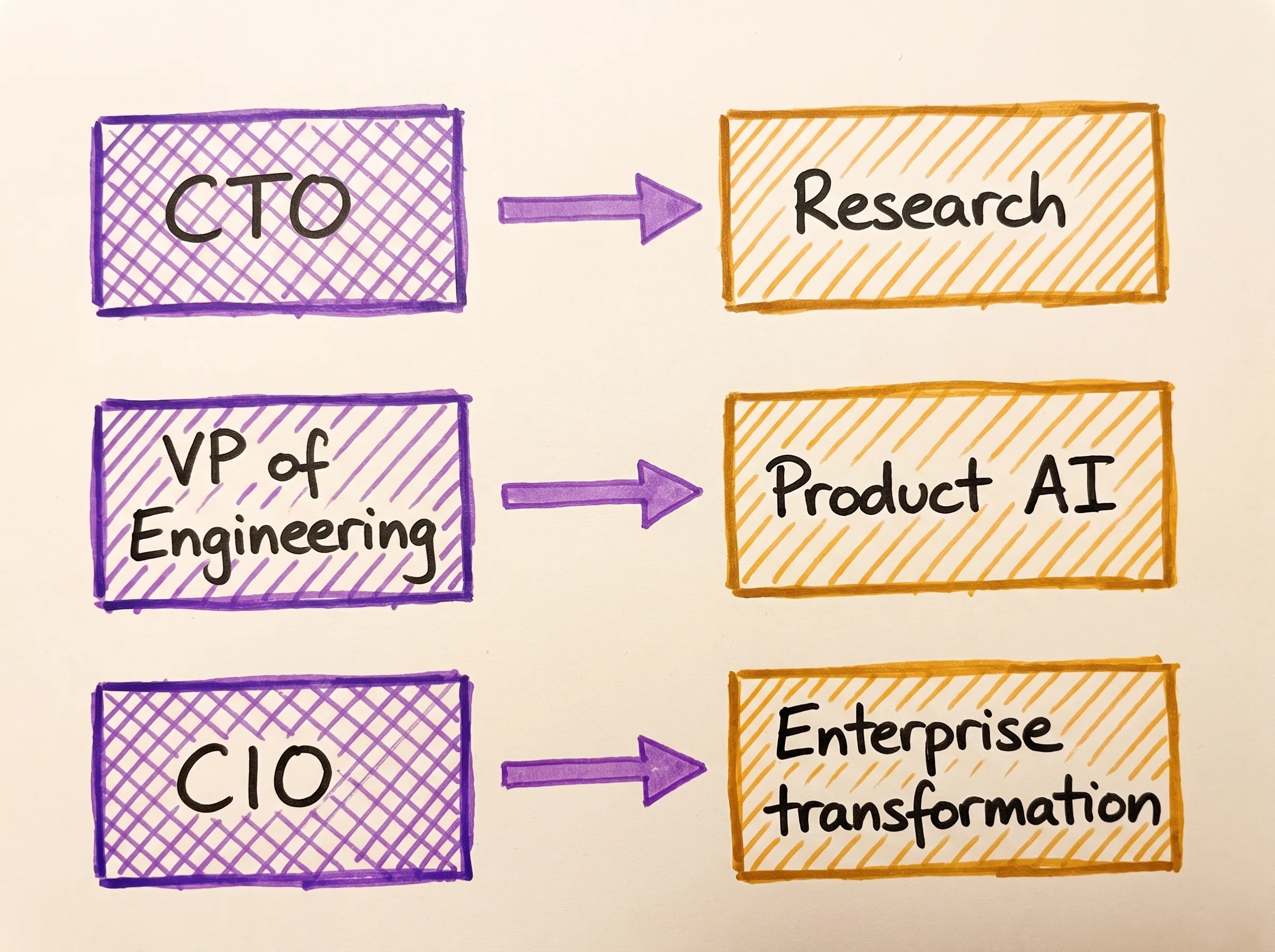
The research director. Writer’s Director, AI Research posting said the role “reports to the CTO”, asked for experience “guiding research teams of 5-10 scientists”, and expected the person to “transform research into tangible evaluation metrics and product features”. The work is models and evaluations. Expect this version at companies that train or fine-tune their own models.
The product AI director. This one ships AI features inside a product or platform organisation. iManage’s Director of AI Engineering posting was the clearest of the 17 ads reviewed for this page. It named the boss (the VP of AI Engineering), the team (“a 15 person team”), the decisions (“build/buy/partner decisions across the AI stack”) and the target (“ROI targets”). Lenovo’s Director, AI Engineering asks the person to “build and lead the Core Intelligence organization”, which tells you the organisation doesn’t exist yet, and lists the quality problems you’ll own: retrieval accuracy, hallucination, grounding, agent reliability.
The enterprise transformation director. This version sits in a company whose product isn’t AI and gets the whole company using it. Novanta’s AI Strategy Director role was “reporting to the CIO” and asked the person to “develop and own” the AI strategy and “oversee governance, compliance, and ethical considerations”. Forbes’s Director, Enterprise AI Operations leads adoption across editorial, audience and revenue teams and tracks “AI adoption, workflow efficiency, time savings, output quality, and business impact”.
The versions blur at the edges. Unum’s Director, AI/ML Transformation at an insurer trains models and writes the strategy. A director at a homebuilder with “AI Engineering” in the title can turn out to run corporate IT systems that are slowly getting AI added to them. The verbs in the responsibilities tell you which version you’re looking at.
Who does a director of AI report to?
A director of AI’s boss depends on which version of the seat the company is hiring for. In the postings that name a boss, research directors report to the CTO, product AI directors to a VP of Engineering or the CTO, and enterprise transformation directors to the CIO or Chief Data Officer.
| Research | Product AI | Enterprise transformation | |
|---|---|---|---|
| Boss named in the postings | CTO | VP of Engineering, VP of AI Engineering or CTO | CIO or Chief Data Officer |
| Budget it holds | Research headcount and compute; rarely written in the ad | Build, buy or partner calls on models and vendors; inference cost | Often shared: “supports” budget and vendor work owned elsewhere |
| How success is measured | Evaluation results, capabilities that reach the product | Quality in production, cost per request, ROI targets | Adoption, time saved, output quality, use cases with business impact |
| Words that give it away in the ad | research team, publications, PhD | hands-on, production, build and lead | enablement, literacy, governance, change management |
The table hides how thin most ads are. Of the 17 director-level AI postings reviewed for this page in October 2026, 4 named a reporting line, 1 gave a headcount and 3 mentioned budget ownership at all. Six of the seven engineering-track ads used the phrase “hands-on”. An ad that asks for hands-on building, company-wide strategy and governance in one seat is describing three roles and paying for one.
What the postings pay
Posted US base ranges, each from the employer’s own ad:
- AI strategy director at a precision components maker (enterprise): $160,400 to $256,600
- Enterprise AI operations director at a media company (enterprise): $180,000 to $195,000
- AI engineering director at a health insurer (product AI): $172,200 to $236,900
- AI engineering director at a legal software company (product AI): $200,000 to $290,000
- AI engineering director at a PC maker (product AI): $220,000 to $320,000
- AI engineering director at a bank (product AI): $244,700 remote, up to $335,100 in New York and the Bay Area
Salary.com puts the average AI engineering director salary at $228,214. Burtch Works gave $167,000 to $275,000 in its 2024 explainer, which is two years old now. In these ads, enablement and strategy seats start around $40,000 to $80,000 below engineering seats. If an offer called “director” lands at $160,000 to $200,000 with no reports, you’re probably looking at a senior manager seat with a director title.
The European clock on the enterprise version
In the EU, the enterprise version comes with a legal calendar. The AI Act’s prohibitions and its AI literacy duty have applied since 2 February 2025, and the obligations for general-purpose AI models since 2 August 2025, per the European Commission. The digital omnibus that entered into force on 27 July 2026 pushed the high-risk obligations for stand-alone systems to 2 December 2027, and for AI built into regulated products to 2 August 2028.
The delay moves the deadline and leaves the preparation work exactly as large. Someone has to know which AI systems the company runs, which of them could count as high-risk, what the vendors behind them promise, and how staff were trained. If the job description says “oversee governance”, that someone is probably you, and the question is whether legal and risk are on the hook with you.
Negotiation checklist before you accept
Gartner predicted that at least 30% of generative AI projects would be abandoned after proof of concept by the end of 2025, citing poor data quality, weak risk controls, rising costs and unclear business value. The director of AI is the obvious person to blame for that. The terms below decide whether the blame lands on you.
- The version, named out loud. Get the hiring manager to say whether you’re hired for research, product AI or company-wide adoption, and agree on paper how your time splits between building and leading.
- A reporting line to whoever owns the outcome. If the result you’re judged on belongs to the COO, reporting three levels down inside IT will hurt.
- A budget number for next year. Ask for the figure and for sign-off on AI vendor spend. “We’ll find budget per use case” means the seat is advisory, so price it that way.
- Headcount on day one and at month twelve. Named people or a written capacity allocation from engineering. “Partner with the data team” is a request, and it won’t hold up as a team.
- The first-year metric, written into the offer. Stage it: data readiness and adoption or evaluation quality first, cost savings or revenue later.
- A kill-or-keep review of every pilot you inherit, plus the authority to stop one. Otherwise last year’s failed pilots become your first-year record.
- Named co-owners for governance. Legal, data protection and security sign with you, and the job description says where your role advises and where it approves.
- What happens if the role gets merged or renamed. Severance terms, and the title you’d fall back to.

If the seat you’re weighing reports to the CEO or the board, and governance and the AI budget land on you, that’s the work in Chief AI Officer coaching. If it sits inside engineering and you’ll be fighting roadmap battles with the CTO, the Head of AI mentoring page describes how I work with people in that position. Bring the job description and the offer to the first session.