
A principal engineer is a senior individual contributor who sets technical direction across an organisation, with nobody reporting to them. They make the trade-offs between product areas that no single team can make. The work is architecture, multi-year bets and growing the staff engineers below, done mostly through writing, reviews and trust.
On a full ladder it’s the third rung of what Will Larson calls Staff-plus: staff, then principal, then distinguished. It’s rare. When Uber had about 2,000 engineers in 2020, two of them were principal level, roughly 0.1%, against 2.5 to 3% at staff (Pragmatic Engineer).
The ladder, rung by rung
| Rung | Scope | Clock | The decision it owns | Who feels a bad call |
|---|---|---|---|---|
| Senior | One team’s hardest problems | A sprint to a quarter | How to build it | The team, quickly |
| Staff | Several teams in one product area or domain | Quarters | The best option inside that area | Those teams, for a few quarters |
| Principal | An organisation, across product areas | A year or more | Which area takes the cost of a trade-off | The org, and the director who backed it |
| Distinguished | The company, sometimes the wider industry | Years | Which bets the company makes at all | The company |
The rows follow the published ladders. Dropbox puts its principal (IC6) on “org/company-wide multi-year, multi-team goals”, “partnering closely with Directors/senior EPD leadership”, while its staff level owns multi-team strategy for one product or platform. GitLab describes distinguished as the IC equivalent of a director and fellow as the equivalent of a VP.
In practice, the clock column is the softest one. GitLab’s career matrix asks principals to plan “with a 6 month view”, Dropbox says multi-year. Both ladders are public, so read the column as a direction of travel.

Principal engineer vs staff engineer: what changes?
A principal engineer decides which product area pays for a trade-off, while a staff engineer usually optimises inside one area. On most published ladders principal sits one rung above staff, and its decisions run on a clock of a year or more, against quarters for staff.
The staff engineer guide covers what staff owns. The move to principal changes the kind of decision more than the size of it. A staff engineer usually finds the best answer inside one area. A principal decides which area pays: the platform team that loses a quarter so three product teams can ship, the migration that gets funded while another waits a year. Those calls hurt somebody, and the principal has to explain them to directors who weren’t in the design review.
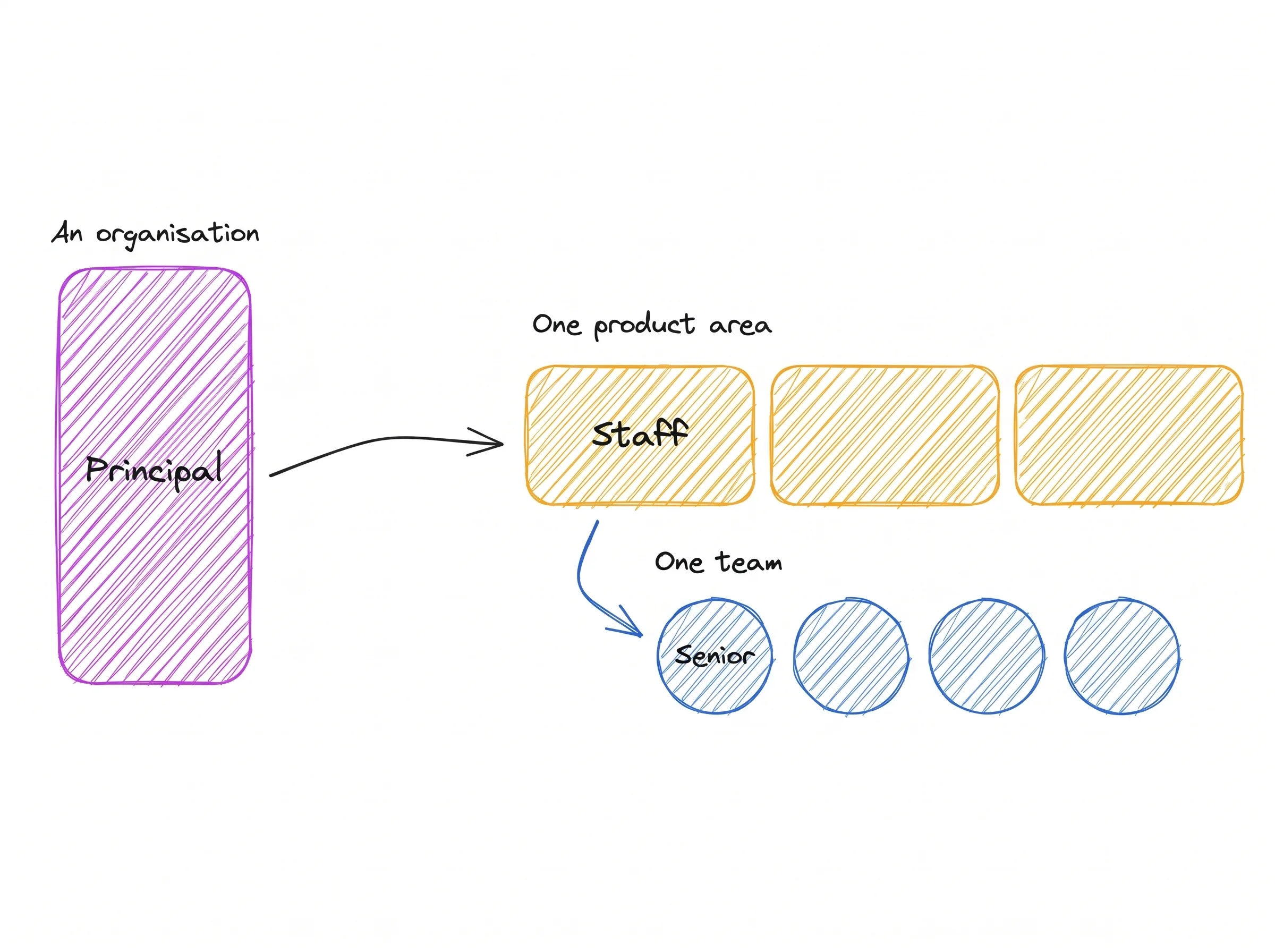
Larson’s four archetypes help here, as long as you treat them as shapes and not levels, which he says himself in a 2021 mailbag post. He ties the Tech Lead to roughly one per eight engineers, the Architect to organisations of around 100 engineers, and the Right Hand, who borrows an executive’s scope and authority, to around 1,000. The Solver goes wherever the hardest problem is. At principal scope the Architect and Right Hand shapes are the common ones, because those are the shapes that only exist in bigger orgs.
What principals get hired for, going by the postings behind this page: cross-team architecture that no single team owns (GitLab), build-versus-buy and multi-year bets (Weave), legacy migrations (Twilio) and growing staff and senior engineers (Olo, Belfast). Alex Ewerlöf names the risk on the other side: a principal who stops talking to the teams becomes “ivory tower and irrelevant” (his 2024 piece).
Why the same title means three different levels
“Principal” is the least portable title on the IC track. At Amazon, principal is L7, the level right after senior, because there is no staff rung. Levels.fyi shows an average L7 total compensation of $641,534, most of it in stock. Microsoft’s principal spans levels 65 to 67, which one comparison maps to Google’s staff level; Microsoft publishes no official map, so treat that as approximate.
Going down the scale, Oracle’s Prague posting for a principal engineer in its cloud media services team sits at career level IC4 and asks for six years of experience. At Capital One, “Principal Associate” is the senior software engineer band. Twilio prints the level in the title: “Principal Engineer (P5)” in the US, and the same job family appears as L5 in its India posting. If the posting carries a code, ask what band the code maps to. The code is the honest part.
In Czechia the title is rare. On 9 October 2026, Productboard, Mews, Kiwi.com, Rohlik and GoodData had no principal software role open, and Productboard’s highest IC openings were staff. The principal postings in Prague come mostly from global companies: Microsoft’s GitHub Actions role is listed at CZK 1,983,000 to 3,553,000 base a year (posting copy), labelled IC5. For a Western European anchor, Elastic posts €104,800 to €165,700 base for a principal AI engineer in Ireland.
Questions to ask before you accept the title
- Which internal level is this, and what sits above it? If the answer is IC4 or a band shared with senior engineers elsewhere, you’re negotiating a senior offer with a better word on it.
- How many principals are there per 100 engineers? Uber’s ratio was 0.1%. A company with ten principals among 200 engineers is using the title for something else.
- Who do I report to? Weave’s posting asks for company-level strategy and a multi-year vision, with the role reporting to a director of engineering. Company-wide scope with a director as your manager is a mismatch worth naming before you sign.
- Tell me about a decision the last principal made that a manager disagreed with. Who broke the tie? GitLab and Twilio both list influence “without direct authority” as a requirement. You want to know if it ever wins.
- How much of the last person’s week went to coding? Dropbox wants a “company level technical strategist” who also stays “deeply hands on”. That’s a strategy role and a delivery role in one seat, and delivery usually wins the week.
- Am I on an on-call rotation? GitLab, Cloudflare, Microsoft and Olo put principals on incident rotations. GitLab’s handbook mentions “weekday and weekend and occasional night” shifts.
- Which roadmap item fails if this role disappears? Senior ICs are expensive. Calcalist reported in September 2026 that Oracle’s cuts hit principal core infrastructure engineers harder than most roles. That’s one company only, so read it as a warning sign. A role tied to a named roadmap item is easier to defend than a role tied to “strategy”.

Around half the staff-track engineers I work with end up changing companies, often because the path above them exists only on a slide. Moving for the level is a reasonable call. If you’re sizing up a principal offer or arguing your own case for the level, Staff+ mentoring is where we work through it, starting with a free intro call.