
Impostor syndrome affects between 9% and 82% of people, depending on which questionnaire you hand them. That number comes from a review of 66 studies and 14,161 participants, and it is the most honest thing published on the subject.
A range that wide is not a finding. It is an admission that we are measuring a feeling and calling it a condition.
Let’s call him Stan. He had just come out of a good one-to-one with his CTO. Reviews fine, team happy, his function delivering in every market it covers. Then he sat in the next leadership meeting, listened to the other directors talk, and concluded quietly that he was not one of them.
He had told nobody. He told me in the first ten minutes of a free intro call, which is roughly when people tell me.
Almost every article ranking for his problem would tell Stan his brain is lying to him. I think his brain was reading the room correctly and drawing the wrong conclusion from what it read.
Stan was not failing, which is the part everyone skips
Go and search what he searched. The top practitioner result is titled “Managing Impostor Syndrome as a New Engineering Manager”. Below it: Reddit threads from first-time EMs, two Quora questions from an engineering intern, and a Stanford page written for students.
The whole corpus is addressed to someone in month three. Stan is in year three, he is good at the job, and his boss has told him so in writing.
There is a second thing they agree on. One of the ranking posts opens by explaining why your brain is lying to you. That is the majority position, and for the anxious new manager it is often correct and kind.
For Stan it is the worst advice available. It deletes the signal and leaves the cause running.
The feeling was accurate. It was pointing at the wrong thing
That range up top does not prove anything about what causes the feeling. It only means the label is too loose to plan a career around. What follows is not from the literature. It is one conversation and a test you can run on yourself this week.
Stan was not misjudging his competence. He was correctly noticing that nobody in that room could have described what he had done.
That is an information problem wearing a psychology costume. And you cannot reframe your way out of an information problem, which is why the reframing had not worked for two years.
Here is the test, and it takes a week. Ask three people senior to you to describe what your team shipped last quarter. If they can, and you still feel like a fraud, you have a confidence problem and this post is not for you.
If they cannot, it was never about confidence.
There is a third answer and it is the one nobody wants. Sometimes they cannot describe your work and you are also not ready for the seat you want. Both at once is common. You find out which by fixing the visibility first: if the rooms open and you then struggle inside them, the gap was real. That is a better problem than the one you started with, because it is finally specific.
Your boss cannot be your mentor, and it is not his fault
Stan already had mentoring. His CTO gave him an hour a month, he liked the man, and he said so warmly.
Keep that. Add to it. But understand what it is.
The person mentoring you also decides your promotion, your compensation and your next role. That creates a set of questions you cannot put to him, and they happen to be the useful ones. Anything about him. Anything that begins “I am thinking of leaving.” Anything where the honest answer makes you look less finished than you would like to look at review time.
The second problem is arithmetic. An hour a month, when the calendar allows, is roughly the interval at which behaviour does not change. You get advice and then you get four weeks alone with your existing habits.
None of this is a criticism of his CTO. It is a criticism of expecting one person to be both your judge and your confessor.
Discount this paragraph, by the way. The man telling you your free mentor is structurally compromised sells paid mentoring. Weigh it accordingly, then go and check whether it is true.
Invisible work is unpaid work, and here is the arithmetic
At Stan’s level, visibility stops being vanity and starts being the mechanism. The people who hand out roles cannot hand you one for work they cannot describe.
My estimate, from 3,611 mentoring sessions rather than from a dataset: a leader with no visibility leaves 30 to 40,000 crowns a month on the table. I want to be exact about what that is. It is a number I would defend in a room and would not publish as research.
What buys it back is boring. Being in the room where a decision gets made. Having a story people repeat when you are not there. Speaking somewhere that is not your own all-hands.
There is a second-order effect Stan had not considered once. Visible people pull other people in, and whoever is hiring you is counting on it. He reads two things off your visibility: you can convince a room, and other engineers will follow you into one. Both are worth money to him, which means both are worth money to you.
He was not asking to get better at his job. He was asking to be seen doing it.

The four things Stan asked for
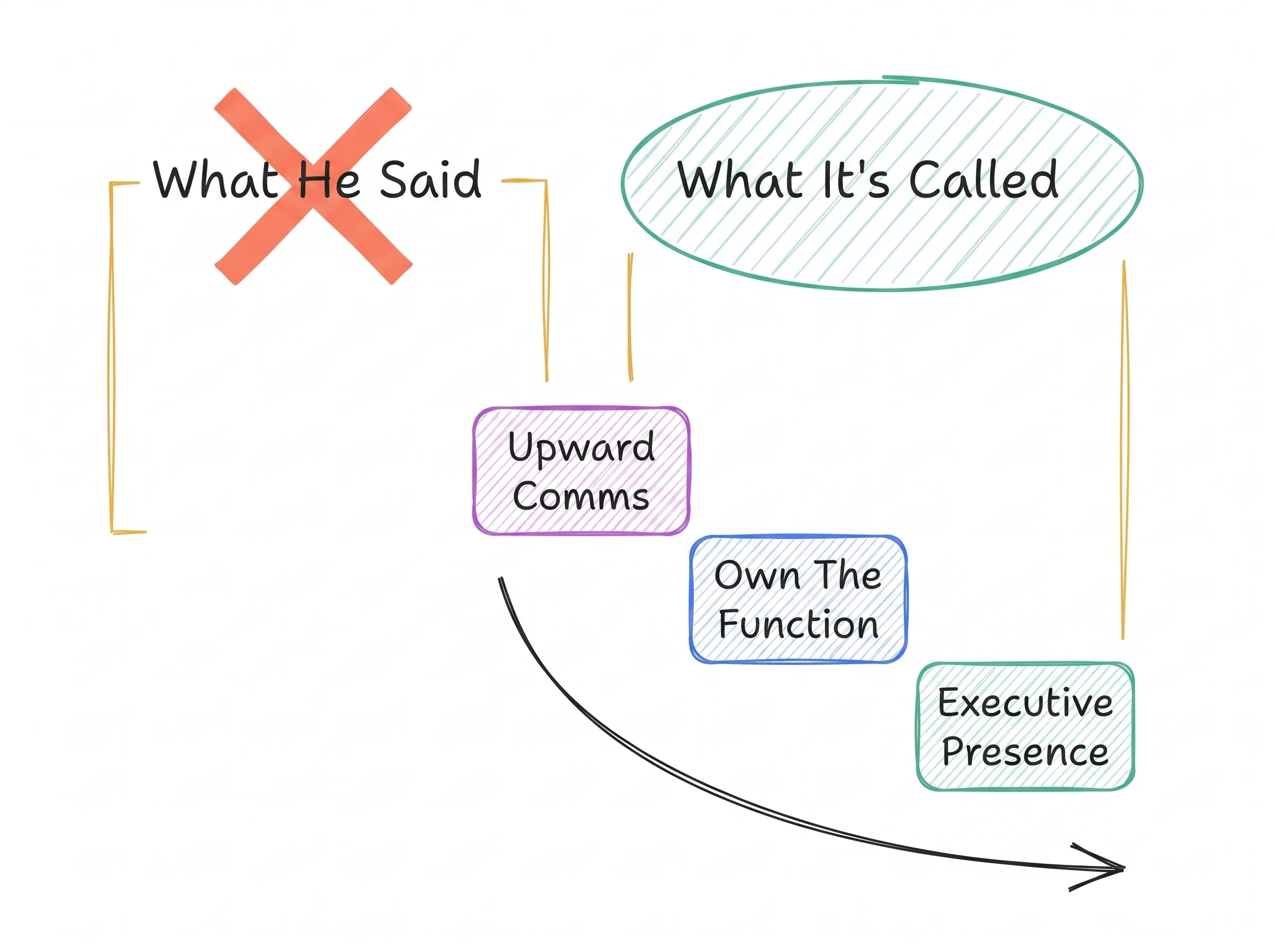
He arrived with four asks. He thought they were four problems. They are one problem with four surfaces.
| What Stan said | What it is called | Where it shows up |
|---|---|---|
| ”First, sell our achievements” | Upward communication | Few people senior can describe your last quarter |
| ”Be strategic enough to always sit at the table” | Owning a function, not a team | You hear decisions instead of making them |
| ”Presentation skills” | Executive presence | Competent in the room, forgettable outside it |
| ”I want to unlock my X factor” | The one with no technique behind it | It arrives once the other three are fixed |
The fourth is the one he led with and the only one that is not a skill. In my experience it is what people call the other three before they have names for them.
This is the shape most of these conversations take, which is why the free intro call is thirty minutes and not a form. Six situations come up over and over; his is the first one on that page.
The thing you are paying for is that I do not accept your excuses
Everything I have written above is free. It has been free for a decade. Stan could have read it on a Tuesday and changed nothing, which is what he had been doing.
What is scarce is not advice. A mentor keeps people accountable, and I accept no excuses why they have not progressed.
That shows up as a small piece of homework at the end of every session. Talk to this person. Put that proposal in front of that one. Build this presentation. Small on purpose, because you still have a day job and I am not going to put it at risk.
It is also the filter. I am interested in people who do things between sessions rather than people who enjoy talking about them. Sessions two through four are where that becomes obvious to both of us.
I am not an esoteric coach telling you that you are great and you deserve it. Any session you rate under 7 out of 10, you do not pay for. That keeps the pressure on my side of the table, which is where I would rather have it.
I had this exact problem and it cost me years
Twenty years ago I got promoted to an EM role and it was purely sink or swim. My manager had no time for me. No feedback. Hard school times.
I got things wrong that I now watch other people get wrong. For example, I thought the best strategy is to be friend with everyone, which is false. It doesn’t create the performing env.
The one that cost most was the same one Stan came in with. Being technical only, and talking tech language in US-based companies, buried me down. I had to learn how to talk business and money.
Nobody told me that was the gap. I thought I was behind on ability, so I studied more technology, which is the most comfortable wrong answer available to an engineer.
And there is a clock on this, which is the part I say out loud to men in their thirties and which nobody enjoys hearing. After thirty five, something happens. Which is all in sudden, every fucking year counts.
Stan starts in September. The first session is a diagnostic and it is deliberately uncomfortable, because the alternative is two more years of good reviews and the same feeling.
I do not know yet whether any of it works for him. I will in three months. If it does not, this post gets a dated note at the bottom saying so, rather than a quiet edit.
If you recognised yourself somewhere above, that is a mentoring conversation, and the first one is free.