A technical program manager (TPM) is the person accountable for landing a technical program that spans several teams. They own the order of the work, the dependencies between teams, the risks, and the date. Most TPMs do this without a single engineer reporting to them.
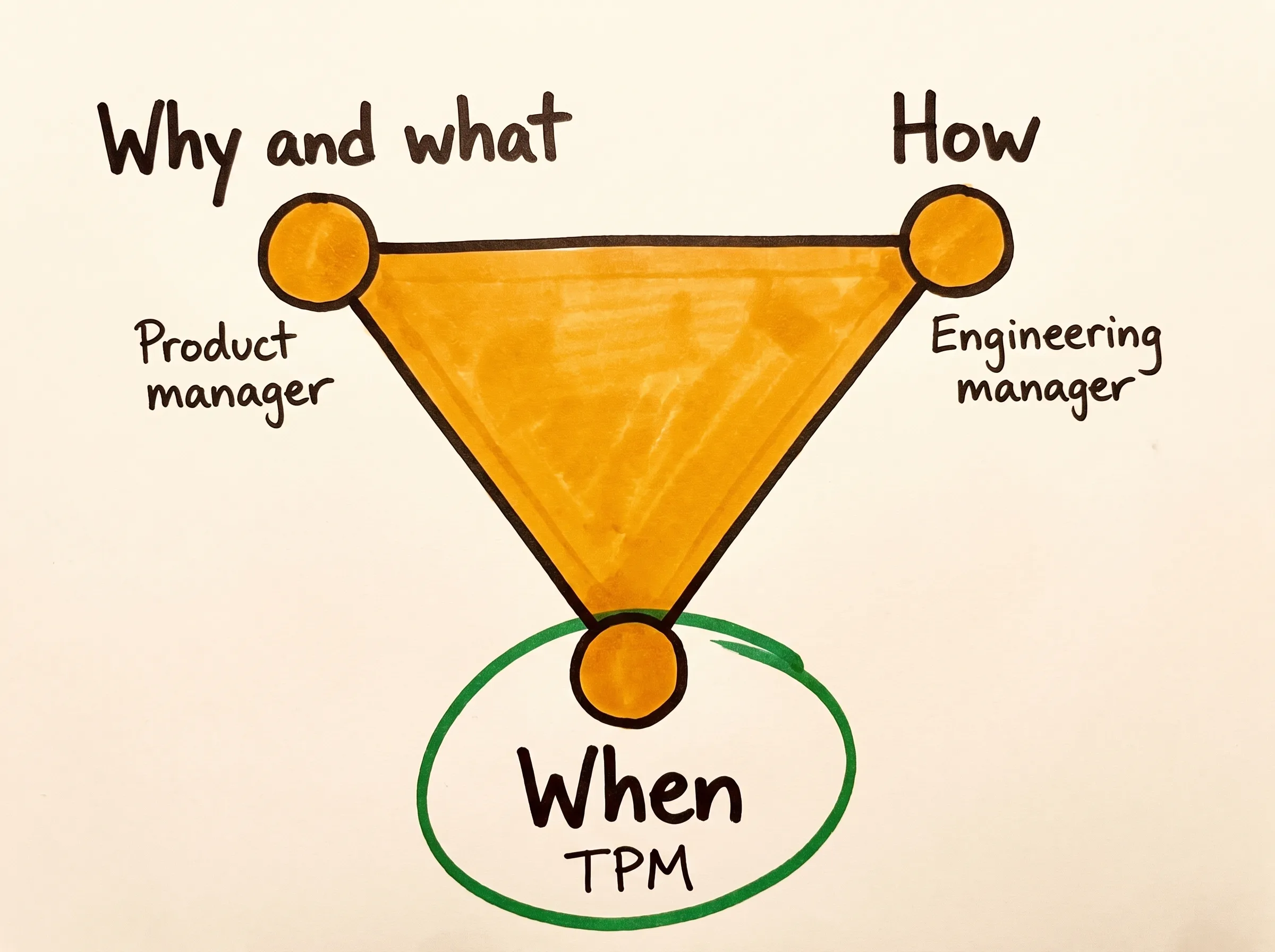
The quickest way to place the role is by the question each person owns. In the split that The Pragmatic Engineer collected from working TPMs, the product manager owns why and what, the engineering manager and the engineers own how, and the TPM owns when, plus who has to do what, in which order, across teams that don’t share a manager.
One team building one thing rarely needs a TPM. Six teams shipping one launch usually do.
TPM vs product manager vs engineering manager vs project manager
The four titles get mixed up in job ads constantly, so here they are side by side. The columns come from the Pragmatic Engineer split above, checked against fifteen live TPM postings read on 9 October 2026.
| Technical program manager | Product manager | Engineering manager | Project manager | |
|---|---|---|---|---|
| Question they answer | When, in what order, across which teams | Why build it, and what | How it gets built, and by whom in the team | Is this one project on scope, time and budget |
| Unit of work | A program: several teams, several projects | A product or feature area | One team, sometimes two or three | One project |
| People reporting to them | Usually none | Usually none | The engineers | Usually none |
| Decides | Sequencing, cadence, when to escalate | Problem priority, roadmap | Staffing, technical execution, performance | Changes inside the project plan |
| Does not decide | Product scope, technical design, who sits on a team | How it’s built | What the business needs | Anything outside the project |
| Typical artifacts | Integrated plan, dependency map, RAID log, exec status | PRD, roadmap, success metrics | Hiring plan, 1:1s, technical plan | Project plan, Gantt chart, status report |
| When a date slips | Sees it first and brings options | Cuts or re-scopes | Re-plans or re-staffs | Reports the variance |
| Technical depth expected | Enough to challenge an estimate | Varies widely | High | Low to moderate |
The TPM column holds no people and no product calls. A JetBrains posting for a Senior TPM says so outright: partner with product, engineering and quality “without taking over their decision-making authority”. Microsoft files its Principal TPM at level IC5, an individual-contributor level, even at principal seniority.
The project manager column is where most confusion sits. A project manager runs one project against a plan. A TPM runs a portfolio of projects whose plans depend on each other, and is expected to be technical enough to “sanity-check feasibility claims”, as the same JetBrains posting puts it. Program manager and TPM do the same coordination job; the T means you can follow the engineers into the design document without a translator.
Why a company opens the role
A TPM vacancy is usually a description of something that already hurts.
Anthropic’s API Platform posting describes work that “spans many teams and many simultaneous programs, with no single person focused on cohesion across them”. The JetBrains one gives the 2026 reason: “AI is increasing both the pace of change and the coordination load”. Adyen wants someone to catch “dependencies that individual product teams might overlook” before a hardware launch. Mercury hands one Senior TPM a plan across Engineering, Product, Risk, Compliance, Treasury and Operations.
So the role exists for four recurring problems: work that crosses team lines with no owner, decisions without a known owner, dependencies found a week before the date, and leadership that can’t get one honest status view. If the hiring manager can’t name which of the four is burning right now, the role is probably a coordinator seat with a nicer title.
Influence without authority, and who carries the blame
Google writes the core tension into its own TPM III posting: “influence without authority, all while maintaining schedule velocity.” The velocity is yours to deliver. The people producing it report to someone else.
Reddit’s Staff TPM posting is the most honest one in the set: “while the roles generally don’t involve direct management, they are a part of the organizational leadership.” Leadership expectations, no reports. Mercury adds “real accountability for outcomes” and influence on executives “without a senior manager to translate”. Adyen asks the TPM to own launch readiness “to hit the launch date”. Read together, the pattern is accountability for a date whose inputs sit in other people’s teams.
Three things follow from that, and each has a defence.
The blame lands on the visible name. When a launch slips, the post-mortem looks for the person who owned the date. The defence is a dated record: a RAID log and escalation notes that show the risk was raised, to whom, and when. In practice, that record decides whether the review reads “TPM missed it” or “the org chose to accept it”.
The coordination layer is the first thing a reorg cuts. In January 2024 Instagram cut 60 technical program manager positions and told the people affected to re-interview for product manager roles. Weeks later at Messenger, TPM responsibilities were absorbed by product managers. A TPM whose output is status decks is easy to remove; one whose name sits on a shipped outcome is harder to.
The work disappears at promotion time. In Tanya Reilly’s essay Being Glue, an engineer who did the coordination work for her team is told at promotion time that she “didn’t really have a technical contribution”. Adyen’s posting calls its TPM “the glue” in so many words. Write the outcome next to every program you land (shipped, by when, what it unblocked) and ask who writes your review before you accept.

Seven questions for the hiring manager
These come straight from the gaps in the postings. Ask them in the hiring-manager round, as opposed to the recruiter call, because the recruiter usually doesn’t know.
- When two teams in this program disagree on priority, who decides, and how long did the last one take? A vague answer means you’ll be the one absorbing the delay.
- Who’s the executive sponsor, and when did they last overrule a team because a TPM escalated? If nobody remembers it happening, escalation is decorative.
- Can I see the list of programs the current TPMs carry? Look for budget, business reviews or vendor contracts mixed in. A Prague posting from Everpure put CapEx tracking into the TPM’s scope; an Amazon one added the org’s weekly-to-quarterly business reviews.
- Tell me about the last launch that slipped. What did the post-mortem say about the TPM? This is your blame-exposure test.
- How many TPMs do you have per engineer, and how long has the function existed? A central program office with its own leader (Reddit, GitLab and JetBrains all have one) survives reorgs better than a lone TPM.
- Who writes my performance review, and what was in the last Staff TPM promotion packet? If the answer is “the EM you support”, ask how they’ll see your work.
- What internal level is this offer? Reddit’s posting “may span more than one career level”, and Anthropic ties years of experience to “the internal job level”. The level is set at offer time, so negotiate it there.
How much does a technical program manager make?
Technical program manager pay in the US runs from about $149,000 to $435,000 base in published postings, depending on level and employer. Google’s TPM III lists $163,000 to $236,000 base plus a 15% bonus target, and Anthropic’s API Platform TPM tops the set at $290,000 to $435,000.
US postings publish ranges, so the numbers are easy to check. Amazon’s Senior TPM in Seattle lists $148,700 to $201,200 before sign-on and stock. Self-reported total compensation on Levels.fyi puts the US median at $244,000 across 1,502 submissions.
Europe is opaque. None of the four European postings behind this page (Monzo in London, Adyen in Amsterdam, Everpure in Prague, and JetBrains across its EU offices) published a number. Levels.fyi medians give a rough anchor: £109,179 in the UK, €101,145 in Germany and CZK 1,424,690 in the Czech Republic, the last from only 17 submissions. Ask for the band in the first recruiter call; it saves both sides a month.
The ladder has two branches. The individual-contributor branch goes Senior, Staff, Senior Staff, Principal, and all four titles appear in live postings this month. The management branch runs to Director of Technical Program Management: Datadog’s director posting leads “a team of senior Technical Program Managers” and measures success “by the business outcomes we drive, not the projects we complete”. Moves sideways into product management happen, though the Instagram case shows they’re sometimes forced. The jump into engineering management, or on to VP of Engineering as some explainers promise, is harder to evidence: none of the fifteen postings treated TPM experience as a route there.
If you’re holding a TPM offer next to an EM or product offer and can’t tell which one grows your career, that’s the kind of decision engineering career coaching is for. Bring the job description and run the seven questions above against it with me. I’ve run 3,662 1:1 leadership sessions with 317 leaders since 2019, and the 30-minute intro is free.