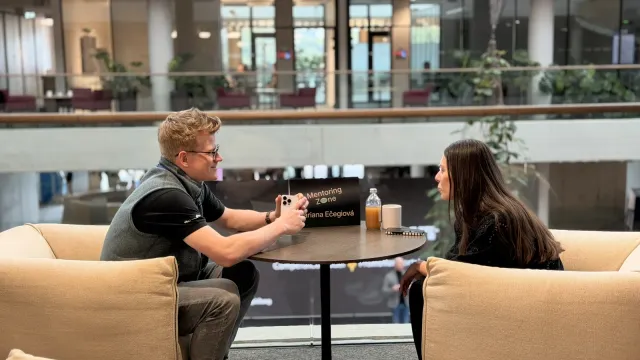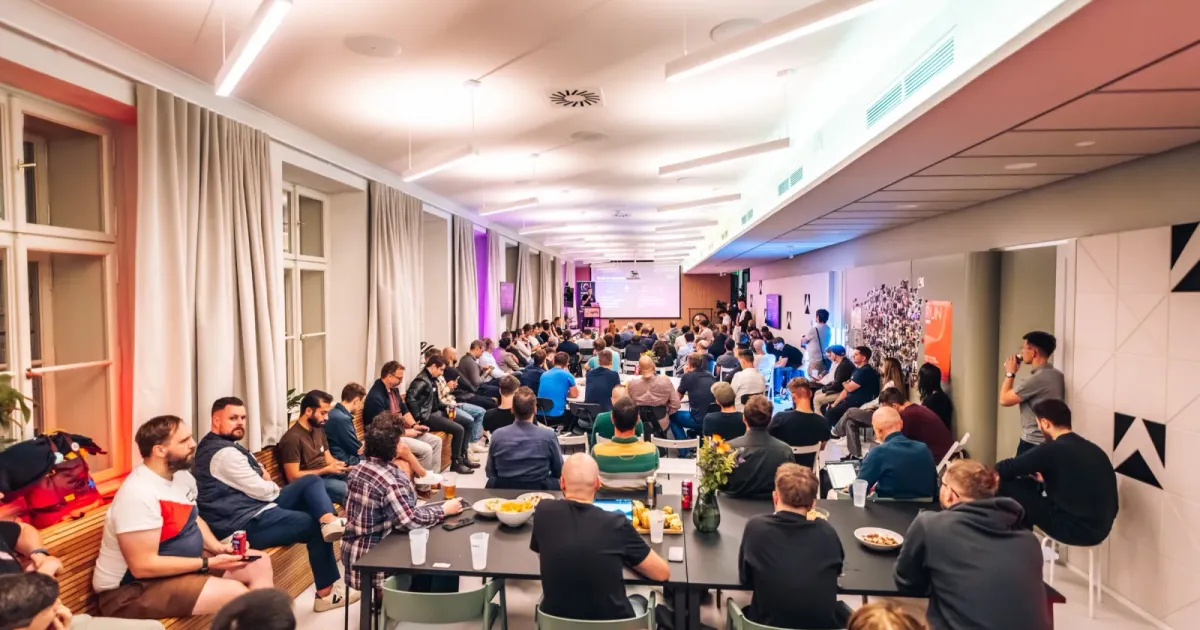
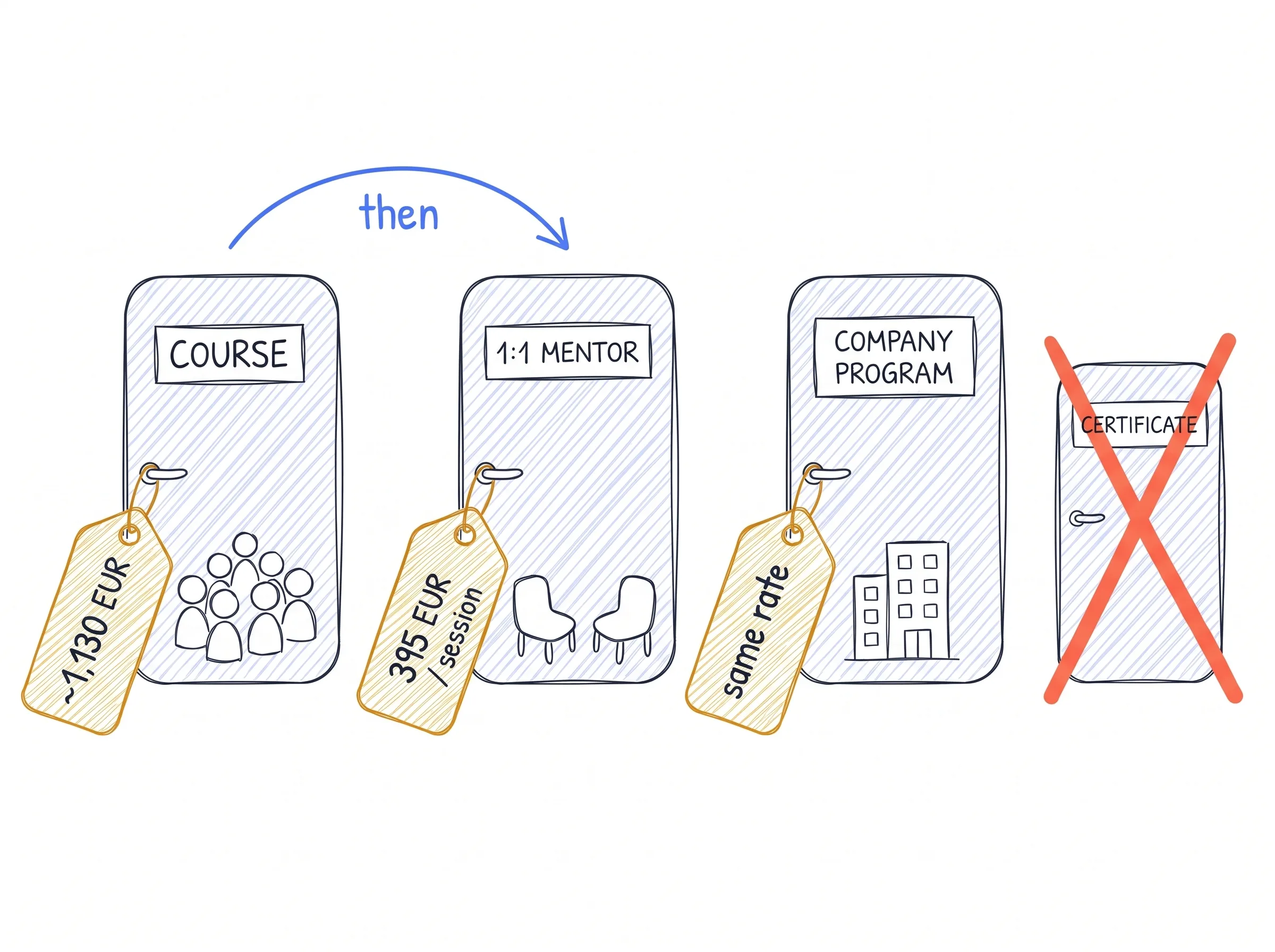
An engineering manager course puts you in a room with 10 to 30 other new managers and walks the group through a curriculum on a fixed date. A mentor sits with you alone and works on the problem you brought this week. The third door, the one 81% of my mentees walk through, is the company paying for either.
Which one to buy comes down to one question: do you need people, or do you need an answer?
I sell two of the three. I teach the First-Time Engineering Manager course at ELC Academy and I mentor engineering managers 1:1, so read what follows as a seller’s view with the prices left in.
Three doors, priced
| Cohort course | 1:1 mentor | Company-paid program | |
|---|---|---|---|
| Format | 2 days on-site, max 12 people, 3 monthly 1:1 callbacks after | 60-minute sessions every two weeks, your agenda | The same 1:1 sessions, paid from the L&D budget |
| Price, excl. VAT | 27,560 CZK per seat, about 1,130 EUR | 395 EUR per session, or 1,975 EUR for a quarter of 6 (5 paid + 1 free) | Same public rate, one purchase order |
| Time to a result | Two days, then 90 days of follow-up | A plan after session one | Same as 1:1, plus the approval loop |
| You leave with | A map of the job, 11 other managers, a talk slot | Your own problem solved, a KPI you set | A manager who reports your progress upward |
| Where it’s weak | Your specific problem gets 10 minutes | No peers, no room | Needs a budget owner who says yes |
The course column is the First-Time Engineering Manager course at ELC Academy, the one I teach; price and inclusions are quoted from its page in October 2026, and the euro figure is the CNB rate of 24 October. The mentor column is my own pricing for engineering manager coaching. The company column is the engineering leadership program: the same 1:1 work, with the invoice going to your employer.
When the course wins
A cohort gives you something no mentor can: a room of ambitious people at the same point in their career as you. Twelve engineering managers promoted in the last year, in one room for two days, arguing about the same problems. That is what the seat buys. The modules are the excuse, the people are the product. Six months later, when you have to let someone go for the first time, you’ll message one of them before you message me.
The course also wins when you don’t yet know what you don’t know. An EM in month two doesn’t need a sparring partner, they need the map: what a 1:1 is for, how a performance review is written, what to do with the engineer who was your peer until Friday. A curriculum covers the map in two days. A mentor would get you there in six sessions, at 395 EUR each, which is a bad use of both your money and the mentor.
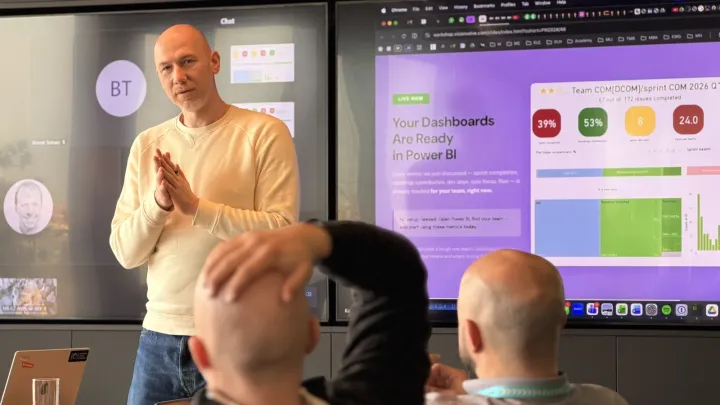
What a seat at the ELC course includes, from the course page: 2 × 7 hours in 11 modules, a maximum of 12 people, three 1:1 callbacks over the following three months, a lightning-talk slot at an ELC meetup within 90 days with video and photo, and a written evidence pack that helps your manager to see the progress at your next review. If the group’s average score at the end is under 8 out of 10, every seat is refunded. The predecessor course scored 9.3 out of 10 from 21 reviews; this version has no public dates yet. I wrote up how I built these courses and why there is no certificate, and the older course page is still up.
When the mentor wins
A mentor wins when the problem is yours and it’s live. Your senior engineer told you yesterday he’s interviewing elsewhere. The CTO wants a reorg plan by Friday. The review for your underperformer is on Monday and you haven’t written one before. That can’t wait for a cohort date, and it doesn’t belong in a room with 11 people from other companies.
It also wins on scope. A course has one level; the first-time EM course is built for people in their first 12 months. If you’ve managed for three years and the problem is managing managers, or getting a director to hear you, you’ve outgrown the curriculum, and what you need is someone who has sat in the next chair. That is what engineering manager mentoring is for.
In practice, a quarter runs like this: session one is a diagnostic, your top three goals and two KPIs you’ll be measured on. Then every two weeks, whatever is on fire that week, worked against those goals. Session three is a checkpoint, session six scores you against your own definition of success. 1,975 EUR for the six, 5 paid and 1 free, and a session you rate under 8 out of 10 is free. Mentees rate every session from 0 to 10 right after it; since 2024 the average is 9.79/10.
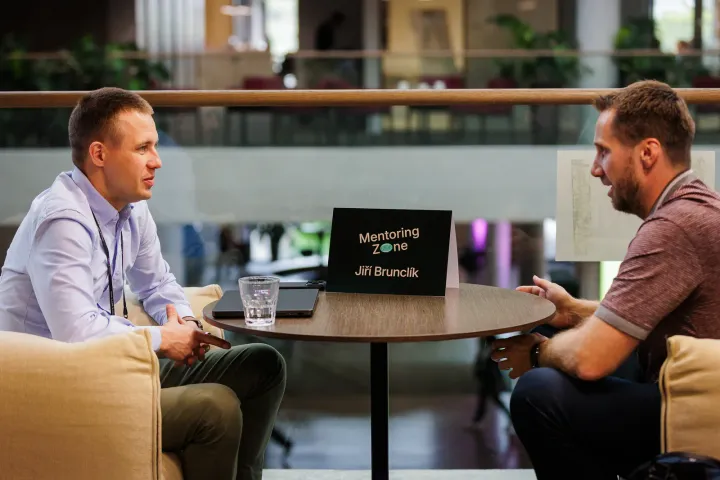
Course first, boost later
One of my mentees did it in the order I’d recommend to most people. A course first, which worked: the job got easier and the obvious mistakes stopped. Then, once the problems left over were the ones specific to that company and that team, a 1:1 boost tailored to exactly those. The course covered the common ground. The mentoring went to the parts that were only theirs.
That’s the sequence: the course for the part of the job most new managers share, the mentor for the part that is only yours. Buying them the other way round is expensive, because you pay 395 EUR an hour for content a cohort covers in two days for about 1,130.
The courses people search for, rated
The Google results for this search are mostly lists of courses, so here is what I’d tell a mentee about each one. Prices are from the vendors’ pages in October 2026, linked.
Coursera, Real-World Engineering Management. Three courses from Advancing Women in Tech, sponsored by AWS, about 17 hours, self-paced, rated 4.6 from 105 reviews. It’s included in Coursera Plus at €50 a month or €343 a year. Good for vocabulary, and for the person deciding whether they want the job at all. The button says “Enroll for free”; the FAQ on the same page says you cannot take the course for free. Finishing it is on you, and a completion certificate rarely changes a hiring decision.
Reforge. $1,995 a year plus tax for an individual membership with live and on-demand courses; the Engineering Management program sits inside it. Strong material, US-centric, written for product-led companies at scale. Worth it if you’ll use the rest of the membership, expensive for one program.
Tech Lead Academy, Pat Kua. Self-paced courses at €299 + VAT each on feedback, time management, systems thinking and communicating like a CTO, plus a 4-hour live workshop on tech leadership for 10 to 30 people. Narrow by design, one skill for one price, which is the point.
LeadDev Together. Six modules on hiring, inclusive teams, motivation, progression and retention, run by the LeadDev editorial team. The current page publishes no price; the 2022 cohort started at $699 a person. A conference community with a course attached, which is a strength if you already read them.
MentorCruise. A marketplace of individual mentors: eight engineering management mentors at the time of writing, from $150 to $360 a month, median $180. Cheaper than me by a wide margin. The vetting is yours to do and the fit decides most of the outcome, so take the trial call seriously.
ELC Academy, First-Time Engineering Manager. 27,560 CZK a seat, about 1,130 EUR, two days on-site, maximum 12, three 1:1 callbacks and a meetup talk slot included, refund if the group scores it under 8/10. I teach it, so weigh that. It’s the only one on this list where you leave with 11 phone numbers.
The one credential on these results, ASEM’s CAEM and CPEM, is for industrial and general engineering management. For a software engineering manager it’s a syllabus worth skimming; I wouldn’t pay for the exam.
Four ways to waste the money
A course bought instead of the hard conversation. You know the underperformer needs the talk, so you book a two-day course for March. The course won’t have it for you.
A mentor hired to be heard. If after three sessions there is no KPI you’re moving, you’ve bought a therapist at a mentor’s rate, so stop or change the mentor. My own quarter has a stop rule at session two for exactly this: if it isn’t working, we stop and the rest is on me.
Picking by price per hour. The Coursera hour is the cheapest on this page and the mentoring hour the most expensive, and neither number tells you what changed on your team.
Certificate collecting. Three certificates on a profile and a team that still ships late. The people above you can see the team.
When the company pays
81% of my mentees are company-sponsored, at the same public rate. The route is one email to your manager framing it against the L&D budget; the template and the ROI case are at get your company to pay for mentoring. For a bench of several EMs, the engineering leadership program is the same 1:1 work with one purchase order, and the ELC course runs in-house from 460,000 CZK for a company cohort. If the budget covers one of the two, send the first-year managers to the course and buy the mentoring for the one with the live fire.