The site you’re reading was built in 2 days.
Thirteen pages, two languages, one person directing a fleet of AI agents. In 2023, the same job took an agency six weeks and most of my patience.
The board asks “what’s our AI strategy?”, and most leaders I meet did the same two things next: bought a course, poked at ChatGPT on a Sunday. Nothing shipped.
They’re not alone. 78% of organizations now use AI in some form, yet only about 1% of executives call their company’s rollout mature. The tooling clearly exists, so the gap sits with the people who were supposed to learn it.
What closes it, in my experience, is an AI mentor. And I mean a person: a practitioner who ships with AI every day and builds your real thing next to you, 1:1, as opposed to a course with your name on the certificate or a chatbot with a coaching skin. If you want the general distinction, I wrote about the mentor vs coach split separately. This post is about the AI-specific version, and how to find one who is worth your calendar. For the engineering management version of the same choice, with prices, see engineering manager course vs mentor.
An AI mentor is a person. The apps stole the name.
Search “AI coach” and you get fitness bots and coaching chatbots. Search “AI mentor” and you get marketplaces like MentorCruise and ADPList, built for aspiring ML engineers hunting their first AI job.
Neither is for you. You’re not trying to become a machine learning engineer, you’re a leader who needs to use AI credibly, decide with it, and answer unscripted questions about it.
The obvious objection: can’t ChatGPT be the mentor? It explains transformers better than most humans, and it never gets tired. But it doesn’t know your org, your board, or the legacy stack your team quietly hates. It won’t call your bluff. And it will never say “you promised this would ship by week 4, show me.”
A tutor answers questions. A mentor holds checkpoints. You need the second one. Where ChatGPT does help is the search: it can find and price a leadership mentor for you before the first call.
The course was stale before you finished it.
ChatGPT launched in November 2022. Almost everything that matters in my daily AI work didn’t exist in usable form when most catalog courses were recorded: agent fleets, MCP servers, skills that run whole pipelines. The stack under my own work changed three times in the last year alone.
Recorded curriculum can’t keep up with that. By the time a course is edited, reviewed and published, it describes last year.
Andrew Ng’s AI for Everyone is a genuinely good course. Take it if you want shared vocabulary for the exec meeting, just don’t expect it to get anything of yours shipped. I made the same argument about leadership courses before AI made it twice as true.
A mentor is live by definition. What they teach you this week is what they shipped this week, on your repo, your data, your constraints.
You can’t delegate your credibility gap.
The standard move is to hand AI to a task force. Smart people, a budget, a quarterly readout. And you keep approving decks you couldn’t demo.
That’s the trap. Your team’s AI skills grow, your personal credibility gap stays, and the board didn’t ask your task force, it asked you.
The test is simple and a bit brutal: could you, today, demo two AI workflows of your own, live, and defend them unscripted?
Make what you say about AI true, that’s the whole job, and nobody can delegate it for you, because the thing being tested is you.
What learning ultra fast looks like
3,662 1:1 leadership sessions with 317 leaders in 17+ countries taught me one pattern: leaders learn AI fastest when every week produces a real artifact. Here’s what that looked like in practice, in my own work and with mentees.

- A website in 2 days. The site you’re reading, from the opening. The point is not the site. The point is that a 6-week job compressed to 2 days once the skill existed.
- A quarterly roadmap skill. A repeatable AI workflow that turns a messy backlog into a quarterly plan with tradeoffs named. Built once, reused every quarter. Mentees run it now with their own product context.
- AI-first team standards. At ČSOB I ran C-level AI pilots inside bank compliance: 10 sessions plus a 2-day workshop, sanctioned tools only. Same pattern at scale-ups: define what “AI-first” means on your team before the tools decide for you. For whole orgs, that is a Mentor in Residence engagement.
- Comms nobody dreads. Status updates, board reporting, customer-facing copy. Unsexy, high-frequency, low-risk. This is where most leaders get their first personal AI win, usually in week one.
None of these came from a course. Every one came from sitting next to a problem I owned, with something real due that week.
The five questions that expose a fake AI mentor
The market will flood with AI mentors this year, and most of them will be content creators with a calendar link. Ask these five, in order.
-
“What did you ship with AI last week?” Not last year, not “for a client once”. Last week. A real mentor answers in specifics within seconds.
-
“Will we build my thing?” Sample projects transfer badly. Your pilot should come from your own agenda: a problem you already own, scoped into something you can demo. If the program comes with a fixed curriculum, it’s a course, whatever the landing page calls it.
-
“What’s the week-4 checkpoint?” By week 4 you should be using AI in your daily workflow and have your pilot scoped. A mentor who commits to a measurable checkpoint has skin in the game; a “journey” with no checkpoint is a subscription model.
-
“Can you work inside my compliance?” If you are in banking or another regulated industry, frontier tools may be off the table. A real mentor works with your sanctioned stack, even when that stack is Copilot-only, and keeps experiments on non-sensitive material. Anyone who waves compliance away has never worked under it.
-
“Who else will know?” Your learning curve is nobody’s marketing material. A mentor who needs to post about your engagement is serving their funnel. Ask for discretion explicitly.
And yes, a good mentor costs more than every course you’d ever buy, combined. A quarter of “evaluating approaches” costs more than both.
| AI course | AI coaching app | Delegate to team | 1:1 AI mentor | |
|---|---|---|---|---|
| First shipped win of yours | Rarely | No | No, the win is theirs | Weeks 1-4 |
| Knows your context | No | Shallow | Yes | Yes, that’s the job |
| Current this week | No, recorded | Model-dependent | Varies | Yes or fails question 1 |
| You can demo it unscripted after 90 days | Unlikely | No | No | The whole point |
Where to look
Marketplaces are real but skewed. MentorCruise and ADPList list hundreds of AI mentors, mostly aimed at career-entry mentees. You can find practitioners there, just filter hard with the five questions.
Better sources, in my experience on both sides of the table:
- Practitioners who publish what they ship. Their site, their tools, their writing is the portfolio. If someone claims AI skills and their own web presence shows no trace of it, that tells you everything.
- Your own network, one step ahead. The CTO who already runs agent workflows in production. Leaders one step ahead teach faster than gurus ten steps ahead, because they still remember what confused them.
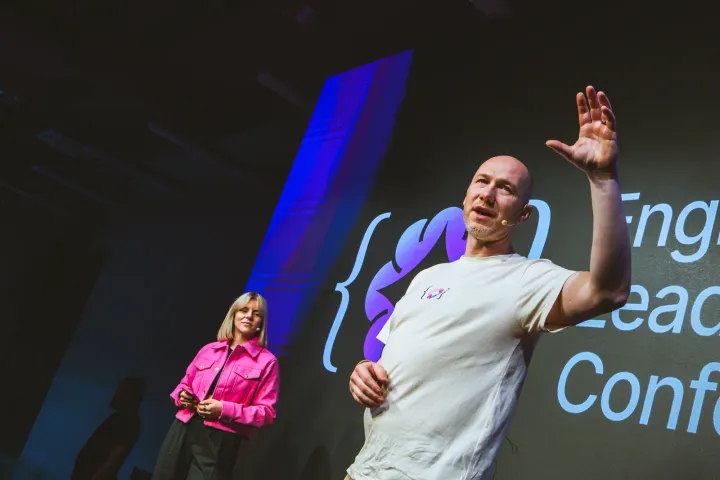
Communities help too. 2,000+ engineering leaders pass through our community events every year, and the ones doing real AI work are obvious within minutes, because they demo instead of opining.
The pattern under all of it
I didn’t learn agents from a course. I learned them building this site, then a roadmap skill, then client pipelines, with real deadlines attached. My mentees who moved fastest all shared one thing: a weekly session where something real had to ship.
The ones who stalled shared one thing too. They were still “evaluating approaches” three months in, with a folder of course certificates and nothing they could demo.
Which folder does your last quarter look like?
If you want a weekly session where your real thing ships, that’s exactly what 1:1 mentoring looks like.