An AI program manager is the person who runs the delivery of an AI system across the teams that build, test, approve and ship it. They answer for getting it out of the pilot stage and into production. Some companies call the same seat AI technical program manager, GenAI program manager or responsible AI program manager.
A normal software program has one target that moves, the scope. An AI program has four more that move on their own schedule, and they rarely ask the program manager first.
What moves under an AI program
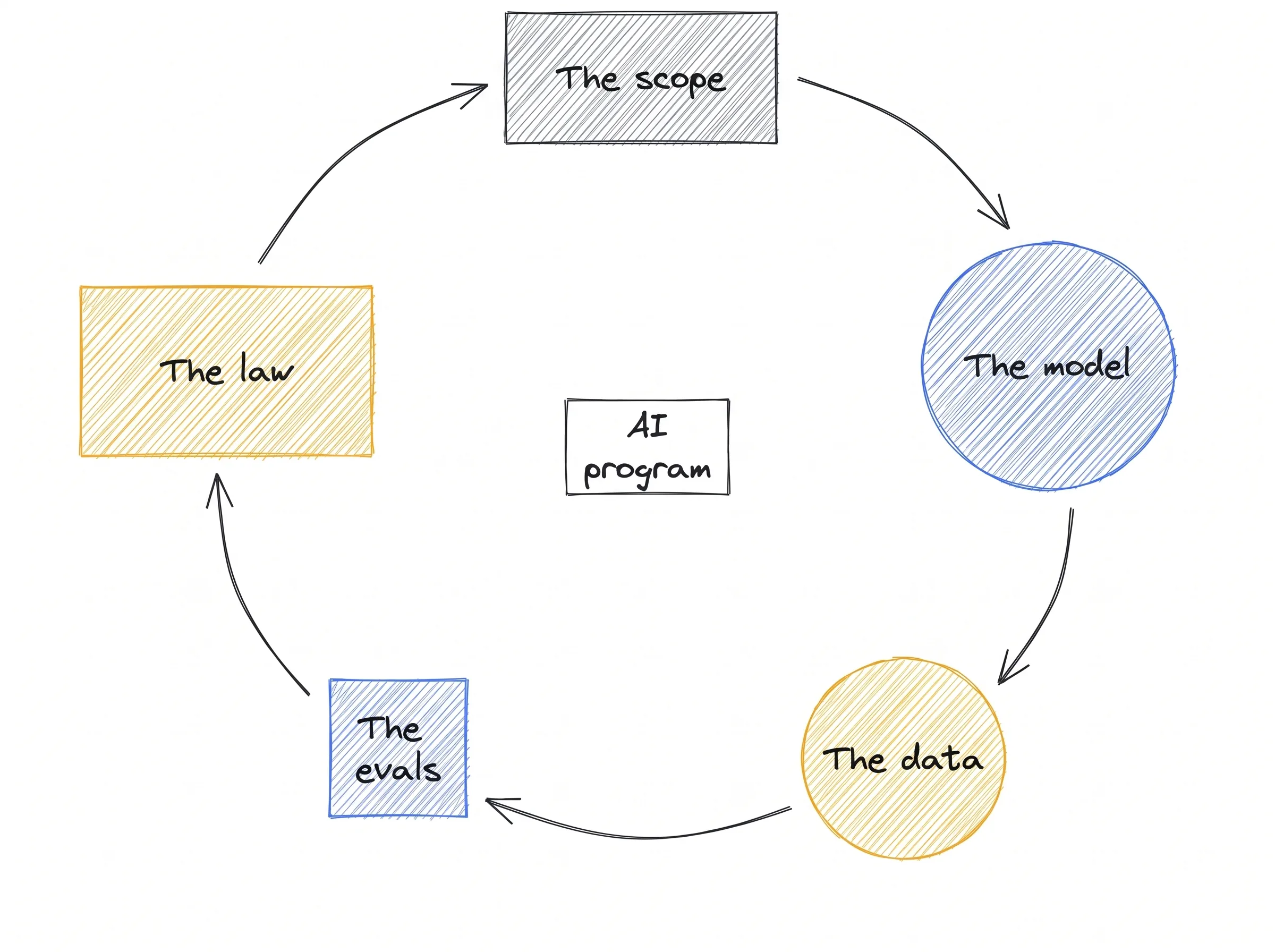
- The model. Vendors retire hosted models on their own clock. Anthropic promises at least 60 days’ notice for publicly released models, and its own table shows Claude Sonnet 4, released in May 2025, retired in June 2026. OpenAI commits to at least six months for generally available models and as little as two weeks for previews. Amazon Bedrock and Google Cloud run their own retirement schedules for the same Claude models. A program longer than a year should expect one migration it didn’t plan.
- The data. In July 2024 Gartner predicted that at least 30% of generative AI projects would be abandoned after proof of concept by the end of 2025, and poor data quality is first on its list of causes. A JPMorgan posting for a principal AI TPM asks the hire to manage risks “especially around data readiness”.
- The evals. In a software program, done means the feature works. In an AI program, done means the evaluation score holds above the release threshold, and that score moves whenever the model, the prompt or the data changes. A feature that passed in March can fail in June with no code change on your side.
- The law. The EU AI Act (Regulation (EU) 2024/1689) entered into force on 1 August 2024. The bans on prohibited practices and the AI literacy duty applied from 2 February 2025, obligations for general-purpose AI models from 2 August 2025, and most of the rest, including the transparency duties, from 2 August 2026. The high-risk rules were due the same day, until the Digital Omnibus on AI, Regulation (EU) 2026/1744, entered into force on 27 July 2026 and moved them to 2 December 2027 for Annex III systems and 2 August 2028 for AI built into regulated products. That was six days before the old deadline. The Commission’s AI Act page keeps the current timeline.
Any compliance plan written for August 2026 had to be re-cut in the last week of July, and if you were the program manager, you were the one holding it.
A risk register for an AI program
These eight rows come from the job postings behind this page and the sources above. The program manager’s name belongs in the last column and rarely in the third.
| Risk | Trigger to watch | Who decides | What the program manager owns |
|---|---|---|---|
| The vendor retires the model | Deprecation notice from the vendor or the cloud | Engineering lead with the vendor owner | A migration line in the plan and the vendor feed as a tracked dependency |
| Eval score drops after an upgrade | Score below the agreed release threshold | Applied AI or ML lead | A re-runnable eval suite scheduled before every model switch |
| Data isn’t ready | The data-readiness milestone slips | Data owner | Data readiness as a gate with a date, visible in status |
| The use case is high-risk under the AI Act | It touches hiring, education, credit scoring or another Annex III area | Legal and compliance | Classification at intake, before anyone builds |
| Oversight is assigned without authority | A name on the oversight list with no decision rights | Executive sponsor | Raising the gap in writing, citing Article 26(2) |
| Logs aren’t kept | Logging missing from the architecture review | Engineering with compliance | Six-month log retention in the definition of done |
| Inference cost runs past forecast | Monthly spend against plan | Finance with engineering | A cost line in every status report |
| The business value has no number | No value metric agreed at intake | Business sponsor | A written kill criterion before the pilot starts |
Two rows quote the law directly. Article 26(2) of the AI Act requires deployers of high-risk systems to give human oversight to people “who have the necessary competence, training and authority, as well as the necessary support”. Article 26(6) requires them to keep the system’s automatically generated logs for “at least six months”. Both texts are in the EUR-Lex version linked above.

Who hires AI program managers?
AI labs, big tech, banks, a pharma group and a humanitarian nonprofit posted the twelve AI program manager roles read for this page. Ten of the twelve put compliance or legal work inside the program manager’s scope. Only two mentioned regulation, and only one drew a line around what the program manager doesn’t decide.
The AI labs among them were Anthropic, OpenAI and Google DeepMind, and the pharma group was hiring in Prague. Microsoft’s responsible AI TPM in London was the only one to name the EU AI Act, as a preferred qualification.
Synchrony’s head of AI program management is the one that draws the line, and the posting spells it out. The role “does not independently own AI model decisions, business case approval, technology architecture, risk acceptance, legal interpretation, or policy decisions”. The other eleven postings leave that boundary for you to discover after you’ve signed.
The title also stretches. A London “AI Programme Manager” posting runs a grant-funded business-support programme on Excel, Dynamics and Salesforce, with AI knowledge listed under “Desirable”. That’s an honest job, but it won’t build AI delivery credentials, and the title on your CV will promise more than you did.
Pay follows employer type more than title. OpenAI’s safety TPM lists $207,000 to $445,000 and Anthropic’s research TPM $365,000 to $435,000. Synchrony’s VP-level role lists $170,000 to $290,000. Across 468 US postings, Axial Search found a median of $182,650. Europe publishes less. A 2025 Novartis posting for a Program Manager AI and GenAI in Prague or Ljubljana gave no salary at all, only a cafeteria benefit of 12,500 CZK a year and meal vouchers of 105 CZK a day.
What to negotiate before you own compliance
If the offer puts “ensure compliance” in your scope, get these in writing before you accept. Each one is cheap to agree before day one and expensive to argue for after the first incident.
- A decision-rights table. Who decides risk acceptance, legal interpretation, model choice and go or no-go. Synchrony’s sentence above is a usable template.
- A named signer for every accepted risk. Your signature confirms the process ran. Someone at the right level signs that the residual risk is acceptable.
- Legal and data protection as gates, with response times. They approve at intake and before production, and the plan shows how long they have to answer.
- Budget for evals and migrations. People or compute to build the eval suite and re-run it when a vendor retires a model. The 60-day and six-month clocks above aren’t yours to move.
- An escalation path that can stop a launch. Who you go to, how fast they answer, and a written promise that a stop-the-line call doesn’t count against your delivery numbers.
- Authority that matches any oversight duty. If your name goes on human oversight for a high-risk system, Article 26(2) expects authority and support to come with it: training, access to the logs, and the power to pause.
- Funding past the first program. Fixed-term governance roles exist (one nonprofit posting in the set ran for twelve months). Ask how the role is paid for after the first release, and what happens to it if the AI budget is cut.
Having said that, the role is worth taking when these are in place. An AI program manager with written decision rights, a working eval suite and a sponsor who backs a stop sees the model, data, legal and cost lines of the AI portfolio in one place, which few other seats in the company do.
If the program is turning into the company’s AI function and you’re the one holding it, Head of AI mentoring covers that seat: the mandate, the boundary with the CTO, and the number the board should see. Bring your risk register to the free 30-minute intro.