Member of technical staff (MTS) is a flat job title AI labs give engineers and researchers, and it says little about seniority. At OpenAI, Anthropic and xAI, a new graduate and a former CTO can carry the same title.
At older software companies the same letters mean something else. Salesforce uses MTS as one rung on a numbered ladder, and it’s the rung for early-career engineers. So before you decide what an MTS offer is worth, find out which of the two worlds wrote it.
Why do AI labs use the member of technical staff title?
AI labs use member of technical staff so researchers and engineers share one title instead of being sorted into two camps. OpenAI’s founders picked it after Alan Kay told them Xerox PARC had used it. Elon Musk’s version for xAI is “There are only engineers”, and Anthropic’s 2025 careers page said research and engineering hires share a single title.
The title is older than any of the labs. A. Michael Noll, who worked at Bell Labs in the 1960s, wrote that “engineers and researchers were usually all classified as a Member of the Technical Staff”, and that even the vice president of research was “just” an MTS. Even that flat version had tiers hiding inside it: some staff were Associate Members, and decades later Bell Labs added a Distinguished Member grade for its stars.
OpenAI picked it up at its founding. Greg Brockman posted in February 2023 that the founders “didn’t want to bucket people into researchers & engineers”, and that Alan Kay told them Xerox PARC had used the title. Elon Musk gave a blunter version for xAI in 2025, per Business Insider: “There are only engineers”, and “Researcher is a relic term from academia.” The same article quotes Anthropic’s careers page of that time, which said research and engineering hires “all share a single title”. The live page now puts it as “engineers here do lots of research, and researchers do lots of engineering.”
How common is it inside the labs? Stanford’s Nick Bloom and Gideon Slocum Moore counted LinkedIn titles in December 2025: 39% of Anthropic, 31% of OpenAI and 26% of xAI employees listed member of technical staff, as Fast Company summarised the New York Times piece on them.
The stated reason is the research versus engineering divide. The flat title does three more jobs for the company, and they matter more to you as the person signing:
- It moves people without paperwork. An xAI model-training posting says you’ll “work on the most critical modeling challenges at any given time”. No new title is needed to send you somewhere else.
- It hides your level from rival recruiters. A LinkedIn profile that says MTS doesn’t tell a competing lab whether to pitch you an L4 or an L7 package.
- It absorbs senior hires without a title fight. Business Insider reported in April 2026 that Workday’s CTO joined Anthropic as a member of technical staff, and that Anthropic’s chief product officer moved into a technical staff role in its Labs team.
Same three letters, opposite readings
On a classic ladder, the letters carry the level. Salesforce runs Associate MTS, MTS, Senior MTS, Lead MTS and Principal MTS, per levels.fyi. One of its current postings calls the plain MTS role “a strong opportunity for an early-career engineer”, with base pay of $117,200 to $176,700. Cohere sits between the two worlds: it’s an AI lab, and it still prints MTS, Senior MTS and Lead MTS in its job titles.
The salary sites show how badly the term travels. On 9 October 2026, ZipRecruiter put the average member of technical staff salary at $29,336 a year. A week earlier, LinkedIn News reported typical base pay for MTS roles of about $223,000, against $177,000 across AI jobs overall. The gap is roughly 7x. ZipRecruiter’s figure only makes sense if its pool includes non-software jobs that also use the words “technical staff”; LinkedIn counted the AI and software people. Any salary page that answers “how much does an MTS make” with one number is averaging two jobs that have nothing to do with each other.
Decoder: what the title leaves out
At the frontier labs the level is still there. It moved from the title into the offer letter. On 9 October 2026 not one of OpenAI’s 817 open postings or Anthropic’s 643 had “Member of Technical Staff” in its title. They advertise “Software Engineer, X” or “Research Engineer, X”, and Anthropic often adds the level, as in its Senior Staff Software Engineer, API posting at $405,000 to $485,000. The level is visible in the ad and goes quiet once you’re hired.
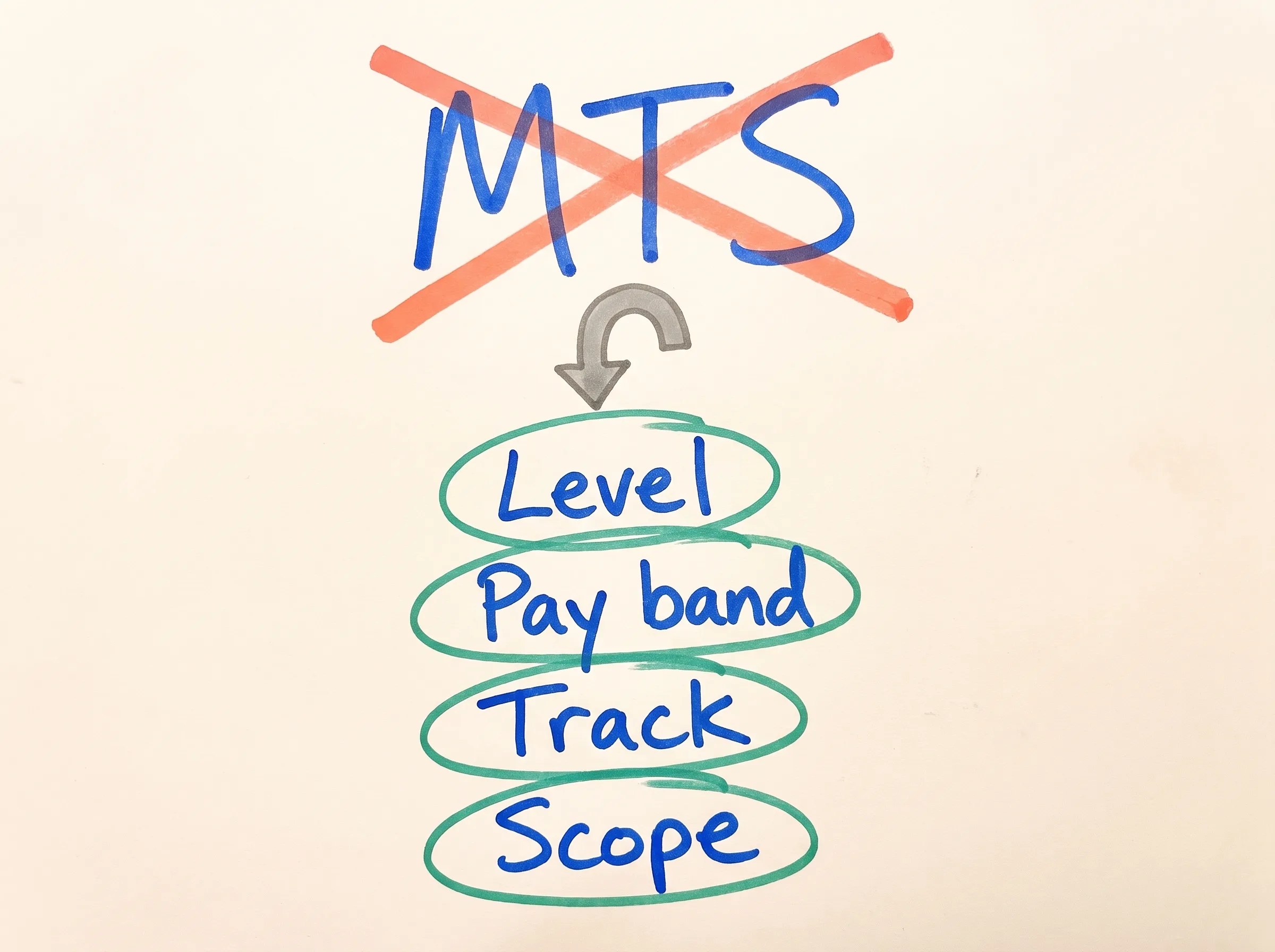
| What the title hides | Where to find it before you sign | How to make it visible on a CV or LinkedIn |
|---|---|---|
| Level | The original job ad, then the recruiter: ask for the internal level by name | Write the level next to the title only if your offer letter states it |
| Pay band | The posted range for that team, then where your number sits inside it | Keep it off the CV; bring it to your next negotiation |
| Track | How performance is judged: papers and evals, or shipped systems | Name the area in the title line, e.g. “MTS, inference infrastructure” |
| Manager or individual contributor | The question “how many direct reports will I have?” | Put headcount in the first line under the role |
| Scope | The first project, named before the offer | Systems you owned, with scale: users, queries, GPUs, cost |
Two rows deserve a real example. A Modal posting titled “MTS, Lead, Storage” says you’ll manage a team of 3 to 8 engineers “while staying hands-on”, so a people-manager job can sit under a title that sounds like an individual contributor’s. And xAI’s posting promises you’ll “get clarity on your first project before an offer”, which tells you the question is normal to ask.
On a CV, write the title the way your employer did, then add the scope straight after it on the same line. A recruiter at a ladder company who sees “Member of Technical Staff” alone may file you next to Salesforce’s early-career hires. A recruiter who sees “Member of Technical Staff, pre-training infrastructure, led a team of 6” can’t.
What to ask before signing an MTS offer
Ask these in writing, and keep the original job posting. It’s often the only document that names your level.
- What internal level is this offer, and what’s the band for it? Crowd-sourced data on levels.fyi lists OpenAI engineers from L2 to L7. The levels exist even when the title is identical.
- Where in that band does my number sit, and what moves it up? xAI’s model-training band runs from $180,000 to $600,000 base. A 3.3x spread under one title means the band alone tells you very little.
- What’s my first project, and who decides when I move to another one? “Whatever is most critical” can be exciting or exhausting, depending on who decides it and how often.
- Will I have direct reports? If yes, ask how many, and get that number on paper. You’ll need it later to prove management experience the title won’t show.
- How is performance judged on my track? Research output and production systems get rewarded differently. Ambiguity tends to cut against whichever side you’re not on.
- What’s the equity instrument, the vesting schedule and the cliff? The labs differ here. OpenAI dropped its vesting cliff for new hires in December 2025; a Reflection AI posting offers stock options. Value the base and the equity separately.
- How often am I on call? Modal states it in the posting. On 9 October 2026, 47 of Anthropic’s 643 postings and 23 of OpenAI’s 817 mentioned on-call at all, so ask in the interview.

Keep your own record for one more reason. A flat organisation makes reassignment easy, and exit too. In February 2026 Musk said xAI had been reorganised and that this “required parting ways with some people”, NBC News reported. If the title can’t tell your next employer what you did, your notes on what you shipped, at what scale and with how many people have to.
Turning a flat title into a level case is close to the work of making a staff or principal promotion case: name the scope, prove it with evidence, and say it in the language of the company you’re talking to. If you’re weighing an MTS offer against a staff role on a classic ladder, Staff Engineer mentoring is where I help people do that comparison with real numbers.