An applied AI engineer builds a company’s AI features into its product: the retrieval, the prompts, the evaluations, the guardrails, and the cost of running all of it in production.
That job sits on the normal engineering ladder, and the rungs above it are where it gets vague. Companies are hiring AI staff engineers before they’ve written down what the level means. The offer letter says Staff, the scope says “own our AI”, and the promotion criteria are a document somebody promised to write last quarter.
Searched for, and barely defined
The keyword data shows the gap. Google Ads puts ai engineer at 90,500 searches a month worldwide and staff engineer at 9,900, both 12-month averages. ai staff engineer and staff ai engineer return no data at all, which means too few searches for Google to report. applied ai engineer went from 880 searches in September 2025 to 4,400 in August 2026, and principal ai engineer averages 390. (Google Ads volumes via DataForSEO, worldwide, pulled 9 October 2026.)
So the applied title is growing fast, and the rung above it is being staffed and paid for while almost nobody types its name into a search box. The people who hold it searched for “applied AI engineer” or nothing at all, and the level got attached to them afterwards. In practice that means there’s no shared definition to appeal to when you argue for the title, and also no outside benchmark your manager can point at to say no. The second one helps you more than the first one hurts.
The US postings that state pay are generous. In October 2026, OpenAI listed $230,000 to $385,000 plus equity for an Applied AI Engineer on its Codex agent team, Ramp $204,400 to $352,000 plus equity, D. E. Shaw a base of $225,000 to $275,000, WorkOS $175,000 to $275,000 plus equity, and Anthropic $280,000 to $320,000 for a public sector seat.
The work behind the same title differs. OpenAI’s ad wants someone to “develop and run evals to measure agent performance, regressions, failure modes, and edge cases”. D. E. Shaw’s wants people who “build bespoke AI agents and user-facing applications”. Anthropic’s public sector seat is there to “support the customer as they build with Claude Code, the Claude API, and Claude for Enterprise”, which is closer to a forward deployed engineer than to a product team.
Applied, staff, principal: the rungs as they exist today
| Applied AI engineer | AI staff engineer | Principal AI engineer | |
|---|---|---|---|
| Who feels a mistake | One product surface | Every team shipping AI | The company’s technical direction |
| The hard call | Does this model do the job | What counts as good enough to ship | Which bets we stop making |
| Owns | Features | Evaluation, tooling, standards | Architecture and the multi-year position |
| Fails when | The feature underperforms | Teams route around the standard | The company commits to the wrong stack for years |
| Roughly | One or more per team | One per AI-shipping org | One per company |
An AI staff engineer whose standards get quietly ignored has failed even while everything ships and nothing has broken yet, and that failure stays invisible for about two quarters. The non-AI version of the top rung has its own page: principal engineer.
What the promotion case has to prove
Because the level is undefined, the promotion case carries more weight than it does one rung down. Four things, and the last one is where most cases fall over.
- Something in production that other teams depend on. An evaluation harness, a shared gateway, a prompt versioning setup that people use without being told to, already running.
- A decision you made that cost money and turned out right. Choosing a smaller model, dropping a vendor, moving inference in-house. With the number attached.
- A standard that survived contact with a team that disagreed. Written down, argued for, adopted. Adoption is the evidence, as opposed to authorship.
- Somebody senior who will say it out loud. At a company without written criteria, a Staff+ promotion gets decided by a sponsor in a room you’re not in. If you can’t name that person, the case isn’t ready, whatever the document says.
The mechanics of assembling the case match the ones a rung down, and the staff engineer role covers the non-AI version of the level.
Where the quality line gets drawn
Earlier Staff+ generations could reason about correctness. A system was right or wrong, and a test told you which.
AI systems are right often enough, and “often enough” is a business decision. Somebody has to decide that, say, 94% accuracy ships for a support summariser and gets blocked for a feature that touches money, then defend that line to a product manager who wants the feature this quarter. The 94% here is an illustration, not a measurement. The real number depends on what you measure, it changes per surface, and no framework hands it to you.
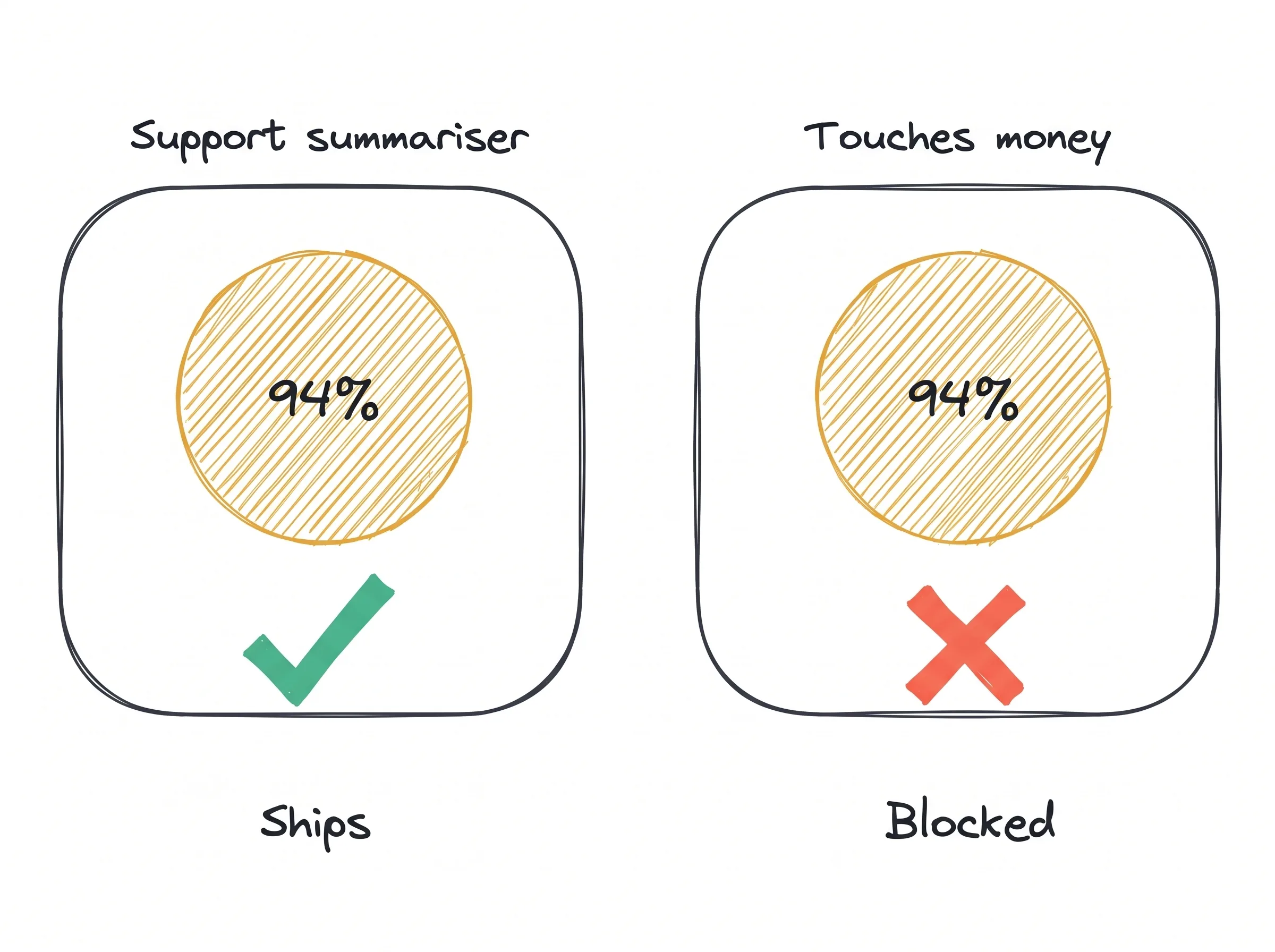
The line only holds if it’s checked at every step. An AI model gives you a probability, so a delivery workflow with no validation between the steps rarely saves anyone time: the hours move from writing the code to checking it by hand. That’s why the question that separates candidates for AI leadership seats is how they validate each step of the AI delivery workflow, and the same question sorts Staff+ candidates one level down. The AI transformation playbook has the full interview set it comes from. For the people who build the checks themselves, see AI QA engineer.
The second shift is what happens to the rest of the team. Agents write a growing share of the code, so the scarce skill on a team moves from writing code to judging it. A staff engineer who spends the year writing more code personally has misread the assignment. Managers are getting the same shift from their end of the org chart, which is why agents expose weak first-line managers.
Manager or Staff+, and where the money is
The management track and the Staff+ track used to be a clean fork. Both are being repriced at once now, which makes the choice feel like a bet. The fork itself, span against leverage, is laid out in the 2027 career fork post.
Which side is safer? I’d say the safest AI-capable engineer is the one closest to the money, whichever title they hold.

That shifts the question from the org chart to the work. A manager whose team’s AI work shows up in sales, support or cost is in a stronger seat than a staff engineer polishing internal tooling with no price tag, and the reverse holds too. Most AI adoption starts inside engineering, and the money from it mostly lands outside R&D, so the engineers who follow it there have the shorter line to a number the business already counts.
If you’re at that fork, 1:1 mentoring for Staff+ engineers is built for it. Bring your current scope, and the first session traces how far it sits from revenue or cost. That first one is free.
Next rungs and neighbours
- Principal engineer: the IC rung two steps above senior
- AI platform engineer: the layer applied engineers build on
- AI QA engineer: testing AI systems vs testing with AI
- Member of technical staff: why AI labs hide the level
- Forward deployed engineer: applied AI work done at the customer’s desk
- Head of AI: the seat that usually hires you