A platform engineer builds and runs the internal platform product engineers use to ship code without waiting on a ticket. It’s offered as self-service and usually covers service templates, pipelines, cloud and Kubernetes modules, and observability defaults.
Vendors agree on that definition, and Microsoft and platformengineering.org explain the discipline well. None of them covers the person in the seat. The job behind the title comes in two versions, and which one you join decides a lot about your next five years. Some companies run the platform like a product, with users, a roadmap and the right to say no. Others hand a renamed ops team a queue of requests and call it platform. Both post the same title on LinkedIn.
What does a platform engineer do day to day?
A platform engineer spends most of the week on building blocks other engineers reuse, then on migrations, support and on-call. The blocks are infrastructure modules, CI templates and a golden path for new services. Migrations take teams off old tooling, and support runs through office hours, Slack questions and docs.
Fourteen live postings from October 2026, nine in the US and five in Europe, describe a similar mix of work.
Most of the hours go into building blocks. Terraform or CDK modules, Helm charts, CI templates, and a golden path that gives a new service its repo, pipeline, dashboards and alerts on day one. Chime wants someone to own its Helm chart repo and Terraform modules and build self-service tools on top. Then come the migrations, which take longer than anyone plans: the last services off the old CI, the last team off a hand-built VM fleet. Then support, meaning office hours, Slack questions and docs a stressed engineer can follow in the middle of an incident.
And on-call. Five of the fourteen postings require it, and not one says how many people share the rota or what it pays.
The honest version of the job is also wider than the ad suggests. nCino puts edge and ingress, data stores, SOC 2 and PCI work, cloud cost, incident leadership and mentoring into one senior seat. That’s a cloud operations department, written as one person.
Ticket desk or product: what week one tells you
You can tell which version you joined within days, from things you can see without asking anyone for an opinion.
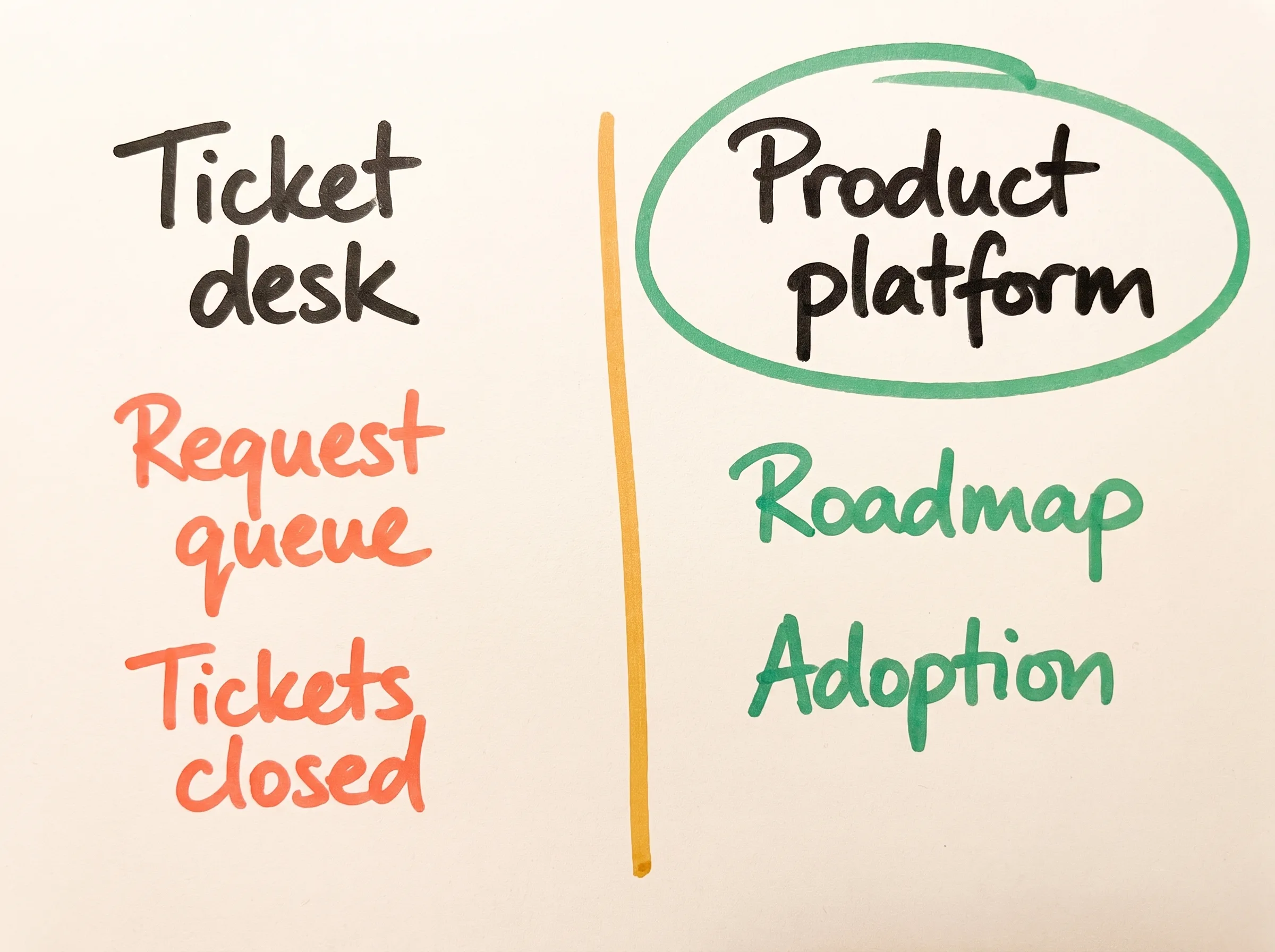
| What you check | Ticket desk | Product platform |
|---|---|---|
| How work arrives | A request queue: “create a bucket”, “add a pipeline” | A roadmap built from what product teams struggle with |
| Who decides what gets built | Whoever escalates hardest this sprint | A named owner, often a platform product manager |
| How teams start using it | A mandate from above | The paved path is faster, and adoption is tracked |
| What gets measured | Tickets closed, request SLA | Time for a new service to reach production, adoption, developer survey |
| Who the pager is for | Any app in production | The platform itself, while product teams carry their own services |
| Docs | A wiki page out of date since the last migration | A getting-started path a new hire finishes alone |
| Saying “not this quarter” | Not allowed | Normal |
DORA’s platform engineering guidance says a successful platform needs a product manager focused on developer experience. The State of Platform Engineering Vol 4 survey of 518 respondents found 38% of teams have no dedicated platform product manager, and 29.6% don’t measure success at all.

Mandates aren’t automatically the bad column. Octopus Deploy’s 2026 platform engineering survey found 62.2% of teams with mandatory adoption hit most of their goals, against roughly 27.5% where adoption was optional. Those mandates came with leadership backing and a safe budget. A mandate without either of them leaves the platform engineer holding the migration pain with no one to escalate to.
There’s a second number worth knowing before your first interview. DORA’s 2024 research found an internal developer platform lifts individual productivity, and in the same report that it can lower throughput and change stability. Per The New Stack’s reading of the report, throughput dropped 8% and change stability 14% for platform users, and the instability correlated with burnout. Google’s own announcement calls it a possible temporary dip. The platform engineer is the one who answers for that dip in the quarterly review, so it helps to know it’s expected.
Platform engineer, DevOps engineer or SRE?
DevOps is a way of working, where the team that builds a service also runs it. A DevOps engineer is usually the person who automates releases and infrastructure for specific teams. An SRE owns reliability against agreed targets. A platform engineer builds the shared product that makes both of those cheaper for the rest of engineering.
On paper that’s clean. In Puppet’s 2023 platform engineering report, 48% of people on platform teams still held DevOps titles, as opposed to 44% with platform engineer titles. So the boundary mostly lives in the job ad, which is where to look next.
Red flags in the job ad
Each of these comes from a live posting. One flag means ask a question. Three in the same ad usually means you’re applying to an ops team.
- “DevOps” fused into the title, or “operational support” in the duties. Alior Bank advertises a “Devops Platform Engineer” whose work is operational support of Kubernetes clusters, with no line about developers as users. Ask what share of last quarter went to requests and what share to roadmap work.
- On-call with no numbers. SumUp mentions cross-timezone on-call coordination, Supabase wants someone who has “carried the pager”. Neither sizes it. Ask how many pages the rota had last month, and whether a product team’s outage wakes you up.
- Five jobs in one seat. Elastic’s posting puts infrastructure, CI/CD, CVE remediation, internal user support and cloud cost work on “a small, focused team”, at a US base starting at $94,300. Ask which of those you’d drop when the platform roadmap gets busy.
- Platform as a product, with no product manager. Ashby says openly that there are no project or delivery managers and you run your own project management. That’s honest, and it suits some people. Ask who decides what the platform builds next quarter, and who tells a product team no.
- “Drive adoption” without authority. Northern Trust’s head of platform posting asks for “influence without authority” and makes the role accountable for platform delivery metrics, within “fixed resource constraints”. Ask what happens when a team refuses to migrate.
- “Platform” that means a different job. Celonis uses the title for engineers who run Google Workspace, Slack and Atlassian. E2B uses it for hypervisor and eBPF work on its own product. Both are real jobs, and neither builds an internal developer platform. Ask who the platform’s users are.
The quietest risk is the budget line. In the Vol 4 survey, 40.9% of platform initiatives couldn’t show measurable value within twelve months, and the report warns that the ones with no results risk underfunding or “outright deprecation”. A team without a number on a finance slide is easy to cut. Ask in the interview how the platform’s value gets reported upward. If nobody knows, you’ll be the one asked to find out.
The head of platform engineering seat
That reporting problem is the head of platform’s whole job. In a large company it’s a director-level seat: Northern Trust’s global head reports to the Global Head of Engineering, with a US base of $240,000 to $375,000, and the posting also makes the head the product manager of the platform. In a scale-up the platform unit tends to sit under the CTO, next to product engineering. That’s how the org chart looked in my first year as VP of Engineering at Mews.
The work moves from building modules to defending a budget, choosing what not to build, and selling the platform to people who don’t report to you. If you’re stepping into that seat, it’s the same ground I cover in 1:1 engineering director mentoring, and you can start with a free 30-minute intro.
Where the job leads
The title opens more doors than most infrastructure roles, because you’ve seen how production behaves across the whole company.
- Deeper as an IC. Staff and principal platform engineers set architecture across the org. Ashby’s EU staff band runs €154K to €188K, and €208K to €250K one level up. The staff engineer and principal engineer guides cover what changes.
- Into management. Platform team lead, then head of platform. E2B’s Prague team lead posting shows the shape early: 1:1s, hiring, the on-call rota and hands-on contribution, all in one role.
- Into AI platform work. Langdock in Berlin already has its platform engineers building a model gateway and an agent runtime, at €90K to €140K. The AI platform engineer page covers that move.
- Sideways into SRE, or back to product engineering, with an unusual advantage, because you’ve seen what breaks.
On pay, Glassdoor’s US data puts median total pay at $220,000 from 1,462 salaries, while Indeed’s advertised base averages $157,185. Glassdoor Germany shows an average base of €70,000 from 118 salaries, and E2B in Prague publishes CZK 150,000 to 300,000 a month. Survey averages fell from 2024 to 2025, roughly $193,000 to $160,000 in North America and $118,000 to $104,000 in Europe, which Vol 4 explains by juniors entering the title. Twilio hires a platform engineer at L2, with one to two years’ experience. So compare offers on the scope written in the posting, since the averages mix four different jobs under one title.