To 300+ clients in one year. Insights from a winning mentoring strategy that breaks the norms.
One of the many things that launching my own mentoring business has taught me is that copying somebody else’s playbook only takes you so far. Marketing experts will advise you to replicate the success tactics of others. In practice, what set me apart was identifying the strategy that works best for me, and committing to it.
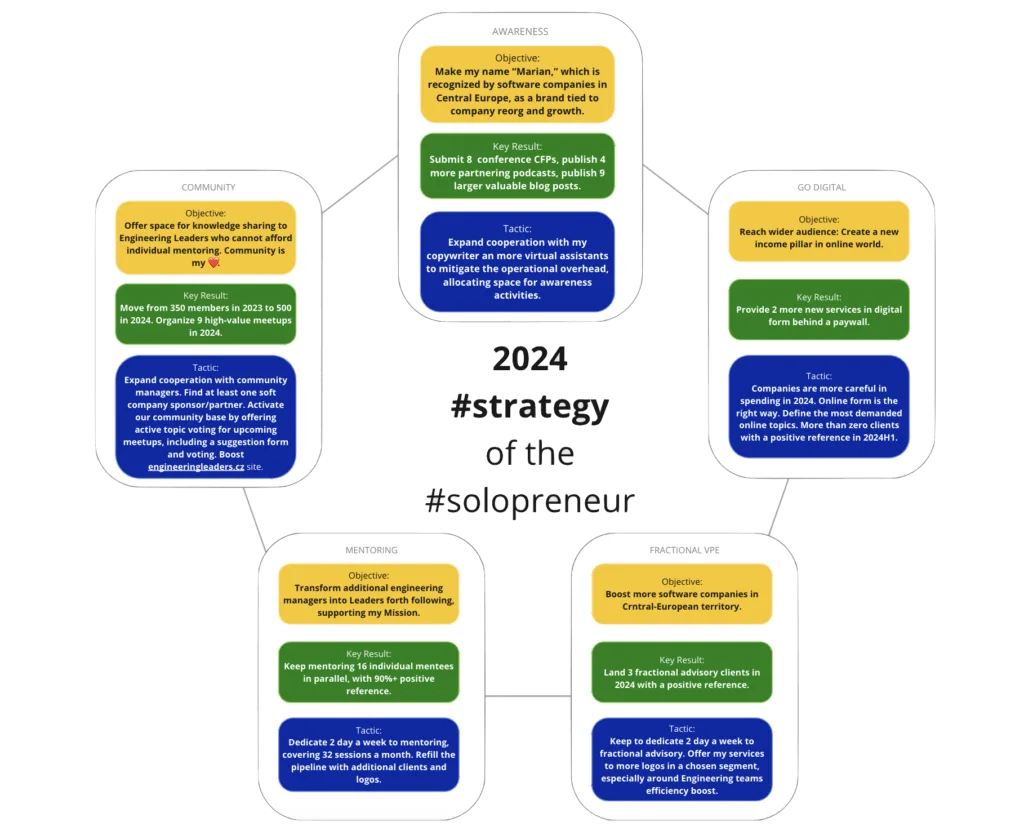
My mentoring strategy is the result of experimentation, feedback, and refinement. It’s built from three parts: continuous learning, mentoring, and advisory.
Pinpointing your business strategy takes time
I shifted my strategy several times before it finally clicked. The key is to dive in, experiment, and use feedback for continuous improvement; waiting for the perfect strategy from the outset gets you nowhere.
Initially, I intended to focus solely on mentoring, but this lacked impact since I was mostly discussing theories from my business background. I felt compelled to make it more practical. While securing my first advisory clients was challenging, it was a path worth pursuing. In the end, I scaled back my mentoring to accommodate this shift.
TIP: Remember, your first strategy idea isn’t necessarily unique or a guaranteed win. Usually, you need to get in the field, experiment, learn from trial and error, and adapt continuously to discover what works and what doesn’t.
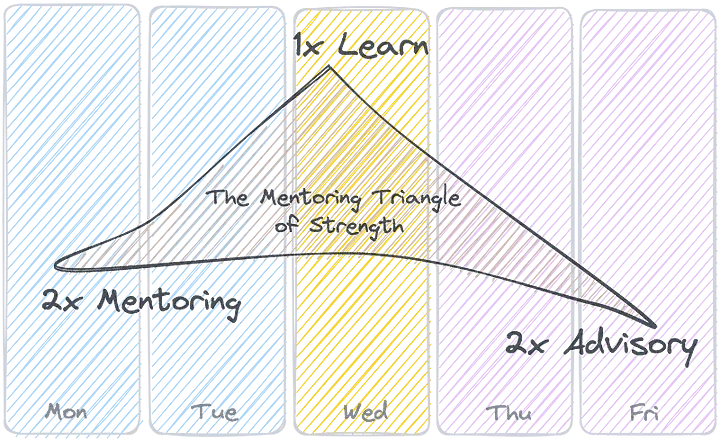
My “Mentoring 1+2+2 Triangle” of strength
Why a triangle? Each element feeds the other two, and it’s the combination working together that puts me in an unbeatable spot.
- Continuous learning = cultivating my knowledge
- Mentoring = talking experience
- Advisory = putting theory into practice and gathering feedback
Here’s how my week splits across them.
1. Learning: Fueling the mind
One day a week, I dedicate my time to continuous learning. This involves reading articles, blog posts, and other materials, writing, listening to podcasts, and actively participating in events, meetups, conferences, podcasts, and panel discussions.
Continuous learning is the foundation of my strategy. It’s what helps me stay at the forefront of my field, possessed with the latest knowledge and insights that I can then share with those I mentor and advise.

2. Mentoring: Strengthening leadership
Two days a week are set aside for mentoring. I allocate 3 to 4 1-hour mentoring sessions each day, with the remaining time spent on preparation and operational work.
Mentoring gives me more than knowledge sharing. By devoting substantial time to it, I ensure that I stay connected with aspiring leaders, strengthen my network, and continually refine my leadership skills.
3. Advisory: Practical application
The remaining two days of my week are devoted to advisory roles in the capacity of a fractional advisor or CTO. This is where I put theory into real-world practice.
Advisory work allows me to apply my insights and provide practical guidance and solutions to the challenges faced by client companies. Through this, I gain firsthand experience that expands my knowledge and perspective.
Continuous learning, mentoring, and advisory working together are my third eye.
Stick to your game plan
It’s tempting to abandon my learning day to earn more.
But this would be a short-sighted decision. Without continuous learning, I risk becoming out of touch and would end up discussing concepts like waterfall, mainframes, and agile manifesto.
Giving up on mentoring would weaken my network and individual leadership.
Leaving advisory behind would mean missing out on experiencing different situations and client models, limiting my capacity to learn from real-world scenarios and develop my practice in the field.
Which is why I stick to my “Mentoring 1+2+2 Triangle”, tempting as it can be to trade parts of it for billable hours. It’s the three elements working together that make the approach mine, and that bring me both joy and success in the work.
Where my clients come from
My awareness strategy is built around being in the field, not online.
Marketing experts recommend creating momentum on LinkedIn through frequent posts, gaining followers, and monetizing your digital presence, simplified by the rise of AI tools like Taplio.
I understand the importance of visibility, but this strategy doesn’t click for me.
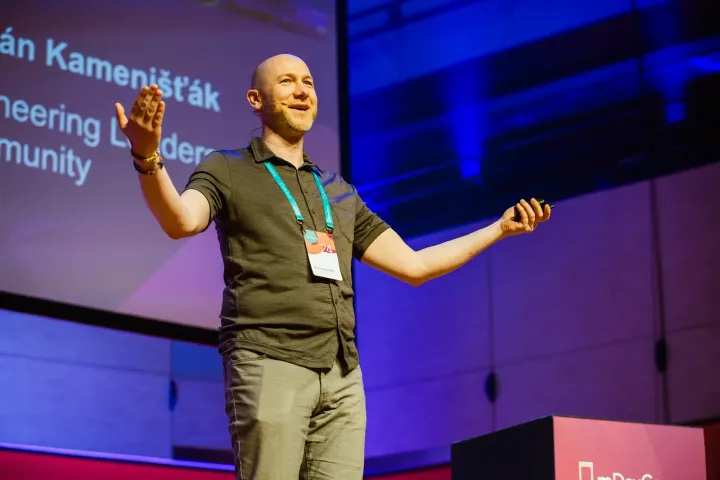
Instead, I dedicate my time to being in the field and building a community through physical meetups, speaking engagements, panel discussions, and so on. This is driven by my belief in the power of personal connections. Why? 80% of my potential leads come from word of mouth.
Conclusion
The “Mentoring 1+2+2 Triangle” works for me because it matches what I care about: knowledge, leadership, and industry experience. I’m certain there are alternative winning strategies out there. This one is mine, and I’m sticking to it. Maybe it nudges you to draw a triangle of your own.
You can read the full story of how I set up my mentoring business in my previous blog post: From Corporate Job to Solopreneurship — Insights From Building My Mentorship Business.