The most expensive AI hire I’ve seen could explain AI to a board and couldn’t turn a Skill into code.
A Chief AI Officer costs a median of $1.87M in total pay at large US public companies, €210,000 to €300,000 in a German scale-up, and about €194,000 a year to employ at the top of the Prague market. Until the AI work fills five days a week, I’d buy one or two days instead.
I’ve run 35+ fractional CTO engagements, and the recent ones at ČSOB, Jablotron, Dr.Max and Eurowag were about AI. Below is what each AI leadership seat costs in the US, Western Europe, Czechia and Poland, the lines the salary leaves out, and the test I’d run before signing anyone full-time.
A seat created before the work fills it
The hire I opened with had the vocabulary and could talk about understanding AI for an hour, in board language. In practice they worked at the level of using Skills, the prompts and playbooks somebody else had built, with no computer science background to go one level down. The company paid a C-level salary for a power user.
It isn’t only a small-company mistake. General Motors hired its first Chief AI Officer in March 2025, and he stepped down eight months later. GM’s AI team now reports to manufacturing engineering, because, in GM’s words, “we are strategically integrating AI capabilities directly into our business and product organizations.”
Intel’s Chief Technology and AI Officer left after about six months. Both were deeply technical, so this isn’t about skill. The seat came before the work that would fill it, and the work ended up inside the business anyway.
CTO salary vs Chief AI Officer salary: the 2026 numbers
For a 200-person company in Prague, the realistic full-time number is in the Czechia column, and it’s closer to Germany than the old “CEE is cheap” line suggests. Euros per year, one figure per cell, sources numbered below.
| Seat | US | Western Europe | Czechia | Poland |
|---|---|---|---|---|
| Full-time CTO | €299K ¹ | €190K (UK) ² | €130K ³ | €82-220K ⁴ |
| Chief AI Officer | €1.66M ⁵ | €210-300K (DE) ⁶ | no survey ⁷ | €159K ⁸ |
| VP of AI | no reliable data | €190-260K (DE) ⁶ | no reliable data | no reliable data |
| Head of AI | €316K ⁹ | €186K (UK) ² | €108K ¹⁰ | €113K ⁸ |
| Fractional, per day | €1,493 ¹¹ | €1,292 (UK) ¹² | €1,000-1,200 ¹³ | no reliable data |
- Glassdoor, median total pay, n=3,654
- Robert Half UK 2026, median base
- TalentUp, median base, n=145
- Antal 2026, base
- Equilar, October 2026, median total pay at large US public companies
- German recruiter bands 2026, scale-up total pay
- Only a vendor estimate exists (headofai.cz)
- Pearson Carter 2026, mid base, indicative
- Glassdoor, median total pay, n=23
- Hays CZ 2025, Head of Big Data as the closest proxy
- GoFractional, $210 an hour × 8, 1,040 profiles
- UK tech leader survey 2024, average
- My public price list
Converted at the ECB reference rate of 16 October 2026. “Total” includes bonus and equity, “base” doesn’t.
The seats differ in scope more than in name: what a CTO does, VP of AI vs Chief AI Officer, the Director of AI, the Head of AI role and the fractional CTO guide each cover one.
Prague isn’t cheap any more at this level
An hour of work in the Czech ICT sector cost €34.9 in 2025, against €58.5 in Germany. That’s 60%. Across the whole Czech economy the same ratio is 44%, so tech is where the gap closed first.
At manager level it closes further. The median Czech engineering manager on Levels.fyi earns €106,500 in total pay (n=30), about 84% of the German median of €126,419.
In practice, hiring in Prague to save money works for engineers. For the person leading them it saves you about 15% on salary, and you still pay the full search fee and the notice period.
The salary is only the first line on the bill
Take the top of the Prague market: the top decile of ICT managers earns about €156,000 a year, bonuses included. I use it as the price of a strong CTO or Head of AI at a 50-500 person tech company.
Employer levies: 24%, not 34%
A senior hire in Czechia costs less on top of salary than the 33.8% people quote. That rate is right at a normal salary, but social insurance stops at 2,350,416 CZK a year in 2026, and only the 9% health levy keeps going.
On the top-decile salary that’s 24.3% on top: about €194,000 a year to employ.
Search fee: a third of year-one cash
Retained search firms charge “generally one-third of the estimated first-year cash compensation”, per Korn Ferry’s own 2026 annual report. Czech agencies quote 25 to 30%. On the Prague example the retained fee is about €52,000.
Time: five to six months before day one
Search firms put an executive search at 12 to 16 weeks, their own estimate. Czech law adds a notice period of at least two months for the person you’re hiring away. Day one lands five to six months after you decide.
And if the hire is wrong
Getting out costs too. A Czech agreement with a fair package of three months’ pay is about €39,000 on this salary, and then the search starts again. How to do it cleanly is in my guide to AI resistance and letting the reds go.
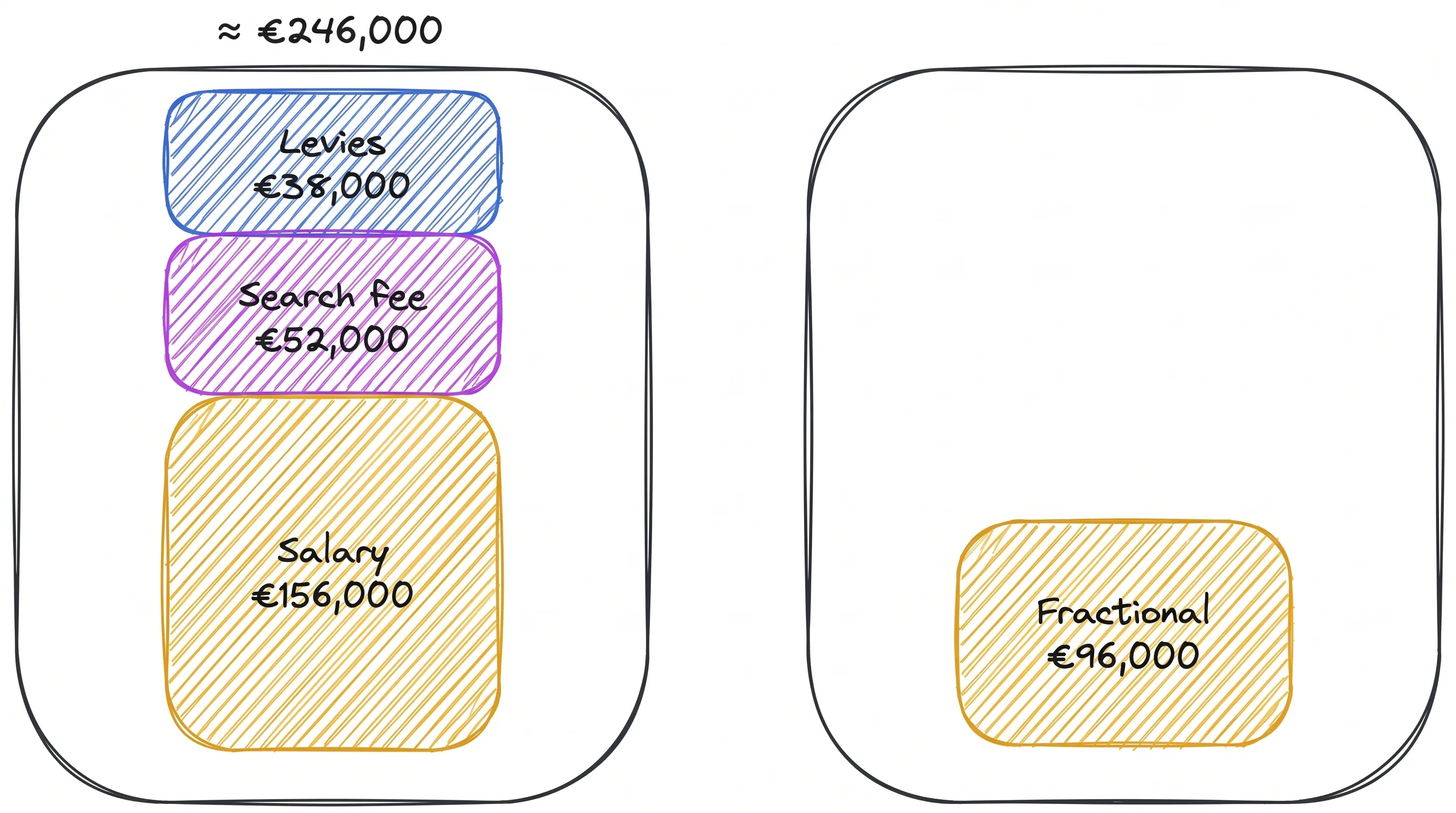
Put together, year one looks like this:
| Year one | Full-time, Prague top decile | Fractional, 2 days a week |
|---|---|---|
| Gross pay | €156,000 | none |
| Employer levies | €38,000 | none |
| Search fee (retained) | €52,000 | none |
| Fees | none | €96,000 (96 days × €1,000) |
| Total, before equity | ≈ €246,000 | €96,000 |
Two days a week isn’t five, and I won’t pretend it is. The question is whether your company has five days of AI leadership work a week, or two days of it plus a lot of meetings.
The title sets the price, not the job
Same title, very different money. The median Chief AI Officer at a large US public company takes $1.87M in total pay, $521,250 of it base. The average US job ad for the same title offers $151,203 base. That’s twelve times apart for one title.
The “AI premium” is smaller than the title suggests, too. Ravio measured it at +12% for individual contributors and only +3% on the management track.
Surveys don’t even agree who has the seat. In IBM’s 2026 CEO study, 76% of 2,000 CEOs said they have a Chief AI Officer, up from 26% a year earlier. In a 2024 Gartner poll, 54% had an AI leader, and 88% of those leaders didn’t carry the CAIO title.
The title is cheap to give, so it tells you little about the job. That’s how my opening hire happened, and how it ended is the usual pattern: the results don’t come, things slow down, and rumors start to protect the seat.
You can’t buy an AI transformation from someone who has never turned a Skill into code.
Buy days until the work fills five
My rule: don’t hire for five days a week until the AI work fills five days a week for one senior person. Until then, name one owner, give them a mandate and one or two days a week, and keep the CTO in charge of the organisation.
The best argument against me comes from Wharton. Its October 2026 study of 1,416 US enterprise respondents found strongly positive AI returns at 58% of companies with a newly designated Chief AI Officer, 24% where AI responsibility was added to an existing executive’s role, and 8% with no such role.
I agree with the 24%. Adding AI to your CTO’s job as a side task is the worst of the three options.
But “newly designated” doesn’t mean full-time. Even the search firms that place AI executives describe a fractional Chief AI Officer as someone engaged “to scope the permanent AI leadership role and set governance before a full-time hire,” usually one to three days a week.

What one or two days a week buys, concretely: at ČSOB it was C-level AI pilots inside bank compliance, 10 sessions plus a 2-day workshop, with sanctioned tools only. Together with the team we built an OKR-based evidence tool with an AI advisor skill in Copilot, and the pilot went into internal production.
Time saved isn’t the goal. When the UK Department for Business and Trade gave 1,000 staff Copilot, the evaluation found small time savings but “did not find evidence that time savings have led to improved productivity”. That’s why I bill on goals, not hours.
How I bill it is on my pricing page: €1,200 per man-day on demand, €1,000 in a 12-week package. No prepayment. I invoice monthly, and only when we hit that month’s goals.
This is how I write a month’s goals, shown on a made-up 120-engineer company:
- People semaphore: everyone placed green, orange or red; red down from 30% to 20%
- AI-native coverage: 3 of 8 departments using an AI workflow daily, not as a pilot
- Workshops: 2 hackathon-style sessions; 80% of invited engineers ship one real change with an agent
- Cycle time: PR lead time down 15% on the two pilot teams
- Incident resolution: time to resolve down 20% where the AI on-call runbook runs
- Automation: 1.5 FTE of repeat work (triage, release notes, test scaffolding) moved into code
Hit them and you get the invoice. Miss them and you don’t.
The second bill: LLMs you keep paying for
A Skill is a reusable instruction set an AI agent runs, like a playbook for one task. A Skill that calls a frontier model every time it runs is a prototype. Once it works, move it into code plus the smallest model that does the job, so you don’t spend money on running LLMs all the time.
Checkr did exactly this with background checks. A plain statistical model already handled 98% of records, and the hard 2% went to GPT-4. Asking GPT-4 directly “was going to cost me about $12,000 per month,” their ML engineer said. “With the SLM, it costs about $800 a month.”
Three I’ve moved this way: an SDLC workflow, the categorisation of incidents, and a product management opportunity evaluator that started as a Skill. For incidents we used JEV, a small model that returns a typed decision instead of text, at $0.042 per million input tokens. Claude Sonnet 5.5 costs $2 per million input tokens, about 48 times more for a job that only needs a category.
Three months after we moved the three to an algorithmic program, they cost $2,270 a month less to run. That money comes back every month, and it’s a line no salary survey shows.
The test before you sign anyone full-time
Ask the candidate for three things. A Skill they turned into code, and the bill before and after. The semaphore of their last team, and what they did with orange. The hackathon they ran, and what shipped from it.
If they can’t show you all three, what exactly are you paying €246,000 a year for?
The people side of the rollout, who adopts and who doesn’t, is in the AI resistance guide. If the work doesn’t fill five days yet, start with a 30-minute call.