IgniteTech spent 20% of its payroll teaching people AI. Then it replaced nearly 80% of them.
AI resistance is when people slow down, avoid or quietly undermine an AI rollout. 31% of employees in a 2025 Writer survey admitted sabotaging their company’s AI strategy. Across 7 companies and 72 teams I’ve worked with, 10 to 35% of people ended up red, the ones who won’t make it through the change.
Not every person will survive AI adoption. It’s the secret rule nobody talks about. Below is how I sort a team, the 10 red signs, and how to let the reds go, fast and in writing.
IgniteTech’s year of AI Mondays
In early 2023, IgniteTech’s CEO Eric Vaughan decided generative AI was existential for his software company. “Every single Monday was called ‘AI Monday,’” he told Fortune. “You couldn’t have customer calls; you couldn’t work on budgets; you had to only work on AI projects.”
The company put 20% of payroll into a mass-learning programme. Fortune’s verdict: “it failed because of mass resistance, even sabotage.” Vaughan: “we got flat-out, ‘Yeah, I’m not going to do this’ resistance.” The technical staff resisted most.
So he replaced nearly 80% of the staff within a year, by Fortune’s count from headcount data, and every division started reporting into the AI organisation. The company says it finished 2024 at near 75% EBITDA.
His own summary: “Changing minds was harder than adding skills.” And then: “I do not recommend that at all.”
The order matches how I work: support first, the exit after. The semaphore below is the person-by-person version of the same decision.
Sort by behavior, not skill
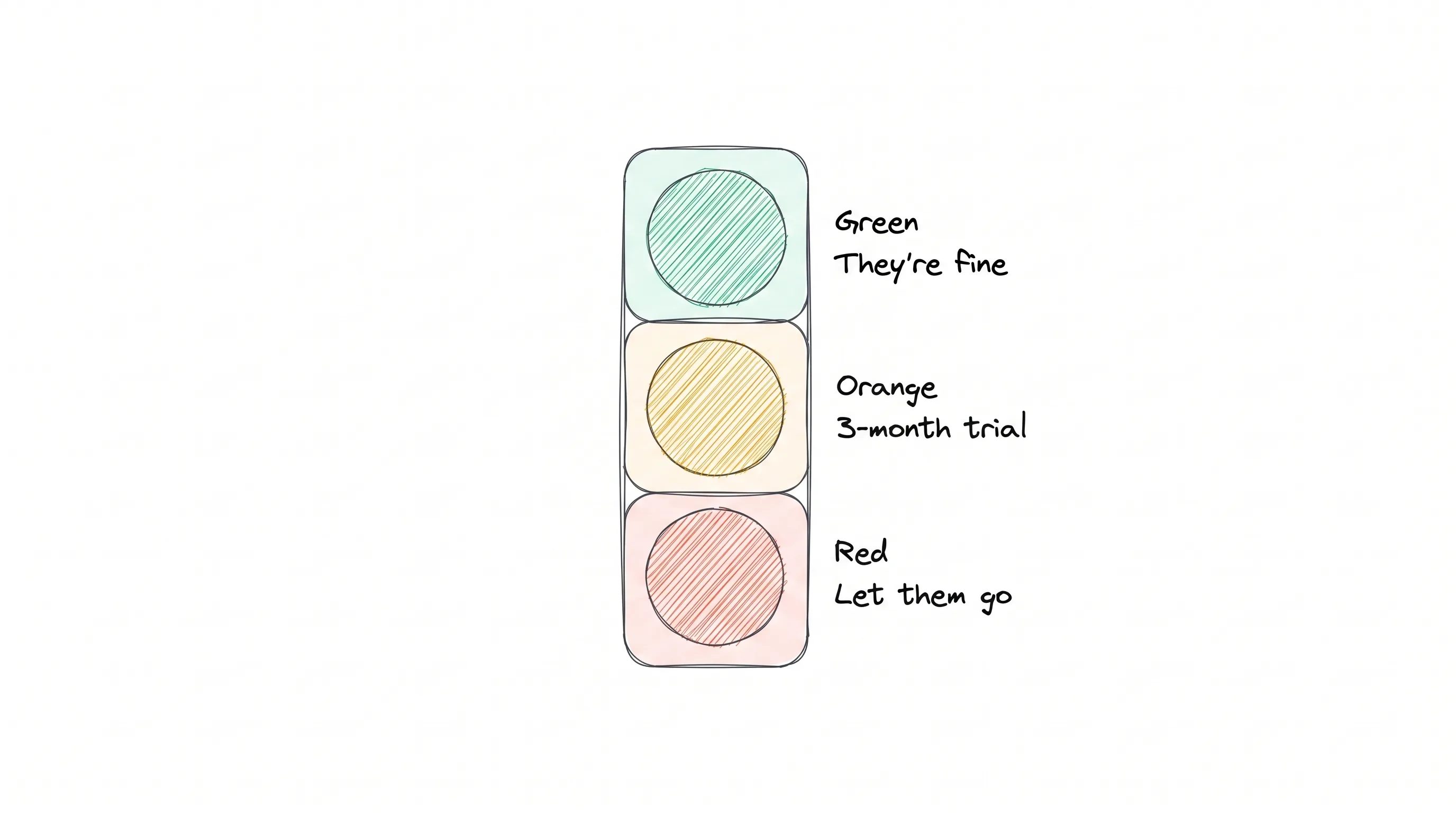
I sort a team with a simple semaphore. It sorts people by how they behave during the change, not by what they already know.
Green
They’re fine. They take the tools and keep delivering.
Orange
Not there yet, and not against it. They get a 3-month trial with support, and firm KPIs as their definition of success.
Red
The behavior is the problem, mostly toxic or cultural. Let them go.
Skeptics
A different group, and they’re okay. Keep them close, as they’re smart. A skeptic argues in the room; a red argues in the corridor.

Gallup’s 2026 data fits the colours. Among people who don’t use AI at work, 46% prefer “to keep doing work the way it is currently done”, which is orange, and 43% are ethically opposed, which is mostly skeptics. Red is the sabotage that Writer measured.
Where the 10 to 35% lands across those 72 teams depends on the company. The low end is in companies with real processes. The high end is in what I call relationship-based companies, where people learned that politics and bonds pay better than delivering value.
The 10 red signs I look for
- Politics over output. More time goes into alliances than into shipping.
- Rumors. The team hears the news from them first, in their version.
- Yes in the meeting, no after it. Agrees with the plan, then slows it down.
- Work nobody can see. No demo, no pull request, no number, always “in progress”.
- Value is who they know. The relationship is the job, the result is optional.
- Fear as a weapon. “AI will replace you”, whispered to colleagues.
- The bottleneck by design. Keeps access and knowledge to themselves.
- Someone else’s name on every miss. Never their own.
- Arguing the KPIs instead of hitting them. Orange that turned red.
- Mocking the people who try. The hackathon becomes a joke for them.
Don’t let output fool you. The Harvard Business School study of 58,542 workers found that avoiding one toxic worker is worth more than hiring a superstar: $12,489 in avoided turnover cost, against $5,303 gained from a top-1% performer.
Say why before you say must
The AI tooling is half the work. The other half is how you bring it to people, which is communication and motivation. Three things worked for me.

Say why, inside and outside
Tell the team why we do AI, and tell the outside world the same story. Duolingo’s CEO published an “AI-first” memo in April 2025 and got a public backlash. His own verdict, weeks later: “This was on me. I did not give enough context.”
He isn’t alone. Only 22% of employees say their organisation has communicated a clear plan for using AI. Part of orange is a leadership gap.
Prepare the materials first
Guides, examples and access are ready before anyone asks.
Run a hackathon early
People build something themselves in the first weeks, instead of watching a demo. In March 2023 Zapier “paused all work for a week and ran an AI Hackathon”. Weekly AI use went from just under 10% of people to over 50% in one week, and today 97% of the team uses AI day to day.
Where to draw the hard line
The hardest version I know: a company gave every member of every business department 3 months to work in Claude Desktop, with predefined plugins per role, Skills, connections and data sources. Whoever wasn’t there after 3 months was out in one day.
It worked. 11 people from the business side left, 27% of them.
Coinbase went faster. Brian Armstrong told engineers to at least onboard to the AI coding tools by the end of the week, then held a Saturday call with the few who hadn’t. Those without a good reason were let go. A few weeks later he posted that about 40% of Coinbase’s daily code was AI-generated.
The other side deserves a fair hearing. Klarna’s CEO admitted that in its AI push “cost unfortunately seems to have been a too predominant evaluation factor”, and the result was lower quality. Of the leaders who cut staff after introducing AI, 55% admitted mistakes in their redundancy choices.
That’s why the line comes after the support, not instead of it. Three months with materials, a hackathon and firm KPIs is generous.
How to let a red go
The same rules work for a red engineer and for a wrong AI executive. The behavior is the problem, so the exit is about behavior too. This isn’t legal advice; check the steps with your employment lawyer.
Write the behavior down
Collect dated examples against the red signs above. A feeling doesn’t survive the conversation, a list of dates does.
Give orange one honest chance, in writing
The 3-month trial with firm KPIs is fair, and in Czechia it’s also the law. To end a contract for poor results, the employee must have had a written request to fix them in the last 12 months, and reasonable time to do it (§ 52 f).
Once it’s red, move fast
The HBS study found that exposure to a toxic colleague has a cumulative effect: the longer it lasts, the more damage it does. Accenture’s CEO called the same move “exiting on a compressed timeline” for people where reskilling isn’t a viable path.
Prefer an agreement
A written agreement ends the contract on the day you both choose (§ 49). Notice for poor results or breaches is at least 1 month (§ 51), and statutory severance of 1 to 3 months’ pay applies only to organisational reasons (§ 67). Do the math before the conversation: put a fair package next to the cost of one more quarter of red.
Tell the team the same day
One sentence on why, one on what changes, and who owns the work now. Research on change communication finds that rumors “flourish in a climate of uncertainty”, and the negative ones outnumber the positive. Don’t leave a silence for them to fill.
Take the work back
Name the new owner that day, and keep the skeptics close. Then look at what the role should be next: it may be two days a week of the right person, as I argue in Chief AI Officer Salary: Buy Two Days, Not Five.
Who on your team is red right now, and how many more weeks will you pay for it?
If you want help sorting the team and running the rollout, that’s my fractional CTO and Chief AI Officer work.