An AI product engineer is one person who owns a piece of product from the opportunity to the adoption number, with agents doing the implementation. FTMO opened its Hiring Sprint #1 in November 2026 with seven Product Engineer postings in Prague, one of them named AI Native, and Mews advertises its version under the name Product Builder.
Such seats are rare here. Since May, 266 forward deployed engineer roles were listed in the whole of Europe, against 820 in the US, and that is the closest sibling role anybody counts. The people who can take them are rare too.
For this post I also counted my own records: 142 mentoring session notes and 34 written requests for a first call. Career is the top topic in them, and the seat people name is a manager’s. The numbers are further down.
I told this story on 20 November at TechMeetup Ostrava, in the last talk of the day at the technical university, to a room of developers.
Twenty years ago I sat on their side, as a senior Java developer. Back then it was a superpower. Today it is the boring part of the job, and I said so from the stage.
Two questions sit under the talk. Why are there so few AI product engineers in Europe? And what skills should a person have to land the role? This post answers the first, through one person. The second has its own post.
A Product Builder is measured by churn, as opposed to tickets
Meet Peter. That is not his name, and on my slide his face is blurred on purpose. He is one of the people I helped get hired as a Product Builder at Mews, where I used to be VP of Engineering.
Peter is a developer, not a manager. In the old hierarchy he would be the last person in the room. Today he has the workforce of a full team: himself and his agents. The ten steps I work through with people going for this seat have their own post. This one is about the job itself.
An objective for a seat like his, for the first quarter of 2027, has two lines. Customer churn goes from 4% down to 2.7%. Digital onboarding conversion stays at 72%. The number of closed tickets is not on the list.
His manager does not ask for 27 tickets by the end of next week. One person carries the number, and when the number is missed, there is a talk about it.
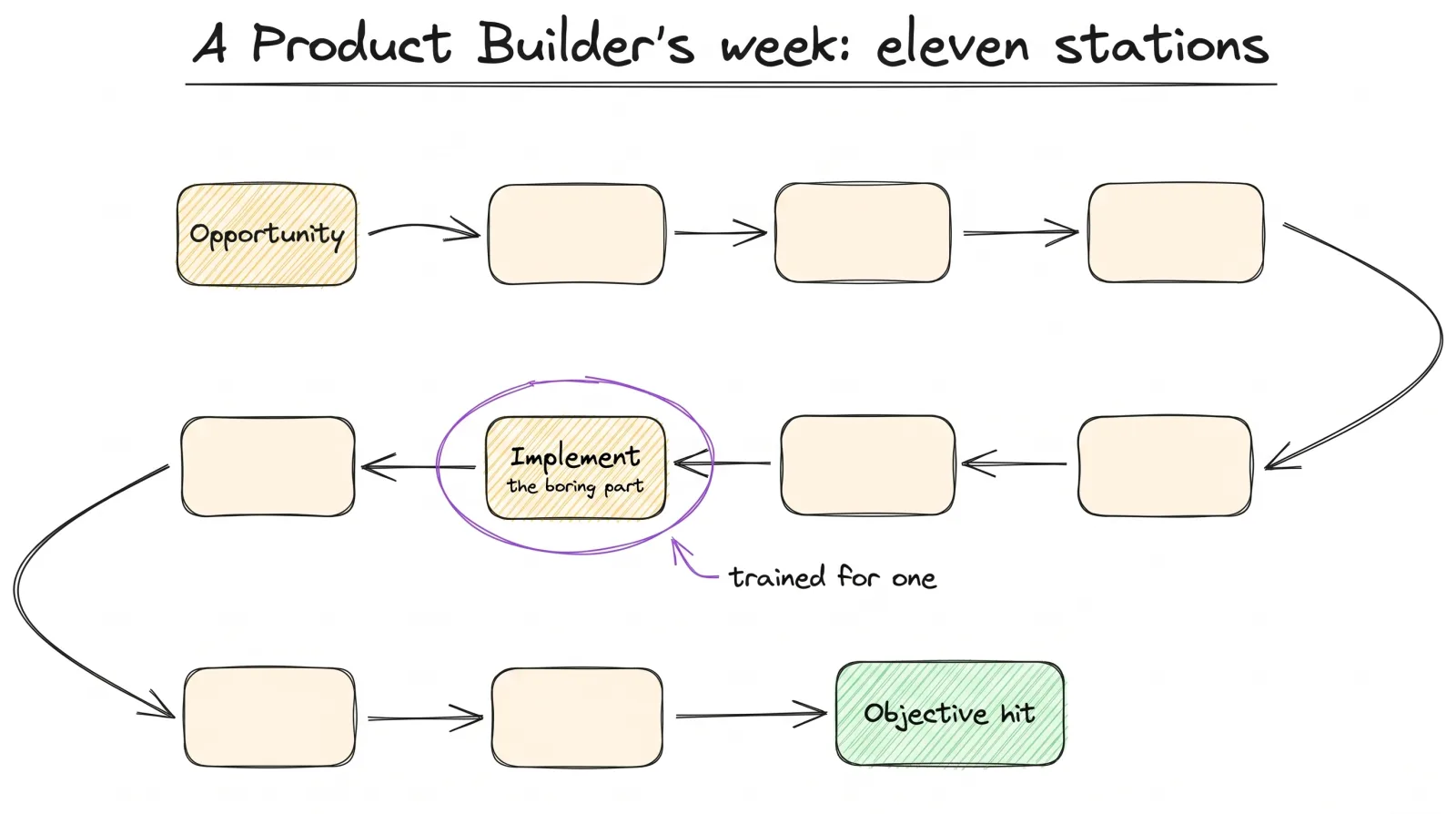
His week is not a sprint board either. It has eleven stations. The drawing at the top shows them, and this is the slide from the talk.
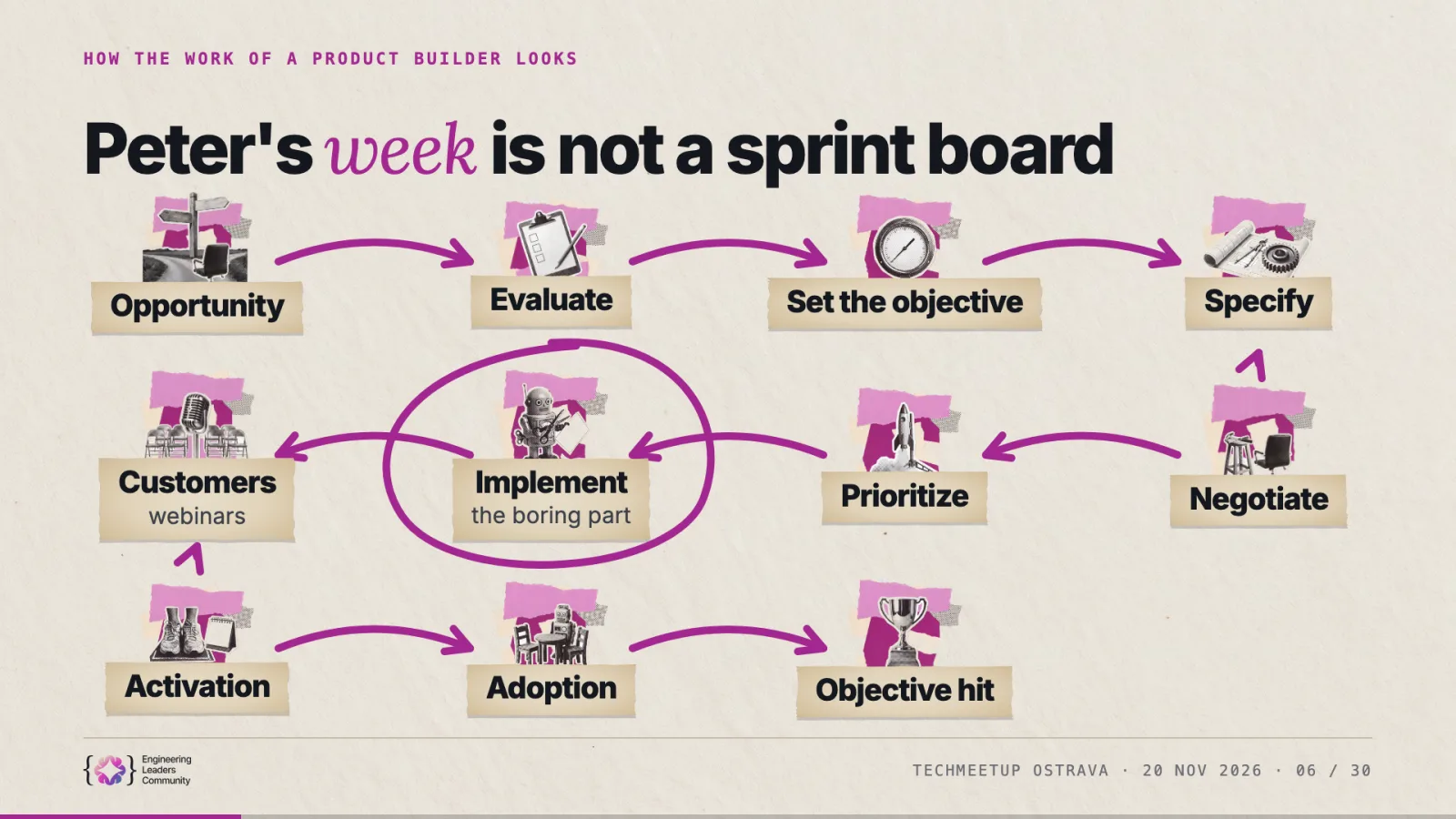
| Station | What Peter does | Who held it in a classic squad |
|---|---|---|
| 1. Opportunity | Spots where churn comes from | Product manager |
| 2. Evaluate | Sizes it, kills it if it’s weak | Product manager, analyst |
| 3. Set the objective | Writes the number he’ll be judged by | Head of product |
| 4. Specify | Describes the change for the agents | Product manager, designer |
| 5. Negotiate | Agrees scope with the teams it touches | Engineering manager |
| 6. Prioritize | Decides what goes first | Product manager |
| 7. Implement | Directs agents, verifies the result | Developers, testers |
| 8. Customers | Calls, webinars, demos | Customer success, marketing |
| 9. Activation | Gets the first use | Product marketing |
| 10. Adoption | Gets the repeated use | Customer success |
| 11. Objective hit | Reports the number | Head of product |
The station developers forget is number 5. An idea reaches development only after Peter convinced the people it touches, and no amount of technical skill replaces that. Station 8 surprises them too: Peter runs the webinar himself and asks customers to test the feature in a pilot.
Station 7 is the boring part. The agents do the typing, Peter checks what they got wrong. From the hiring side, it is also the station I see developers here trained and promoted for.
Deliver value, not Jira tasks. That is the whole difference. Quintin Botes, Lead Product Builder at Mews, puts it like this: “I am not here to wait for a perfect spec, pick up a ticket and disappear after the merge.” The job ad asks for the same person, someone who has “operated without a dedicated Product Manager or Designer”.
Why Europe has so few: rare seats, and a career map with one road
Two shortages meet here, and it helps to keep them apart. The first is seats. 266 against 820 is a count of openings. Gergely Orosz reads the wider hiring data the same way: “European-headquartered companies are more cautious about recruitment”.
The second is people. Developers come to me and say: “Marian, the market is broken.” I ask them whether it is the market, or them, because from the hiring side I see offers that were not on this market two years ago.
In my own records, career is the top question and the seat they name is a manager’s
I did not want to argue this from the stage only, so I counted.
My session notes first. Career moves are the top topic: 53 of 142 tagged sessions from 2024 to 2026, and 31 of the 60 mentees brought a career question at least once. The yearly shares are on my statistics page.
Show the numbers as a table
| Topic | Session notes |
|---|---|
| Career moves | 53 |
| Goals and OKRs | 32 |
| AI adoption | 20 |
| Delivery | 19 |
| Process | 19 |
| Manager or Staff track | 19 |
| Team structure | 18 |
| Managing up | 18 |
| Culture and change | 14 |
| The person behind the role | 14 |
| Hiring | 13 |
| Underperformance | 11 |
Which seat do they aim at? With an AI assistant I went through the 53 career notes, quote by quote. Where a note names the seat, it is a management seat 16 times, a product manager seat twice and a solution architect once. Staff Engineer comes up in three more notes, on the manager-or-specialist question, all from 2026.
Then my inbox. Since August 2024, 34 people wrote down why they wanted a first call, and twelve of them wrote about their next career step. Five named a management seat. Product Builder, product engineer, Staff Engineer: zero.
Show the numbers as a table
| Requests | People |
|---|---|
| Wrote why they want a call | 34 |
| About their next career step | 12 |
| Named a management seat | 5 |
| Named Product Builder or Staff | 0 |
Two cautions. The notes are a sample, about one session in seven since 2024. And my door says engineering leaders, so it leans to managers. Read it as one desk in Central Europe, not as the market.
Still, the two sets agree. Career is the first thing people bring, and the map in their heads has one main road, up the management ladder. The seat this post is about is not on that map yet.
It started to move this year. The manager-or-specialist question came up in 10 of 55 sessions, against 6 of 59 in 2024.
And the words “product builder” or “product engineer” sit in my notes from seven sessions with six people, all since June 2026. In the two years before: zero, though those notes are short bullets and the 2026 ones are full recordings.
Why does the map have one road? Ask a senior developer in Prague or Warsaw what they did last quarter, and the answer is a project, a migration, a deadline. A customer number is missing, because the system around them didn’t ask for one.
Two reasons for that, as I see them from here. Neither is unique to Europe. Here they meet a small number of seats.
Organised by role, so the chain has no owner
Look at the right column of the table. A classic European squad splits the eleven stations among ten job titles, and a person who spent ten years in one station has not practised the other ten.
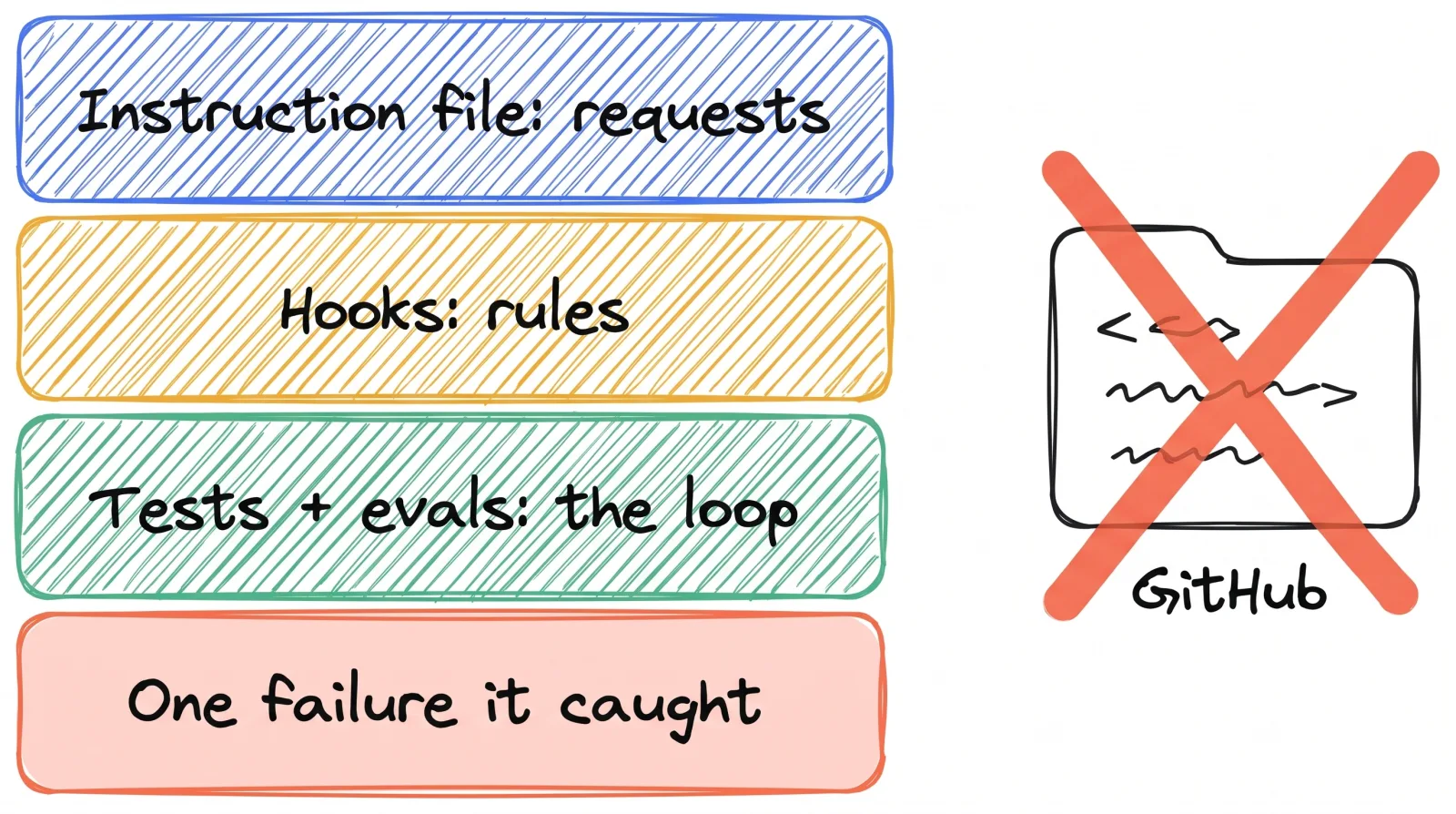
Few companies offer the seat, because it needs more than a new title. As I said on stage, a company has to build a hiring system for it and a software factory, the agent setup that lets one person ship. That takes time.
Mews itself only started to change this recently: in July 2026, by its own account, it replaced the traditional squad in several parts of R&D.
The seat pays the going rate, and the money sits on the Staff road
The Mews ad is the cleanest evidence I know, because it prints one title with four price tags. Next to each I put the median software engineer’s total compensation from levels.fyi (US, UK, Spain, Prague).
| Country | Mews Product Builder, salary band | Median engineer, total pay |
|---|---|---|
| US | USD 132,000 to 210,000 | USD 200,000 |
| UK | GBP 62,500 to 83,600 | GBP 92,398 |
| Spain | EUR 57,000 to 73,100 | EUR 56,847 |
| Czechia | CZK 1,191,500 to 1,600,000 | about CZK 1.56 million (Prague) |
In all four countries the top of the band lands between 0.9 and 1.3 times the local median. It is a band against total pay, so a rough comparison. The Czech statistical office gives a cleaner one, wage against wage: software developers averaged CZK 117.8 thousand a month in 2025, about CZK 1.41 million a year.
So Prague is priced like the rest. The seat asks for seven or more years and eleven stations, at about the going rate for a developer, and a senior developer does that sum in ten seconds.
The money sits on the Staff road. In Prague, Productboard lists a Staff AI Product Engineer at CZK 2,295,000 to 3,305,000, and Everpure, the top payer on the same levels.fyi page, sits at about CZK 3.29 million. In the Productboard ad, “PMs own what gets built and when. Engineers own how.”
Why take the Product Builder seat, then? On stage I said these seats pay close to Google level. The public bands show that for Staff, and not yet for the Product Builder. So the premium is my bet for 2027, and I have no number to link to.
The reason for the bet: in a product company the other choice is an implementation seat, and that is the one I expect to thin out.
So the people for these seats have to be grown at home, from the developers, architects and product managers we already have.
The strongest objection comes from Marty Cagan. He argues that a product manager who builds with Claude Code is “actually building for a very different purpose than the engineers”, to learn whether something is worth building, and that the two jobs stay distinct. Mews agrees on its own blog: “That does not mean Product Builders replace squads”.
They’re right that discovery and delivery are two different activities, and that squads stay. It doesn’t change the supply problem. The seat asks one person to hold both, with one number on top, and Europe has very little practice in raising such a person.
The best candidates have worked outside station 7
This is the claim a room of developers likes the least.
The best candidates for the Product Builder seat are solution architects, product managers and solopreneurs. Senior developers were trained to wait for the spec.
That is my position from the hiring side, and you’re free to fight it. The hiring side, for me, is Mews, where I was VP of Engineering, and the career moves of the people I mentor.
On stage I asked the room for one thing: stop thinking about yourself as a super senior engineer. That is not where the strength is today.
A solution architect already owns trade-offs across teams. A product manager already owns a KPI. A solopreneur already ran the whole chain alone, from the idea to the invoice.
The business didn’t have to succeed. The person knows what an MVP is, and the attempt is the proof. With agents doing the implementation, the coding bottleneck is gone and the scarce part is the work around it.
The ads don’t go as far as I do. The ones I quote here ask for years of engineering first, seven or more at Mews and five or more at Linear.
What they add on top is the part a pure developer career doesn’t give. ElevenLabs, in an enterprise engineering ad with “no PM to define everything first”, wants someone who “has worked directly with customers as a forward-deployed engineer, solutions engineer or founding engineer”. Linear wants someone “comfortable working without heavy PM overhead” who can “shape the problem, not just implement a solution”.
So read my claim precisely: your seven years count when a part of them was spent outside station 7. Peter is a developer, so the door is open. It opens for the developer who can show work outside implementation.
How to land the seat: the skills and the ten steps
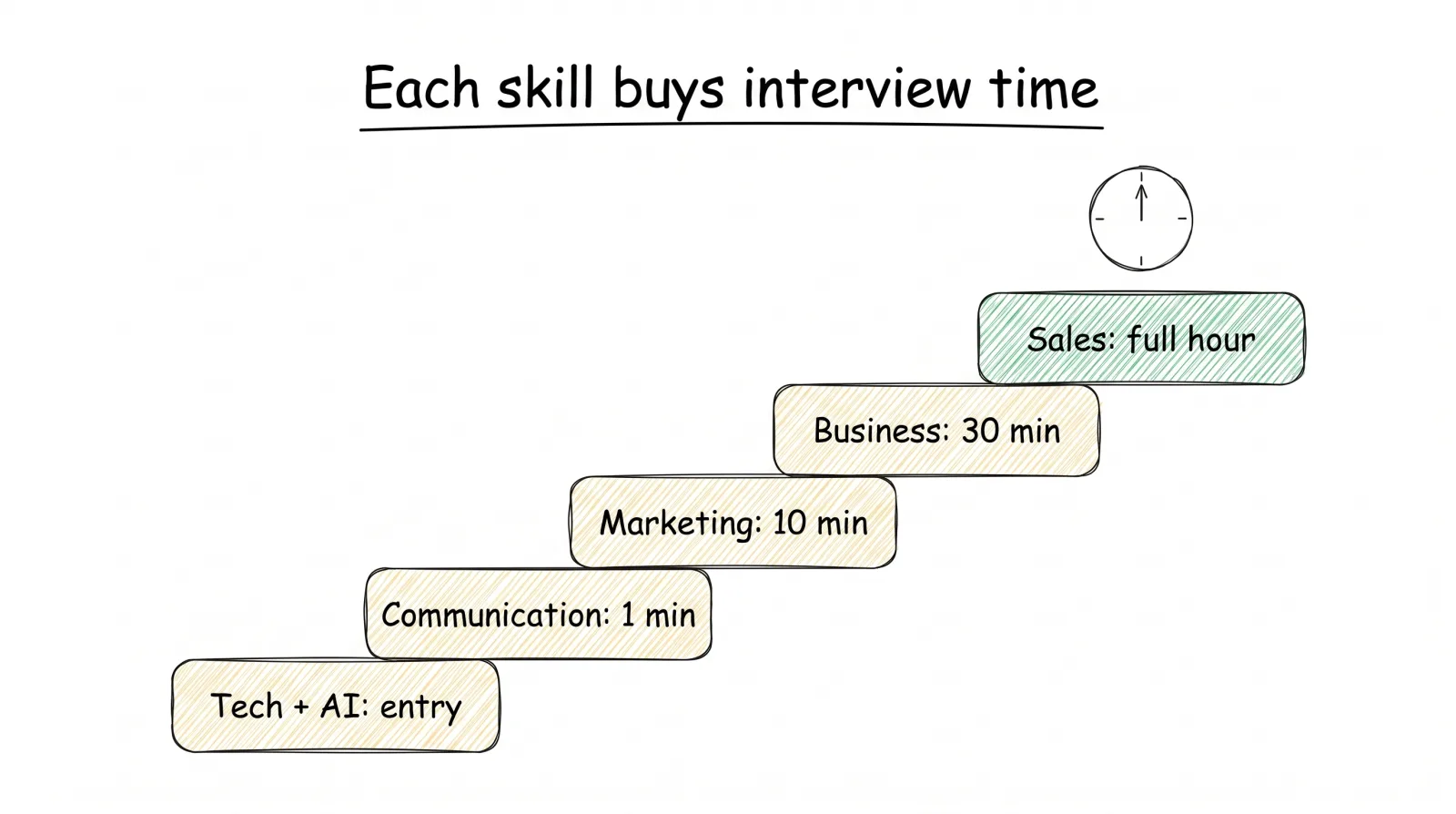
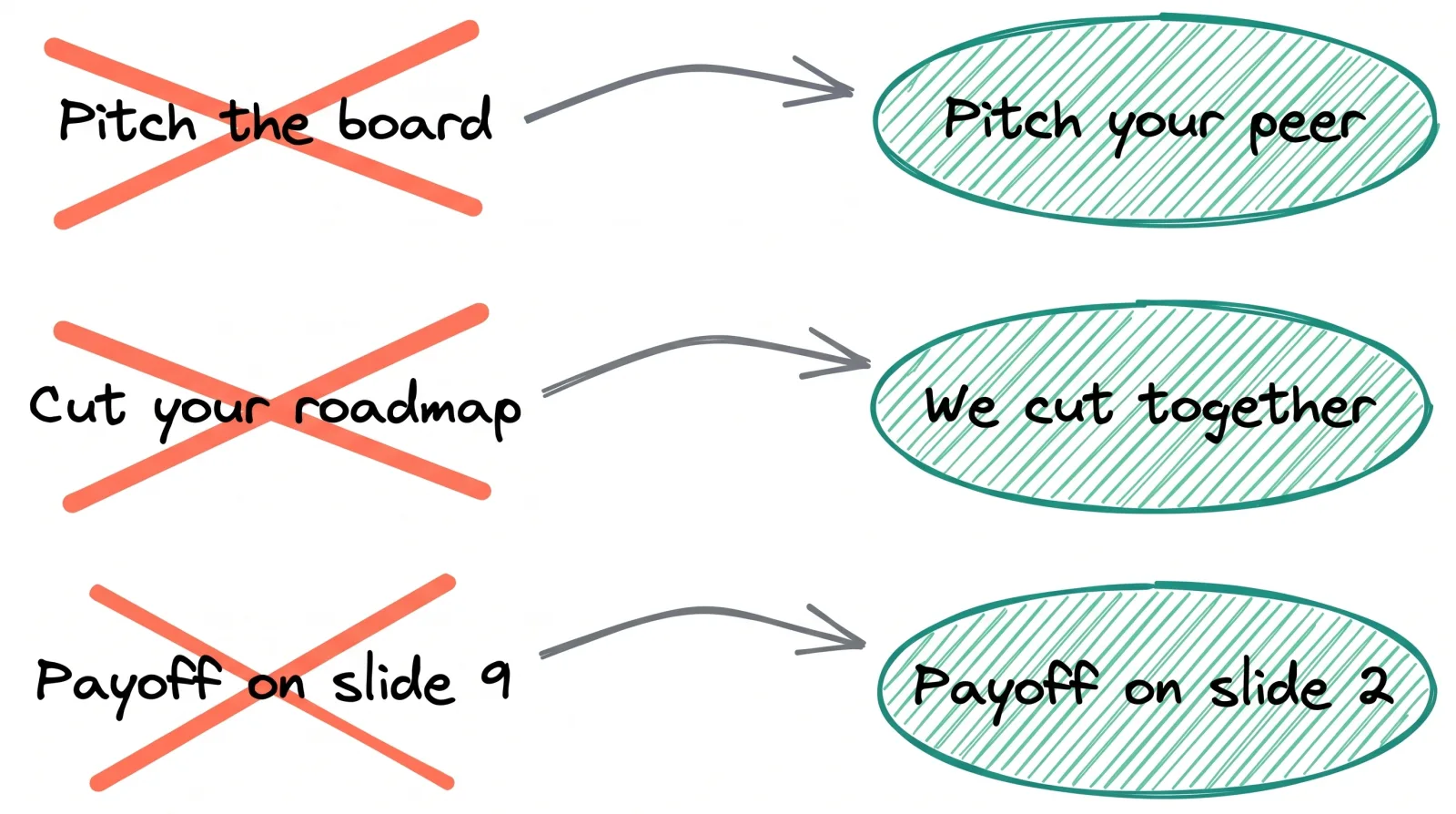
The practical part has its own post: How to Become a Product Builder: 10 Steps. It covers the six skills that get you hired, how much interview time each one buys, and the ten steps I take with people going for this seat, shown on Peter.
In 2027 the old seats thin out and two remain
My prediction for 2027, and it is a bet, not a statistic: the developer, engineering manager and director seats shrink into two. Product Builder, or Staff Engineer. Squads stay, as Mews says, and product managers stay, as FTMO’s own ads show. What I expect to thin out is the seat that only implements and the seat that only coordinates.
If you’re an engineering manager, the table of eleven stations is your map: mark the ones your team hands to somebody else. I described the manager’s side in the 2027 career fork.
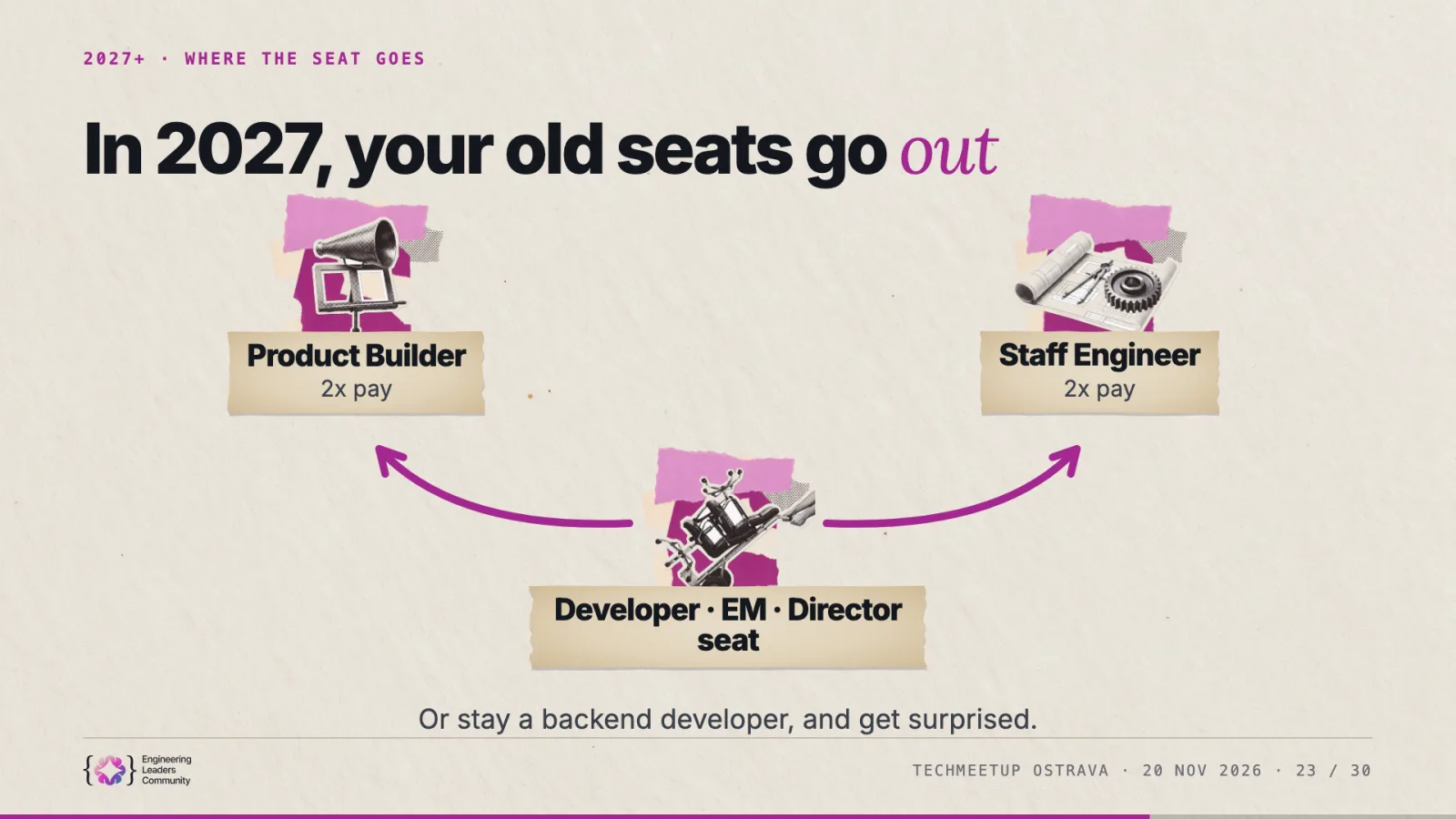
Which one is yours depends on the company type. Product companies such as Vilgain and Mews need Product Builders, people close to the customer. Deep tech companies such as Snowflake, FTMO (which hires both kinds) and Everpure need Staff Engineers, people who own the hard platform. Find your vector.
For the Staff seat the ten steps stay and the proof changes: a platform number such as cost, latency or reliability, a title that names the domain, and a pitch about the hardest system you own.
On pay, the numbers above stand. The CZK 3 million range is possible in Czechia today without moving, and so far the public proof of it sits on the Staff side.
The third option is to stay a backend developer, and get surprised.
A step you can do today: the free digital footprint check takes a LinkedIn URL, scores what the internet knows about you, and recommends what to fix first. The slides from the talk are here.
How many of the eleven stations did you touch last quarter?
[Writing time: 6h]