“When I got laid off, I was even happy. But at the back of my head was this thing: maybe I will not find another job.”
A mentee told me this in our fourth session.
A digital footprint check tells you where you stand. It scores what a stranger finds when they look you up, from 0.4 to 1.7, where 1.0 is a typical 2026 profile.
He’s an engineering leader with twenty years behind him. On this scale he went from 0.9x to 1.17x. The steps have names, so he went from “Nearly there” to “Worth a second look”.
He has no new job yet. Here is what we changed, what his own check found, and how you run yours tonight: by hand in ten minutes, or with the free AI skill I built and ran on myself first.
His check found proof he had forgotten
He ran a footprint check on himself, and it came back mostly positive.
It found interviews and a mentoring role he had forgotten existed. He added them to LinkedIn Featured and filled in what was missing on his profile.
The check also told him that his last public appearance was in 2025. It suggested a meetup or a podcast next.
We applied three specific steps:
- A stage. I invited him to speak at my meetup, the Engineering Leaders Community. His talk outline is in. The talk itself is still ahead of him.
- A better GitHub. We improved his GitHub. What strong looks like there is in the table below.
- The decision makers, in person. At the meetups I connected him with the decision makers directly. Of the three, this was the most important one.
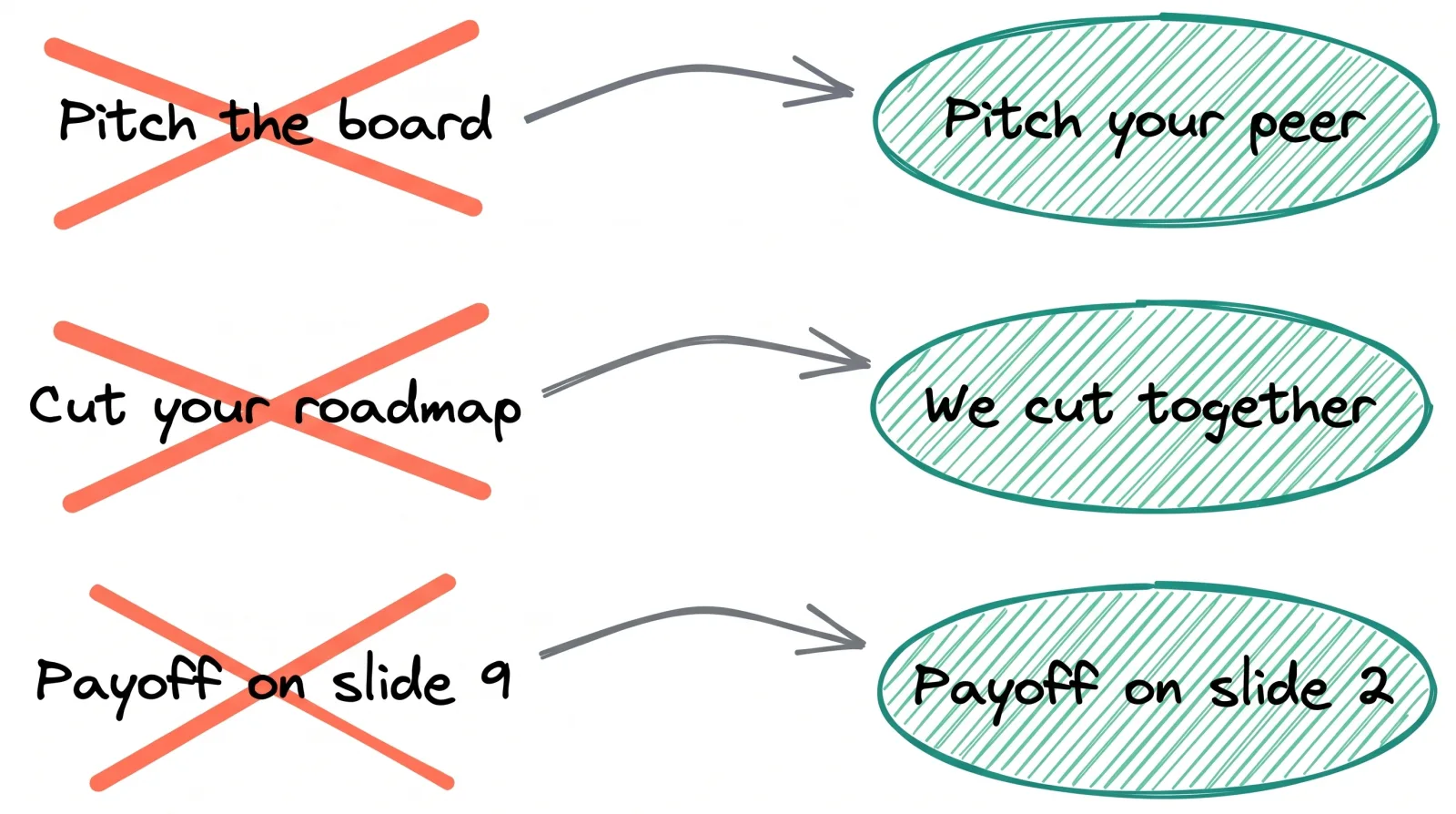
None of the three was a CV rewrite.
His one-minute pitch moved too. On 2 October 2026 I rated it 5 out of 10: no differentiator, no numbers. On 12 November it was close to 8 out of 10, and it leads with numbers now.
Most importantly, we removed his imposter syndrome. That’s my label. His own words are more careful, and the sentence from the top of this post goes on like this:
It’s a little thing, but it’s still there. With your sessions you are giving me confidence that I will.
He also said:
I know where I will stand. Here it is eight out of ten or five out of ten, but you’ll make it better. Here are the opportunities. Here are the companies.
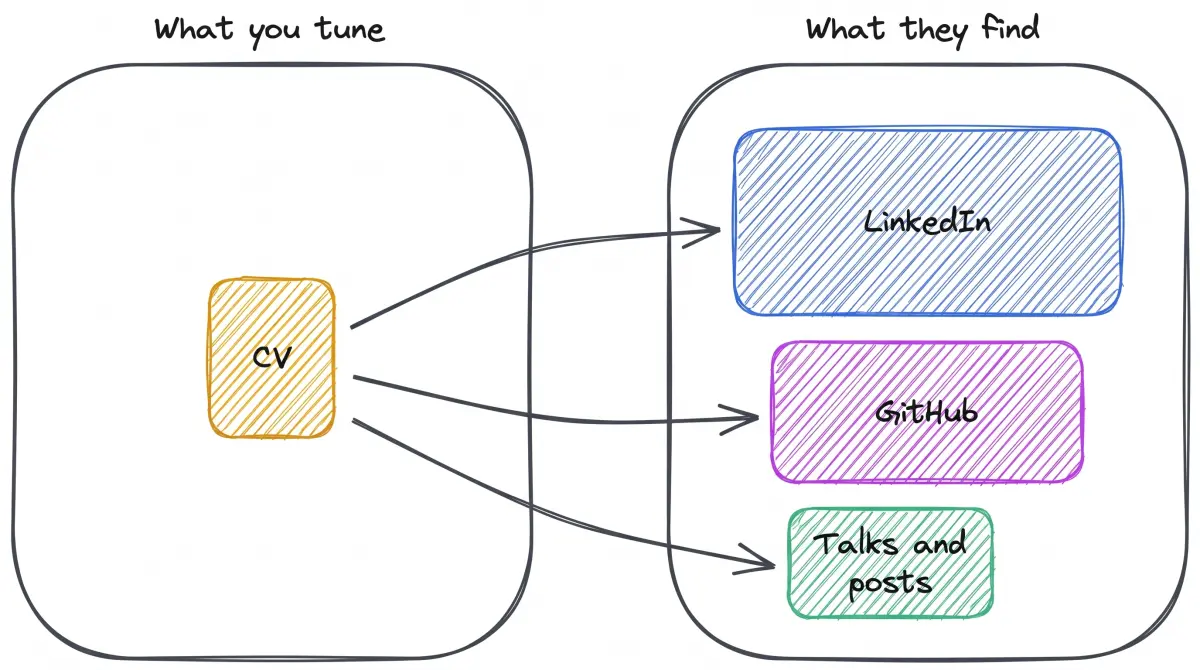
You tune the CV. They look you up
I open my talks with one sentence. A person comes to me and says: “Marian, I sent out hundreds of CVs and I have low conversion. Nothing comes back.”
What you tune is the CV. You rewrite it with AI for each job ad.
What they find is the rest. LinkedIn describes its own AI agents as helping hirers “review job applicants by matching their data to the hirer’s job qualifications”. In SHRM’s 2025 survey of 2,040 HR professionals, AI adoption in HR tasks reached 43%, up from 26% in 2024.
People did it long before the tools. Back in 2017, 70% of employers used social media to screen candidates before hiring, in a Harris Poll of 2,380 hiring and HR managers for CareerBuilder.
My own read goes one step further, and I have no statistic for it. The company’s AI puts your CV next to your LinkedIn before a person reads either.
Lever, which sells recruiting software, tells employers that the hiring decision “stays with your recruiters”. I agree, and for you it changes little. A tool on the first pass and a recruiter on the second both judge what they can find.
You didn’t touch your LinkedIn, your GitHub, your talks and posts when you rewrote the CV.
Run the check by hand in ten minutes
On my own run the skill did four things. You can do the same four by hand, with no tool.
Search your name like a stranger
Put your full name in quotes and add one word at a time: your employer, your city, github, talk, podcast. What comes up in ten minutes is what the other side works with. It can also be proof you forgot about, like my mentee’s interviews.
Count only what is provably yours
A page counts when two signals match: the same employer, the same city, the same photo, or a link to it from your LinkedIn. A GitHub account that only shares your name scores nothing. So link your GitHub from your LinkedIn first.
Put the CV next to your LinkedIn
Mark each number and each title that disagrees. I call them digital ambiguities. The example in the skill: LinkedIn says 12 people, a talk says 30.
Read your last 12 months
Count your own posts, talks and articles. Reposts and likes don’t count as your voice. My mentee’s check told him his last public appearance was in 2025.
What typical looks like in 2026, and what strong looks like
Now compare what you found with the skill’s written anchors for a developer.
| What a stranger checks | Typical for 2026 | Strong |
|---|---|---|
| Headline | A role-based headline and a short About that says what you do | Business domain plus technical scope, like “Biometrics Data Engineer”, and the same line on GitHub or your site |
| Outcomes in your roles | A few lines per role on what was built, in activity words: worked on, responsible for | The last two roles each carry two or more results with a number, like “cut deploy time from 40 minutes to 4” |
| Proof of work | A GitHub profile with repositories, mostly forks, course work or old projects | One project of your own with a clear README that other people use, pinned and linked from LinkedIn |
| Your voice | A few posts, or one article, or one meetup talk in the last 12 months | Three or more talks, podcasts or long articles a year, or original posts that other people answer |
| Fresh and consistent | Activity in the last six months | Activity in the last 90 days in two places, and numbers, titles and dates that agree across your profiles |
Outcomes and proof of work are the two heaviest rows for a developer, 16 points out of 100 each. Scientific papers and patents count as proof of work too.
For an engineering manager, business and team outcomes weigh 18 points. Proof of work gives way to the scope you led and to people who vouch for how you lead.
The score has three fixed points. All criteria at typical give 1.0x, all at strong give 1.7x, and nothing visible gives 0.4x.
One LinkedIn link in, one number and a plan out
By hand you get a list. I wanted a number and a plan, so I wrote a brief for an AI skill:
input: linkedin profile. output: software developer multiplier score, based from digital footprint evidence only. Advice on what to improve in the next week, month, quarter, before you apply for a promotion or a new job.
The result is the Digital Footprint Multiplier, a free skill for Claude Code. It read my LinkedIn profile in my own Chrome, read-only, and then researched the open web. Back came the multiplier, the evidence behind each criterion, and a plan.
Each criterion gets a level with a name: not visible yet, a first sign, typical for 2026, ahead of most, strong. Anything above “not visible yet” needs a quoted line or a link. “Probably has” scores zero.
The wording comes from the same brief: “make the skill fun, not punishing but delivering an optimistic tone: Yes I can do that”. So a gap on your profile is “not visible yet”, and it arrives with the next action and the time it takes.
It installs with one command:
npx skills add marian-kamenistak/digital-footprint-multiplierYou need Claude Code with the Claude in Chrome extension, and you need to be logged in to LinkedIn in your own browser. Then type /digital-footprint-multiplier and your LinkedIn URL. The skill sits with my other free tools on the AI coaching tools page.
A bare number gets forgotten, so it got a name
The first time I saw a number with a label next to it, “1.27x = Hard to ignore”, I liked the label more than the number.
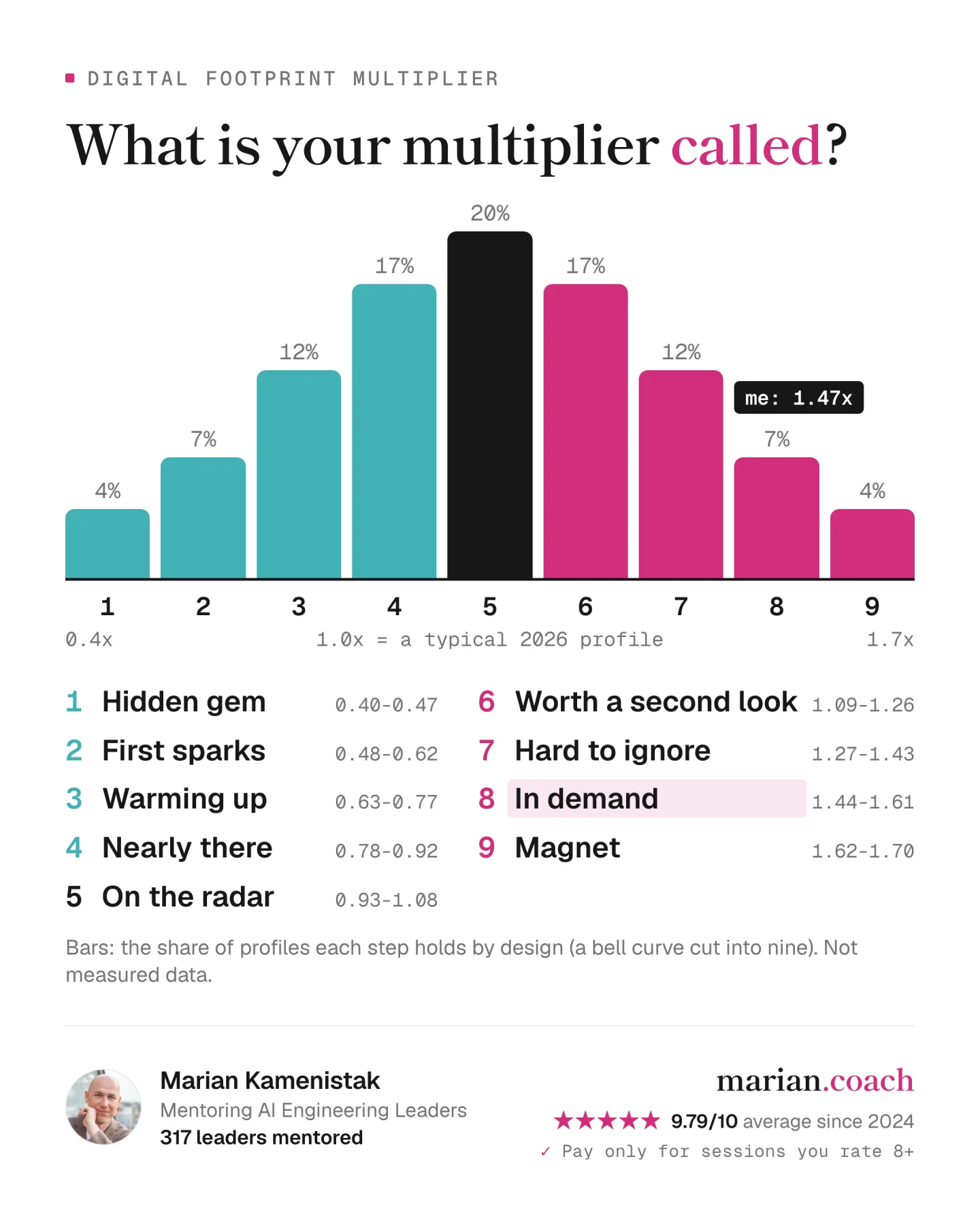
A name helps you to remember where you stand, as opposed to a decimal you have to decode. You can also ask what the next one is called. So I asked for nine categories, with the fifth one neutral, meaning 1.0. They went into version 1.1 on 12 November 2026.
| Step | Multiplier | Name | What it tells you |
|---|---|---|---|
| 1 | 0.40 to 0.47 | Hidden gem | The work is there. The internet has not met it yet. |
| 2 | 0.48 to 0.62 | First sparks | A few signs are out. One evening adds the next ones. |
| 3 | 0.63 to 0.77 | Warming up | The outline is visible. A few evenings make it sharp. |
| 4 | 0.78 to 0.92 | Nearly there | One or two fixes from a typical profile. |
| 5 | 0.93 to 1.08 | On the radar | A typical 2026 profile: complete, honest, easy to forget. Give people one reason to remember you. |
| 6 | 1.09 to 1.26 | Worth a second look | A recruiter stops scrolling. Give them one more proof. |
| 7 | 1.27 to 1.43 | Hard to ignore | Anyone who looks you up finds proof. Keep it fresh. |
| 8 | 1.44 to 1.61 | In demand | People bring your name up when a role opens. |
| 9 | 1.62 to 1.70 | Magnet | The roles come to you. Your job is to choose. |
My mentee started on step 4, “Nearly there”, at 0.9x. He stands on step 6, “Worth a second look”, at 1.17x. Two names up.
Say step 8 of 9, not top 7%
The bars in the chart are the size of each step by design. The steps are cut the way a stanine is, the “standard nine” scale for test scores, with nine bands that hold 4, 7, 12, 17, 20, 17, 12, 7 and 4 percent. Step 5 sits on 1.0.
A dataset of scored profiles doesn’t exist yet. So if you land on “In demand”, the sentence to use is “step 8 of 9”.
I ran it on myself first
A report opens with your name, your number and your step. Mine read: Marian, your digital footprint: 1.47x · In demand (step 8 of 9).
It still listed gaps on my own profile, and I fixed them the same day 🙂 So even at step 8, the list fit into one day.
The number leaves three things out.
It isn’t your skill. It measures how visible your proof is, and it says nothing about how good you are at the job.
It isn’t a salary. A 1.47x footprint doesn’t mean 1.47 times the pay.
It can’t see private work. Anything behind a login stays invisible, and each report ends with a section called “What I could not see”.
One rule comes with it. Run it on yourself, or on someone who said yes. Your visit shows up in that person’s “who viewed your profile” anyway.
Before you send the next CV
When a person tells me nothing comes back, this is my answer now.
Do the two-hour fixes first
The plan in the report is sorted by time. “This week” holds at least two fixes of under two hours each, and each one shows what it’s worth. “This quarter” holds one thing that needs other people: a talk, a project in use, a recommendation from a manager.
Compare it with your own view
The market value calculator needs no install. It asks you twelve questions and answers on the same 0.4 to 1.7 scale, with the same nine names. Where your self-score is higher than your footprint, the work is real and not visible yet. That gap is your plan.
Run it again
Tell the skill what you’re aiming at, a new job or a promotion, and the plan follows the aim. When the week’s fixes are done, run the check again and see if the name moved.
Get help with the quarter item
The quarter item is where my mentee needed another person, and that person was me. I invited him to speak, and I introduced him to the decision makers.
That’s where I come in for you too, in 1:1 mentoring for engineering managers and staff engineers. The longer read on raising your value is 10x your market value as a tech leader.
My mentee has no new job yet. He knows where he stands, and his talk outline is in.
What’s your step called?