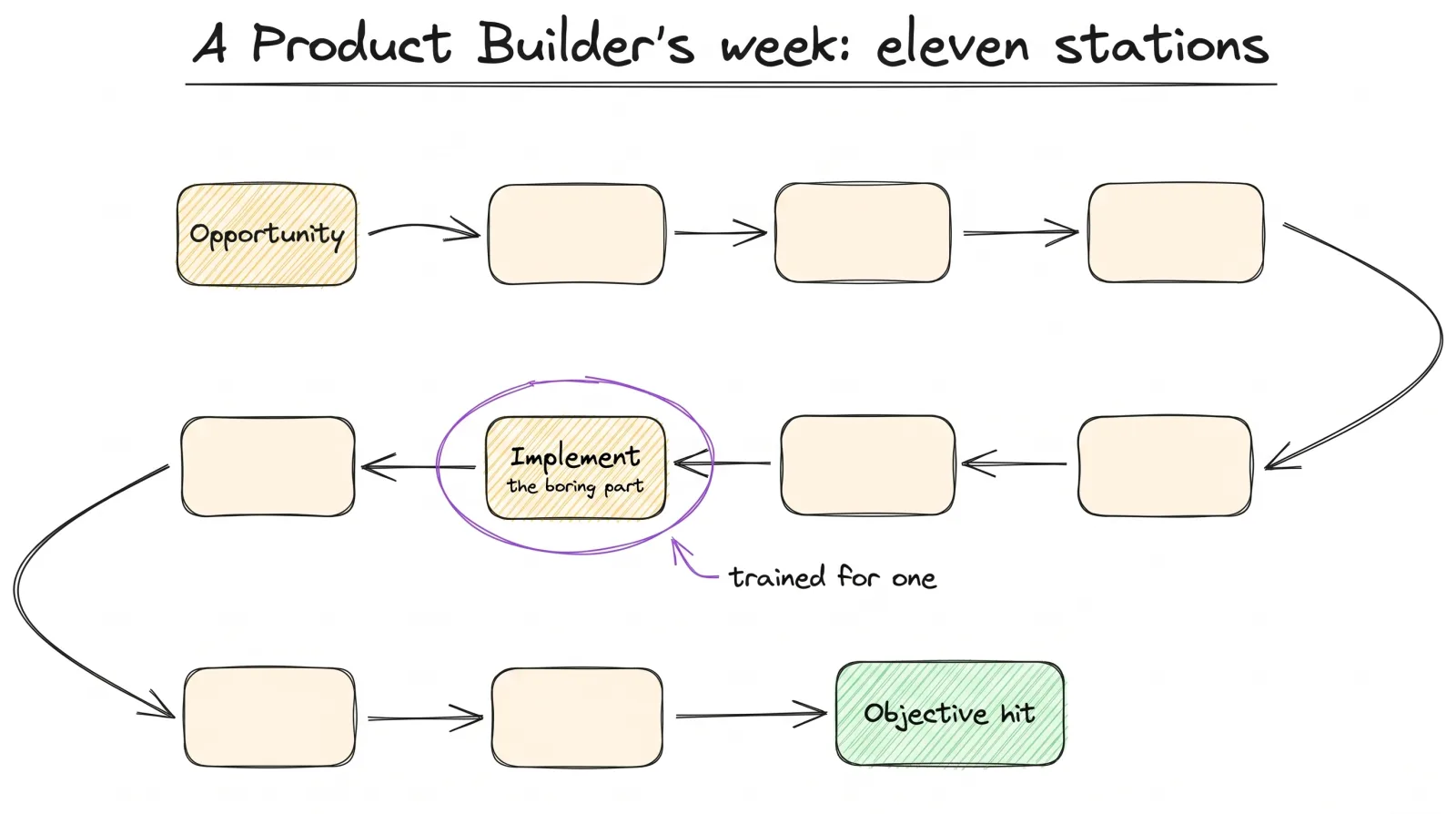
Peter is a developer I helped get hired as a Product Builder at Mews, where I used to be VP of Engineering. That is not his name. In the first part I described his week, eleven stations from a product opportunity to an objective hit, and why Europe has so few people for the seat. What the role is, I described in the Product Builder explainer.
This part is the practical one. How does a senior developer become a Product Builder, or an AI product engineer, as some companies call the seat? First the skills that get you hired, then the ten steps I take with people going for it.
Six skills, and the interview time each one buys
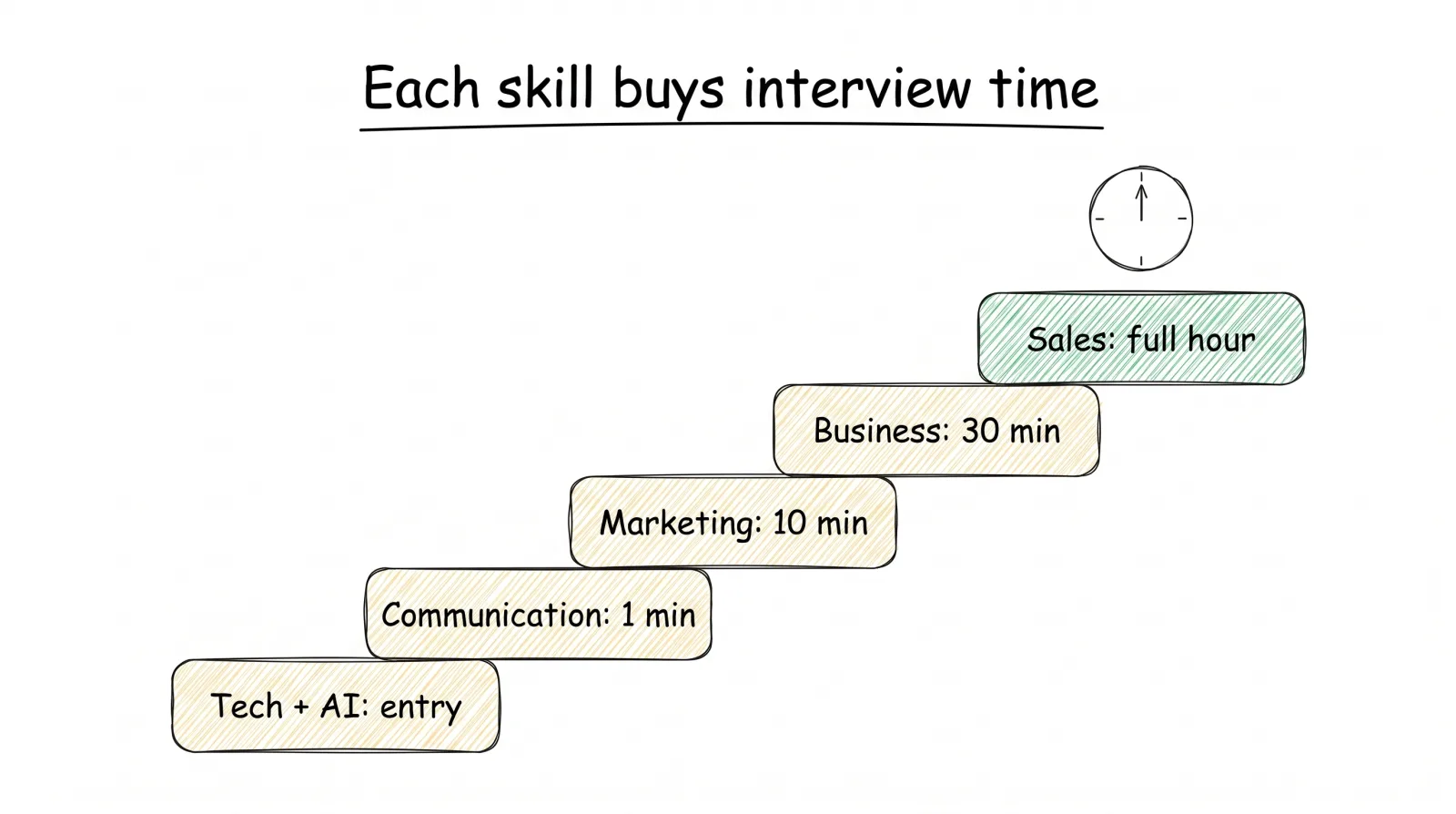
I interview for this seat with a clock in my head. It is my clock, not the market’s. The technical base gets you into the room, and each skill on top of it keeps me in the conversation longer.
| Skill | What it buys you |
|---|---|
| Technical background and AI | A must-have. Without it there’s no interview |
| Product mindset | The entry door |
| Communication | You have one minute |
| You understand marketing | I listen for ten minutes |
| You understand how the business works | You have thirty |
| You understand sales | You have the full hour |
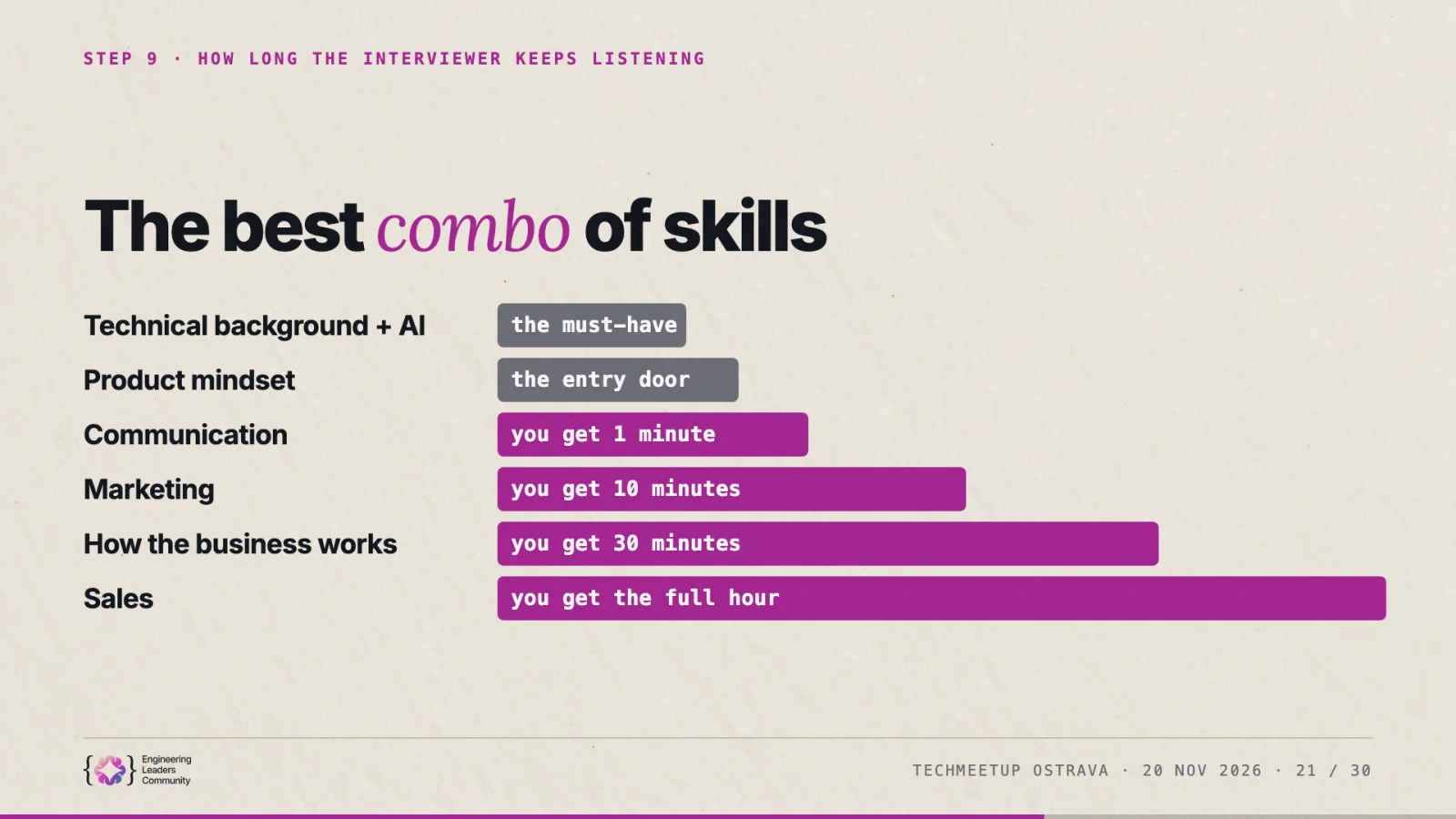
The far end of the table is the rare part. On the day of my Ostrava talk I met a technical person who is moving towards sales, and that is the combination I keep listening to.
One question I like to ask a Product Builder: what is your ROI? When the answer is “what is ROI?”, the hour is over.
The technical base moved too. FTMO asks for “about a year working AI-native, mainly by directing coding agents” and for “verification discipline”: you write the tests that catch what the agent got wrong. Productboard asks for “hands-on LLM experience in real products: prompt design, context management, evaluation”.
Typing speed is on neither list. The ads don’t say “sales” either. They say customer contact and shaping the problem, and I call the far end of that sales.
Ten steps to the Product Builder seat, shown on Peter
Skills that stay invisible don’t get a person hired. This is the order I work in with people going for this seat, as a new hire or as a promotion inside the company.
The steps come from my mentoring sessions. Career moves are the top topic in my notes from 2024 to 2026, with 53 sessions. Of those 53 career notes, 20 are about the job search itself, 8 about the interview and the one-minute pitch, 7 about a step up, 7 about direction and 4 about visibility. Pay is the main subject of two. People ask for the seat first.
Show the numbers as a table
| Main subject | Session notes |
|---|---|
| Job search, positioning | 20 |
| Interview, one-minute pitch | 8 |
| A step up the ladder | 7 |
| Direction: is this the move | 7 |
| Visibility | 4 |
| First months in a new role | 3 |
| Pay | 2 |
| Other | 2 |
To show what each step changes, I tell it through Peter. The counts above are real. Peter’s examples are illustrative: I made up the details, so that he stays unrecognisable.
1. Talk outcomes
Product, impact, mission, value. A sentence with a customer number in it beats “I rewrote the billing service”.
Before the step, Peter’s answer to “what did you do last year?” is: “I migrated the booking service, on the deadline.” When a candidate tells me they delivered on a deadline, it makes me smile. If the first minute is about projects and tasks, the interview may be over in five.
After the step: “Failed online check-ins went from 6% to 2%, and the support tickets about them dropped by half.” Same work, and now there is a customer in the sentence.
No customer number yet? Take one station outside implementation this quarter, a customer call, an activation, an adoption check, and attach a number to it. That number is your step 1.
2. Fix your digital footprint
You tailor the CV with AI. From what I see on the hiring side, the company runs its own AI to see how much you tailored it. Some go further and score your footprint: a GitHub project, a talk on YouTube, a blog post. And the person who recommends you opens your profile first.
Take Peter’s footprint before the step: a LinkedIn profile with a list of employers, and a GitHub account with no commits since 2021. A stranger who looks him up finds a job history and no proof. The fix is one published side project and one post about what it taught him.
I wrote a free check for it: give it a LinkedIn URL and it scores what the internet knows about you.
3. Change your title
“Senior Flutter Developer” says a stack. “Fintech Product Engineer” says a business domain and what you build. Same for “Backend Developer” and “HFT Staff Engineer”.
Peter is a “Senior Backend Developer”. The new line is “Hospitality Product Engineer”, because hotels are the domain he knows after six years in it. The first title invites a question about his framework, the second one a question about hotels.
4. Prepare a one-minute pitch
Your largest outcome, your differentiator, your potential. One minute, because that’s what communication buys you in the table above.
Peter’s first try takes four minutes and names nine technologies. The final version has three sentences.
The outcome is the check-in number. The differentiator is that he sits in on customer calls, which the other developers on his team skip. The potential is that he wants to own a number, and he says which one.
5. Be heard
Once a year, speak at a meetup, sit in a podcast, or write a blog post. The main stage of a conference can wait.
For Peter it is one talk, fifteen minutes at a local meetup, about the check-in fix, with forty people in the room. When I see that you spoke somewhere, I expect you can talk to people inside the company too. Skip it, and you leave money on the table.
6. Build a strong network
The ads you see on LinkedIn are the seats that were not filled through people. The good offers travel through private networks first, the internal one and then the external one, and LinkedIn gets what is left.
For Peter the step is small. After his talk he stays for an hour and talks to three engineering leaders, the kind of people who pass a name on before an ad is public. Go where the people who open such seats meet. The Engineering Leaders Community is free to join, and that’s where I’d start.

7. Show your AI skill
Two kinds of people call themselves AI experts. The first sits at the computer and presses “yes” on each plan. The second walks away and the agents keep working. Mine were working while I stood on that stage.
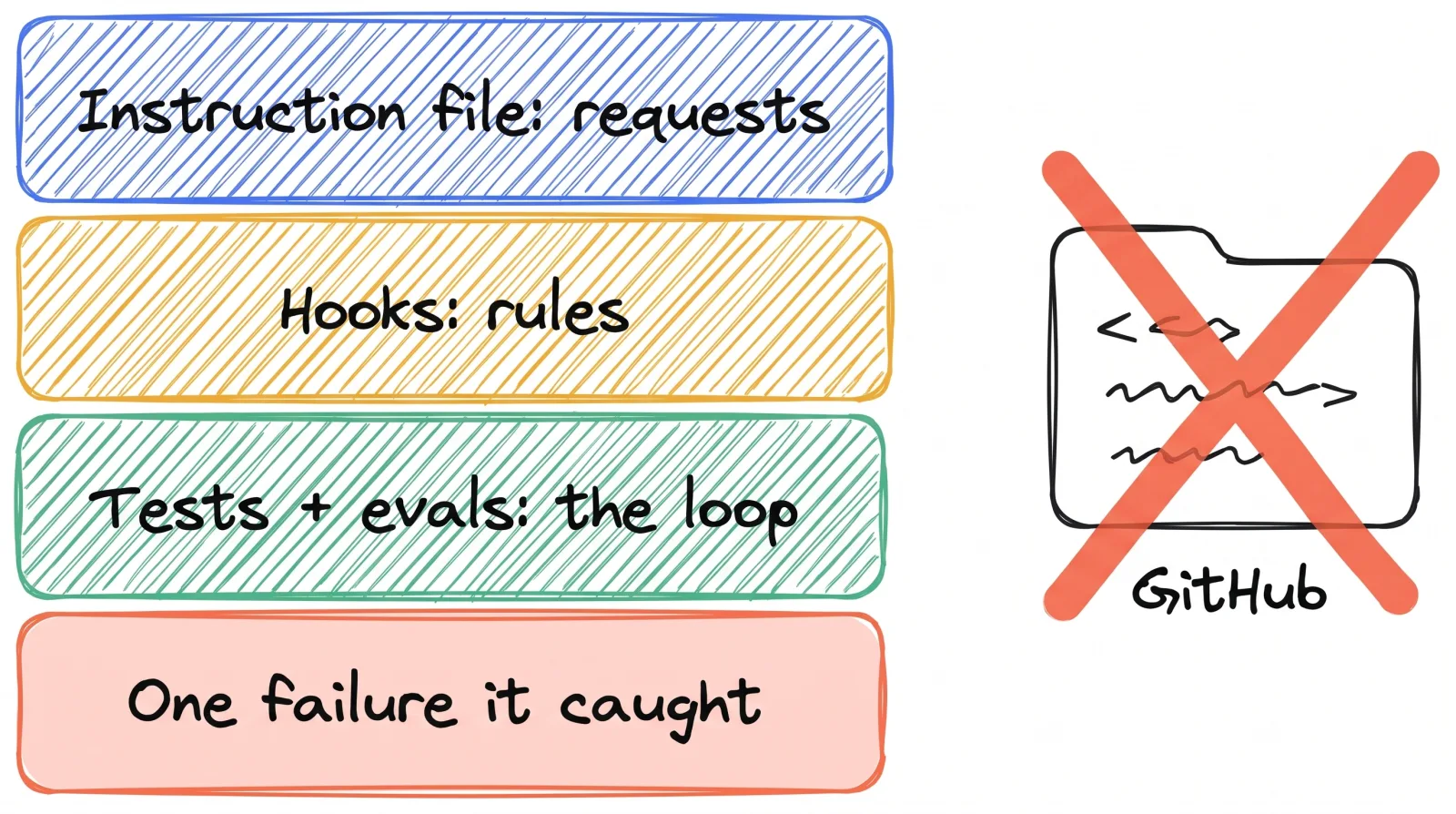
Say Peter starts as the first kind. He moves to the second by writing down how he works: what the agents may do alone, and what he reviews himself. That file goes with him to the interview, and it gives the CTO something to read before the first question.
There are five levels of working with AI, from asking to supervising. Know where you are, and bring your agent file (your CLAUDE.md). I described what interviewers look for in the interview post.
8. Delete your imposter mirror
The low self-esteem mirror lies. And it costs you the interview: when your voice trembles, I can’t tell whether the story is untrue or whether you only struggle to tell it.
Asked for his outcomes, Peter names two. Then he writes the list, one line per outcome with the number next to it, and it has nine lines. He reads the list before the interview. It is also the material for steps 1 and 4.
9. Think of yourself as a portfolio of skills
A portfolio that generates value, as opposed to an employee who generates a salary to pay the mortgage.
It has three layers. Peter’s main skill is backend development. His additional human skills are the customer calls and the negotiation with the teams his changes touch. His virtual skills are the agents and connectors he runs.
In the interview he asks the CTO one question first: “What is your problem?” Then he matches the portfolio to it. Mark the rows of the table above you can prove today, and pick one to add this quarter.
10. Get hired over a coffee
A Product Builder wants to talk with the CTO directly, over a coffee, to understand the mission and check the chemistry. No HR in between.
A coffee like Peter’s takes an hour when it goes well. By my clock, that means the whole table. That is what steps 1 to 9 are for.
For the Staff Engineer seat, the proof changes
The second seat I expect to grow in 2027 is Staff Engineer, in deep tech companies that need someone to own the hard platform. The ten steps stay and the proof changes. Your outcome in step 1 is a platform number such as cost, latency or reliability. Your title in step 3 names the domain, as in “HFT Staff Engineer”. And your pitch in step 4 is the hardest system you own. More on that seat in what a Staff Engineer role is all about.
The step you can do today is number 2. The free digital footprint check takes a LinkedIn URL, scores what the internet knows about you, and recommends what to fix first. The slides from the talk are here.
[Writing time: 1h, on top of the first part]