“Marian, I have a problem getting hired. I have no value on the market.” Nine years of C# in fintech, and that’s how the call started.
A Google software engineer salary in Prague starts at about CZK 2.2M a year, and that’s L3, Google’s entry level. The Prague median for a senior engineer is CZK 1.82M. Google pays its juniors more than Prague pays its seniors.
Let’s call him Tomáš. He called me on 23 October, the same day I recorded AI ta Krajta #71 about exactly this topic. His LinkedIn says senior data engineer, C#. He told me he doesn’t know where he is anymore, what he is, what’s happening to him.
Tomáš is a good engineer, and that’s the problem. He sits in the middle of the market, where good code buys you the median. Technical excellence became the entry fee. In 2027 the interviewer assumes you can code and spends the hour on something else: can you pick a problem worth solving and move a number with it.
Most senior developers I talk to in Central Europe prepare for the wrong hour. I did too, for years.
I was the geek who believed it mattered whether you write i++ or ++i in a Sun Microsystems Java certification test. I worked as a principal architect, then I grew the product engineering teams at Mews from 8 to 80. I’m 47 now, and technology alone bores me.
Prague already pays Google money. The middle doesn’t get it
The Google number is not a fantasy for Prague. It sits on levels.fyi, and Google isn’t even the top payer.
| Who | Per year | Source |
|---|---|---|
| Everpure, Prague, median | CZK 3.24M | levels.fyi Prague leaderboard |
| Productboard, staff backend product engineer, posted range | CZK 2.30-3.31M | Productboard job posting |
| Microsoft, Prague, level 63 | CZK 2.31M | levels.fyi Microsoft Prague |
| Google, Prague, L3 (entry level) | CZK 2.2M | levels.fyi Google Prague |
| Prague, senior software engineer median | CZK 1.82M | levels.fyi Senior SWE Prague |
| Prague, software engineer median | CZK 1.54M | levels.fyi Prague |
| Mews, Prague, median | CZK 1.36M | levels.fyi Mews Prague |
Read it with care.
levels.fyi is self-reported total compensation and leans toward people with something worth reporting; for Google in Prague only L3 has a solid number. Everpure was called Pure Storage until February 2026. The Productboard row is one posted range, not a median. Read on 8 November 2026.
Now the honest part. The top of that table is mostly US-listed companies that pay part of the package in stock. Part of the answer to “who gets Google money in Prague” is simply who you work for, and I’d be lying if I told you it’s all skills.
The other part is the level. Below about CZK 2M you find the medians, including Czech product companies like Mews. Above it you find senior levels at a handful of employers: Microsoft from level 63, Google’s entry band, Productboard’s staff role.
Look at how Productboard describes that staff role: “Engineers own more. Not just the code: the outcome it drives.”
That’s the line between the middle and the money. The levels that pay are paid for scope and outcome, and the entry fee gets you only to the door. On the podcast I said product builders in Czechia have Google salaries in 2026. The Productboard posting shows it at staff level; I haven’t seen it yet at the median, and Mews shows the job can change before the pay does.
The middle is where Tomáš is. When someone tells me they can’t find a job, I open their LinkedIn. It says Senior Java developer, and I probably know where the problem is. The stack in the headline tells a company what you type, not what changed because you typed it.
The full 2026 bands for engineers and managers are in the European salary bands post.
The job changed the day 40 engineers ran out of backlog
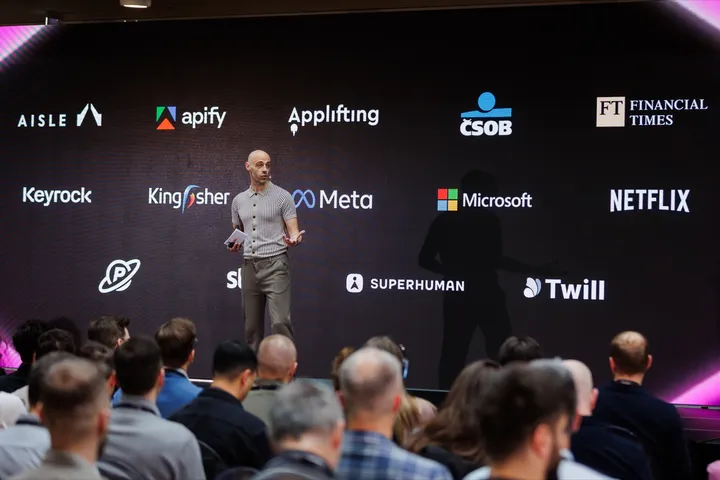
On 4 November I listened to Josef Starychfojtu, CPTO of Mews, on a ClosedLoop AI webinar about moving his whole R&D organisation to product builders. Mews has 15,000 customers in 85 countries, and Josef’s team is around 350 people.
The trigger was a model release. “Roughly when Opus 4.6 came out,” he said, the half of his people who were sceptics changed their minds. So they took 40 engineers, gave them unlimited tokens and asked one question every week: what limited you last week?
The first answers were access and more tokens. Then the answer changed: “I ran out of my backlog and I’ve started working on backlogs of other teams, because I have nothing to do, because my PM is working on Discovery.”
That week the bottleneck moved. Writing code stopped being the constraint, deciding what to build became the constraint.
After three to four months of planning they switched everyone in one day: “From tomorrow, you’re product builders.” Today Mews has over 200 product builders, about 20 staff specialists, five job descriptions in the whole organisation, and no juniors hired at the moment. Josef didn’t sugarcoat the cost. Alongside the change they let “a good portion” of the team go.
I said the same thing on the podcast two weeks earlier, from the mentoring side: “The problem is no longer the coding, but activation and adoption.” How do I get it to people, to the market, who will know about it. Engineering managers went through the same split, which I wrote about in the AI engineering manager post.
What the 2027 interviewer is scoring
Google still checks the entry fee, and pays well for it. Its candidate question bank on Aced lists classics like “Edit distance” and “Reverse a linked list”. But Google’s Prague seats are few, and for the rest of the market the entry fee buys the median. The levels above it are decided in the rest of the hour.
Josef sees that rest of the hour in their hiring already. The people who apply for these roles “are very different people from background, skills, and every possible angle”, he said, “much more entrepreneurial, much more well-versed across multiple disciplines.”
My own rule is shorter. I don’t take anyone into a company without product thinking. Knowing Java or C# is the absolute standard. Here’s what gets scored on top of it.
Can you move a metric
Every Mews product builder owns one outcome metric. Josef’s example: if you own the booking engine, your number is the booking engine’s conversion.
In an interview this becomes “walk me through a product feature you owned end-to-end that moved a key metric” (startup.jobs). This is the question Tomáš’s headline can’t answer today. A senior without a number has nothing to say here.
Can you judge code you didn’t write
Canva lets candidates use AI in its interviews, and one of the things it scores is plain: “Can they identify and fix issues in AI-generated code?” For Meta’s AI-enabled round, one candidate guide sums up the test as “Can you defend every line of code, including lines the AI wrote?”
Can you break a vague problem down
The same Meta round starts without AI: “Can you break down a vague requirement into concrete technical decisions?” Seniors who jump straight to the solution lose points here, because the AI can jump faster.
Will you talk to customers
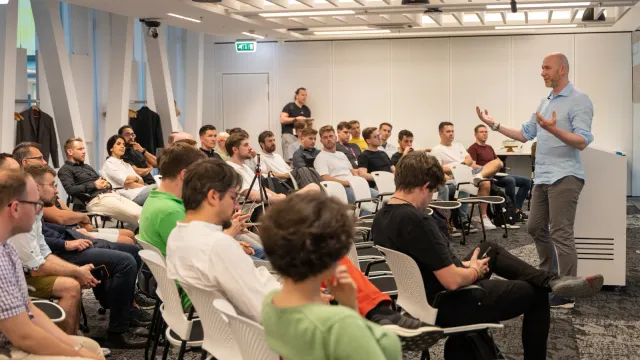
Mews ran a two-day offsite for 350 people to teach product, design, finance and customer interviews, with real customers on stage. The surprise for Josef: the happiest product builders are former PMs. My question to every engineer I interview: when did you last talk to a customer, and what did you change because of it?
Can you kill your own idea
The product.engineer hiring guide asks for a feature you killed and the data that killed it. I run my own business ideas through an AI skill overnight: it pings the target customers, drafts the site and the pitch, and checks the economics. In the morning I either put money in, or the idea is dead. More than once it battered me like a little boy, and thank you for that, because I would have spent a lot of time and money on them for nothing.
Technical excellence is the entry fee. Outside a few Google seats, the entry fee buys you the median.
The fair objection: specialists still matter
One of my co-hosts on the podcast works in finance now. Numeric precision is the whole game there, and even Claude warned him against rewriting their system in certain technologies. Being the expert who can judge the AI’s output in that stack “can still be a skill that has its price,” he said.
He’s right about the seat. Mews keeps around 20 staff specialists next to 200+ builders for the hard engineering problems, so at Mews about one seat in ten is a specialist seat.
Assembler-level depth, like high-frequency trading, is rarer still. Most developers in the middle aren’t there, and they suffer because they can’t define where their value is. Even my co-host agreed that engineers are starting to spend more time on the business domain.
Build your portfolio in three layers, and put the language at the bottom
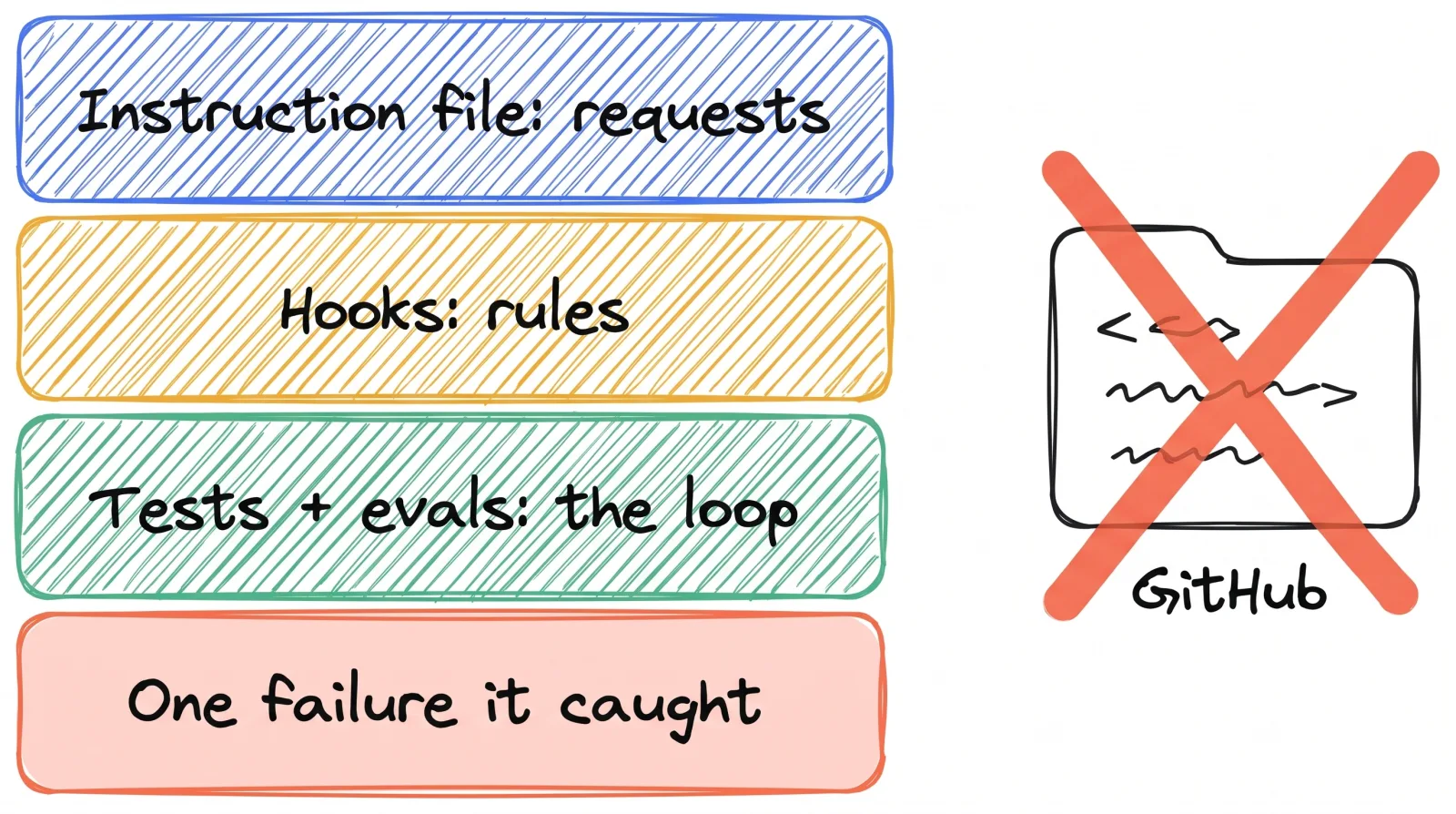
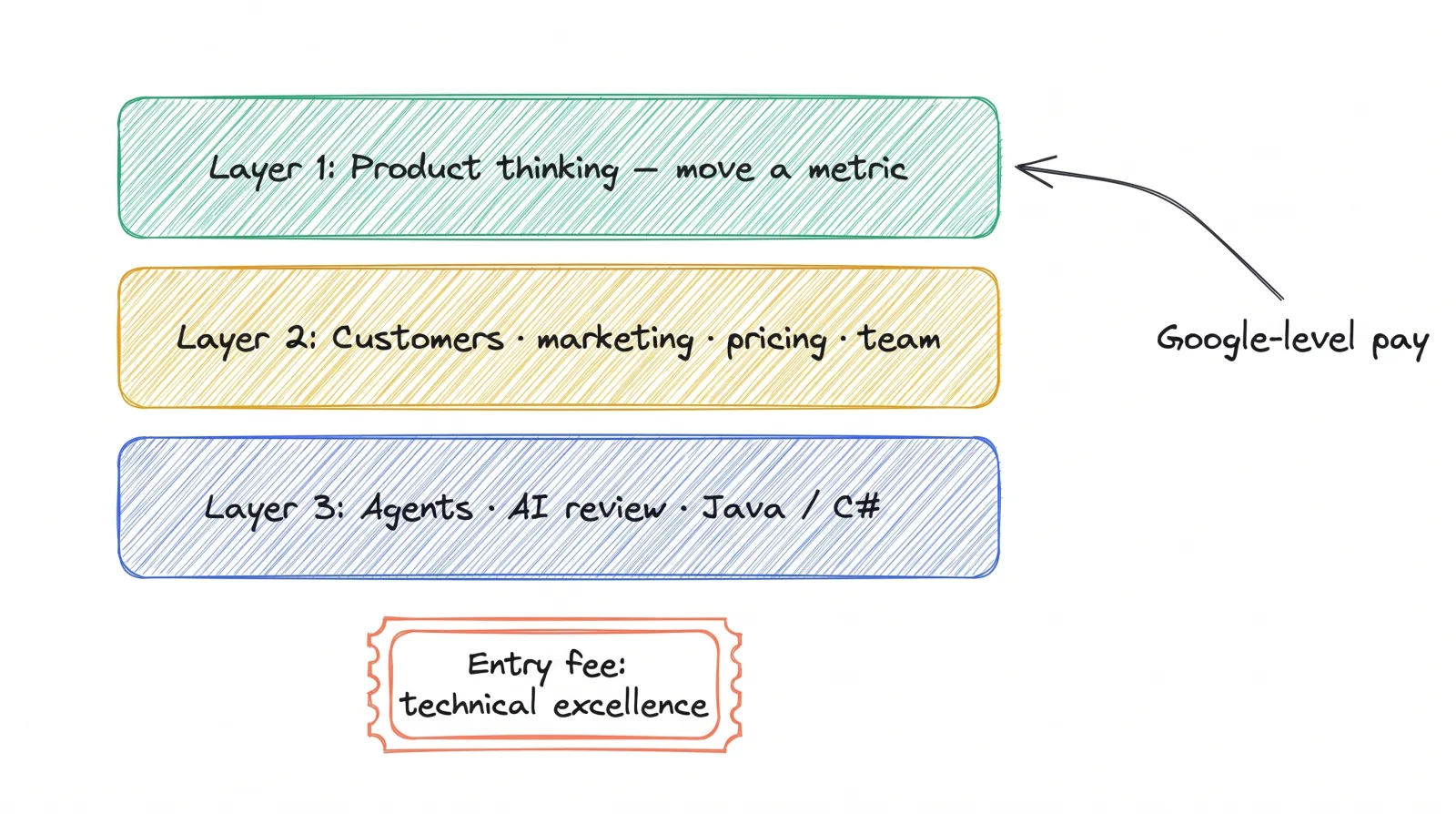
The portfolio that pays in 2027 has three layers. The language you learnt in 2015 didn’t disappear, it moved to the bottom, where an agent runs it for you.
| Layer | What it is | Put in your portfolio |
|---|---|---|
| 1. Main human skill | Product thinking: pick the problem, own the outcome | One feature with a before and after number |
| 2. Additional human skills | Customers and sales, marketing (activation, adoption), pricing basics, storytelling, keeping a team together | Customer calls you ran, a launch you wrote, an adoption number |
| 3. Virtual skills | What agents run for you: Java, C#, frameworks, tests, reviews, overnight runs | The setup that ships while you sleep, and how you check its output |
Layer 1 is what the money is attached to
Product thinking means you decide which problem is worth solving and you answer for the number afterwards. This is the layer Google-level pay is attached to, because it’s the part a company can’t buy from a model.
Layer 2 decides if anyone uses what you built
A builder who can’t sell the idea to customers, or get a launch in front of them, ships into a void. Josef named one more skill here I didn’t expect: keeping a team together. “People will become very lonely,” he warned, product builders “sitting on an island”, because builders rarely depend on each other for a code review anymore.
Layer 3 is where your stack lives now
As I said on the podcast, there’s a huge difference between sitting next to the AI and delegating to it so that I come back in the morning and the work is done. At Mews, some of the best staff engineers moved into a team that puts architecture rules into the shared agent everyone codes with. That’s what senior layer 3 looks like: you encode your judgement once and the agent applies it for 200 people.
To find your empty layer, run the Developer Value Calculator. Its impact score is layer 1, its collaboration score is layer 2, and the lowest one is your plan for next quarter.
The 10 interview questions to prepare before 2027
Only question 5 comes from Google’s own bank, because Google’s bank is mostly the entry fee. The other nine come from product-company hiring guides and interviewer advice published in 2025 and 2026, lightly shortened. They’re not from the Prague employers in the table, but they show where the rest of the hour is going. Each one maps to a layer.
| # | Question | Layer | Source |
|---|---|---|---|
| 1 | Walk me through a product feature you owned end-to-end that moved a key metric. | 1 | startup.jobs |
| 2 | Describe a feature you killed. What data made you kill it? | 1 | product.engineer |
| 3 | Walk me through how you’d decide what to work on if nobody gave you a task for two weeks. | 1 | product.engineer |
| 4 | 40% of users never complete onboarding. The CEO wants to add a chatbot. What do you do, and how do you decide? | 1, 2 | product.engineer |
| 5 | What’s your favorite product and why? | 1 | Aced, Google question bank |
| 6 | Present a case study of something you shipped: the problem, why it was worth it, how you measured it. | 1, 2 | product.engineer |
| 7 | How do you instrument features and define an events schema so you can trust your product analytics? | 2, 3 | startup.jobs |
| 8 | Break down this vague requirement into concrete technical decisions, build it with AI, then defend every line, including the lines the AI wrote. | 1, 3 | Meta round, candidate guide |
| 9 | Here is AI-generated code. Find the issues and fix them. | 3 | Canva |
| 10 | What do you distrust about this generated solution, and what would you test before shipping it? | 3 | Ardan Labs, interviewer advice |
Questions 1 to 6 have no answer you can memorise. Each needs a real story from your own work with a number attached, and that’s exactly where a “Senior Java developer” headline has nothing to give.
Prepare one story per question and write it down. If a question has no story, that’s your gap for the next quarter, not something to bluff in the interview.
What I’d tell Tomáš to do this week
Rewrite the headline
Take the stack out of the first line. Write what changed for whom, and the number that proves it. The stack goes lower, as a layer 3 detail.
Carry one feature past the merge
Pick one feature this quarter and own it to activation and adoption, as opposed to stopping at the pull request. Instrument it before you ship, otherwise you’ll have no number to bring to the interview.
For a data engineer like Tomáš the feature is a pipeline or a dashboard. The number is what it costs to run, how fast someone gets an answer from it, or one decision a manager made because of it. Without a job right now, take the last one you had and dig that number out of your memory and your old reports.
Run your next idea through a kill test
Before you spend a weekend building something, let an agent argue against it overnight: who has this problem, who would pay, what kills it. It will help you to drop the weak ideas cheaply.
Prepare ten stories
Use the table above. Ten real stories, each with a number, is a better investment into your next offer than another certification.
Tomáš’s story isn’t finished, so I can’t give you his outcome yet. I can give you the first week.
This isn’t for everyone, and Josef said it first: “I don’t think this is for everyone.” If you love coding alone in the cellar, keep it for weekends and hackathons, or go on purpose for the specialist seat, the one Mews keeps for one person in ten. Both are fine choices. Waiting for the market to come back to the old job isn’t one.
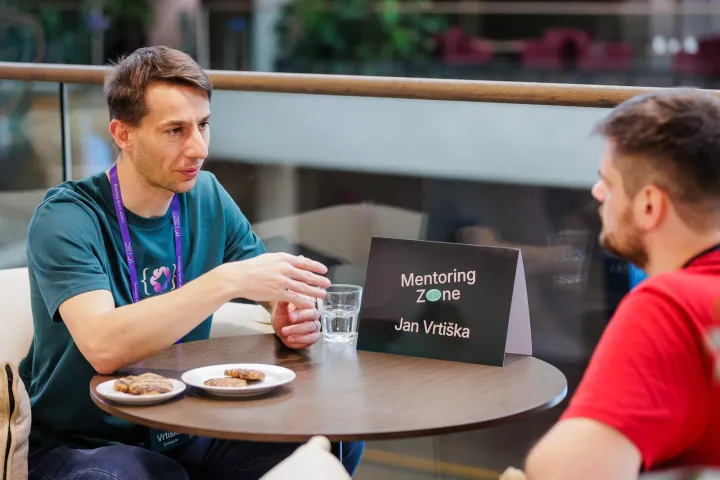
So, if the stack disappeared from your LinkedIn headline tomorrow, which number would you put there instead? Working out that number with someone who hires for it is what staff engineer mentoring is for.