Coaching feels expensive when you’re paying for someone’s time. It stops feeling expensive the moment you’re only paying for a session that worked. The 8/10 rule is my guarantee: rate one under 8 out of 10, and I don’t charge you for it. The guarantee and the rate are public: 395 EUR a session, no call required to find out.
Most coaches bill by the hour because the clock protects them, not you. It runs whether the hour changed anything or not, so their risk is capped and yours isn’t. I don’t bill that way, and the reason isn’t virtue.
I don’t need your money. I’m financially retired. Seeing you grow is my payoff.
Mentoring keeps me sharp; it doesn’t pay my mortgage. That’s the one fact the rest of this post turns on.
A prospect asked me a couple of weeks ago whether he should book a continuous sparring package or a fixed number of sessions. Senior EM, Prague, at a large company.
- Know your specific problem? Take the fixed pack.
- Want long-term growth with no single sharp issue yet? Take the sparring one.
I trust myself to give him that answer straight because I don’t need to sell him either package.
Hourly Billing Protects the Coach, Not the Client
People ask me straight, more than I’d like: “Why the hell is mentoring so expensive?” I tell them they’re not looking for the price. They’re looking for the quality behind it, and I’m the stakeholder in that quality. I’m the guarantee of it.
Consulting Success argues the honest case for hourly billing: it feels safe, transparent, easy to explain. You work an hour, you charge for an hour, the client sees exactly what they’re paying for. That’s a real argument, not a strawman, and for a first-time client with no other signal to go on, it’s a fair one.
It’s also the argument that lets a coach off the hook. Transparent about the hours doesn’t mean transparent about whether the hours worked. Coachvox and the Institute of Coaching both push coaches toward value-based pricing instead, for reasons that are really about the coach’s own revenue ceiling. None of the three asks the buyer’s actual question: if I’m not paying by the hour, what happens when it doesn’t work?
Mine is, one session at a time. Score a session under 8 out of 10 and it isn’t billed. No discount code, no credit toward next time, no negotiation.
The guarantee doesn’t protect you from me. It protects me from getting lazy.
The 8/10 Rule: Rate a Session Under 8, It’s Free
The rule is simple and it runs every single time, not just at the start of an engagement. I don’t screen you once at intake and then coast. Every session gets scored, right after it happens, by you. Below an 8, I don’t get paid for it.
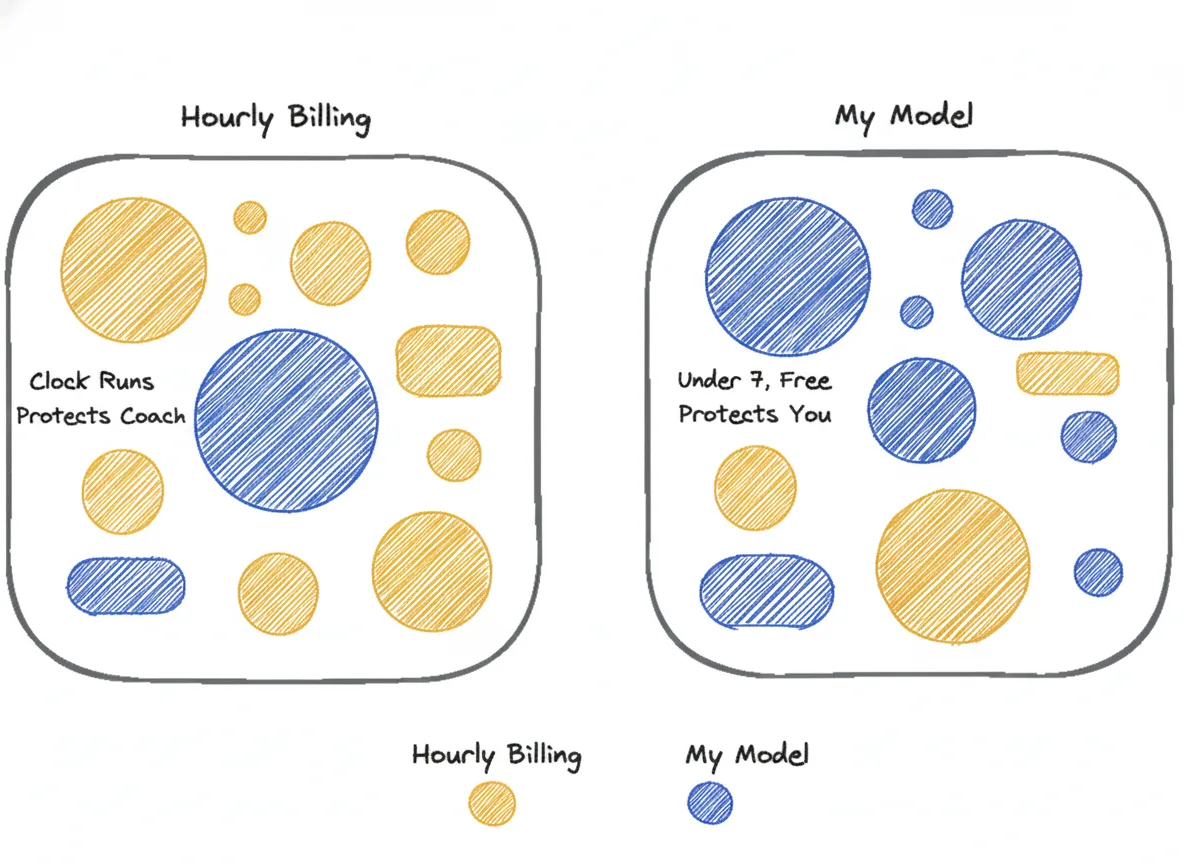
It’s a different kind of promise: you decide, session by session, whether I was worth it, not me telling you upfront that I tried. I’ve run 3,662 sessions since 2019. Mentees rate every session from 0 to 10 right after it, and since 2024 the average is 9.79 out of 10. That’s not the number that matters here, though. Most people clear an 8 easily; the guarantee is about the ones who don’t.
How often does a session land under 8? I won’t publish that number. It’s an aggregate stat about my own performance, and I’d rather you judge the mechanism, session by session, than a figure I could shade in my own favor by choosing how to count it. I stand by the rule because it keeps me motivated and on the edge, not because I can prove a payout rate to a stranger reading a blog post.
The rule has an edge, too. It isn’t built for someone who’s procrastinating, checked out, or carrying a problem that’s genuinely a therapist’s job and not a mentor’s. I’m not a psychotherapist. When I see that kind of pain, I refer out to coaches I trust who do that work.
The 8/10 rule assumes you’re showing up ready to use the session. It isn’t a substitute for wanting to change something.
Financial Independence Is What Gives the Rule Teeth
Neither guide I read says this part out loud. Most coaches cannot structurally afford to offer “under 8, it’s free.” It caps their income on exactly the sessions they can least afford to give away.
Here’s the reasoning, not an observed fact: a coach living off the practice has an incentive to keep the client, keep the invoice, and hope the next session goes better, rather than end a bad fit early. Ending it costs money they need.

I don’t have that constraint, so my honest move and my profitable move are the same move. A session underdelivers, I don’t charge for it. A client shows no real interest, hasn’t done the tiny bit of homework a session asked for, or just isn’t a fit, I end it. No keeping them on the books hoping it turns around.
That’s not a claim you have to take on faith. It’s the reason the guarantee is structurally possible at all.
Here’s the gap in every “charge for value, not time” guide I read: none of them asks whether the coach can afford to keep the promise. That question is the missing piece.
It Makes Us Equal: Why I Still Enjoy This
The rule isn’t only me judging whether you’re worth taking on. It runs both directions: you score every session, out loud, on a number, and I have to earn an 8 or better from you again and again, not just once at the sales call. That’s the part I didn’t expect to matter as much as it does: it keeps this equal, not a service bought from someone above you.
Re-earning the fee every session doesn’t wear on me. It keeps me on the edge, paying real attention instead of running the session on autopilot. If I didn’t need the income and still coasted, that would be worse than any hourly coach padding the clock.

How to Evaluate a Coach’s Price Like This
If you’re comparing a mentor or coach’s price to someone billing hourly, the rate isn’t the useful question yet. Ask these first:
- What happens if a session doesn’t work for me? Hourly billing has one answer: you’re still charged. If a coach’s answer is a shrug or “let’s talk about it,” that’s a data point.
- Would you ever end this, and would you tell me why? A coach who can’t imagine ending a paying relationship early is a coach who needs your money more than your outcome.
- Does the price change based on what happened, or only on hours logged? If nothing in the pricing model responds to whether the session helped, you’re buying time, whatever the sales page calls it.
| Hourly billing | My model | |
|---|---|---|
| Who it protects | The coach’s income | Your outcome |
| If a session underdelivers | Still billed, clock ran | Not billed, you rated it under 8 |
| Who scores the session | Nobody | You, every single time |
| If you show no interest or effort | Usually kept on the books | The engagement ends |
| Requires the coach to have | A full client roster | No dependence on the income |
I’m not the only reasonable model. A coach with 20 years of hourly billing and a full roster of happy clients isn’t wrong to keep doing it that way. But that coach can’t offer you what I just described, and it’s worth knowing which one you’re buying before you compare the number.
Two more useful links, depending on why you’re here. If your company is the one signing off on the spend, here’s the business case and guarantee language to bring to your manager, or build one for your situation on the pricing page. If you want the market rate table instead of my case for this specific model, that’s a separate post.
I use “mentor” rather than “coach” on purpose; the difference is more than a label. And don’t just take my word for any of this: the outcomes people reported are public, name attached.
If you want to see whether a session with me clears the bar, book the free 30-minute intro, or ask me directly what this would look like for your situation.
[Writing time: 3h]