Three months of good questions and zero decisions. That’s what you get when you hire a coach for a problem that needed a mentor, and the invoice is the smaller part of the damage, the lost quarter is the bigger one.
So, the two definitions the whole argument hangs on:
Mentoring transfers experience. A mentor has sat in your seat, made the mistake you’re about to make, and shortens your trial-and-error loop with moves that worked.
Coaching builds clarity. A coach asks questions until you see your own answer, and doesn’t need your domain background at all. A good coach can coach a CFO and a CTO in the same week.
Which one your current problem needs is the only question worth asking, and everything below is there to help you to answer it.
The comparison
I include advisors, because engineering leaders shop for all three under one budget line:
| Mentor | Coach | Advisor | |
|---|---|---|---|
| Brings | Experience from the same seat | Process and questions | Judgment for the company |
| Typical question answered | ”How do I turn around my underperformer?" | "What do I want from this role?" | "Should this company reorg into platform teams?” |
| Needs your domain | Yes. Without the scars you’re getting a podcast, not a mentor. | No | Yes, across many companies |
| Owns the outcome | You; the mentor shortens the loop | You; the coach holds the mirror | Shared; the advisor signs the recommendation |
| Fails when | You need someone neutral on a non-domain problem | You need concrete answers under time pressure | The problem is you, not the org chart |
The difference between coaching and mentoring, without the diplomacy
The coaching industry has a definition and defends it. The ICF, the largest coaching federation, holds that the client is the expert of their own life and lasting change comes from answers you generate yourself. For long-horizon personal work they’re right.

Here’s where I break with them. 52% of the leaders I mentor are in their first leadership role. When your underperformer escalates on Thursday and the board call is Friday, generating your own answer is a luxury your calendar doesn’t have. You need a map from someone who walked the street.
Coaches like to argue with certifications: ICF, ACC, PCC. Fair enough, an ICF badge lets a coach take a CFO on Monday and a CTO on Tuesday. But nobody can badge their way into having run your kind of org, because in mentoring the credential is the scar tissue. That’s also why mentors are harder to find, and why mentoring is often priced above executive coaching.
The 3-question test
- Do I need a move or a mirror? A move (“how do I run this reorg”) points to a mentor. A mirror (“why do I keep postponing this conversation”) points to a coach.
- Is the problem mine or the company’s? Yours: mentor or coach. The company’s: advisor, or a fractional CTO when it needs hands, not slides.
- Would domain scars change the answer? If someone who scaled 8 teams to 80 would answer differently than a smart generalist, you need the scars. That’s mentoring.
In my sessions it runs in that order almost every time: concrete answers first, clarity work later, once the fire is out. That’s also why “get a coach” is premature advice for a leader whose Thursday is burning.
What each costs
Coaching prices are mostly hidden until a discovery call. Benchmarks from the market: executive coaching commonly runs $200 to $600+ per hour in the US, roughly 180 to 550 EUR. I broke down the full range, sources included, in how much executive coaching costs.
My mentoring pricing is public, all of it: 430 EUR per 60-minute session, 2,166 EUR for a 6-session first quarter (361 EUR per session, the package discount), same rate when your company pays. Details and the under-7/10-not-billed guarantee at pricing.
Where I stand
I mentor. I built the engineering org at Mews through Series C, from 8 teams to 80, walked away from a $350k role in 2023 to do this full-time, and billed 317 sessions in year one of going solo. Now it is 3,400+ sessions with 300+ leaders in 17+ countries.
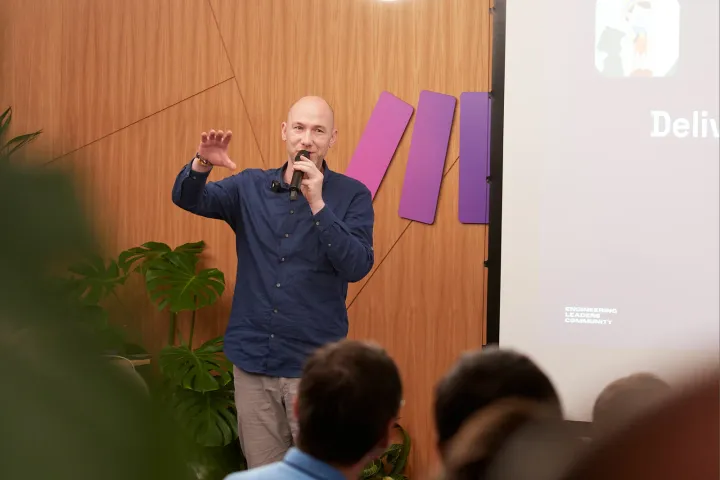
When a session needs coaching mode, I switch and say so out loud. And when what you need is a coach, I’ll tell you in the first session and point you to one. If your next quarter needs answers from someone who has been in your seat, that’s 1:1 mentoring for engineering leaders, and the intro session is free.